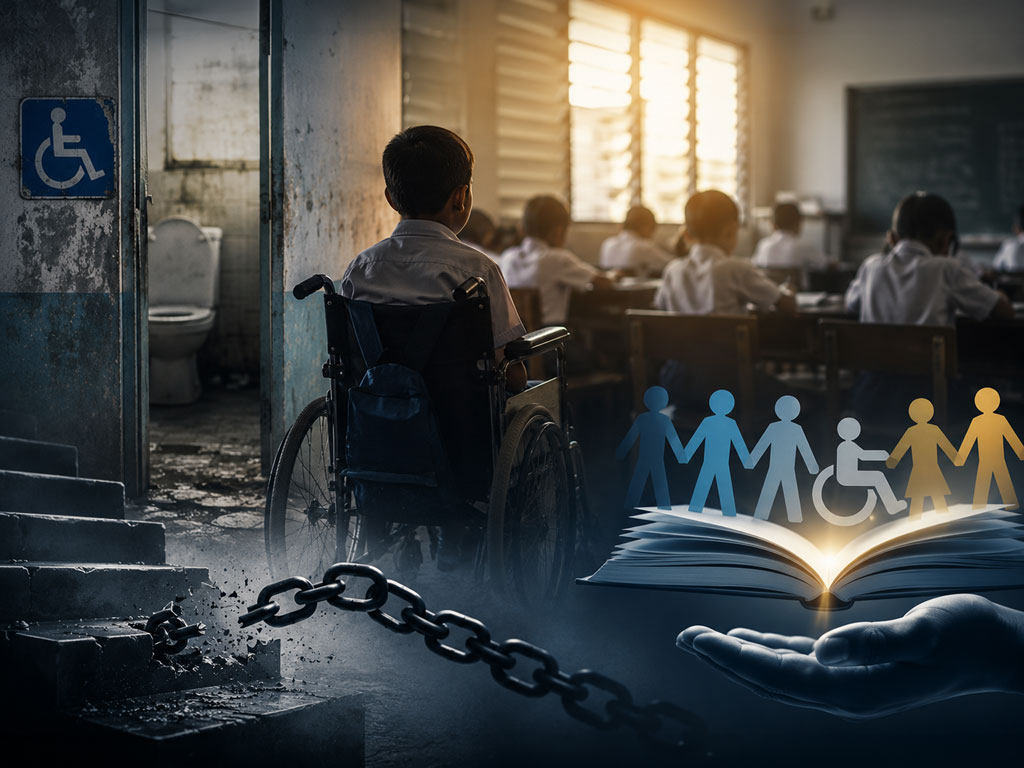
Special needs education in Sri Lanka continues to suffer from poor sanitation, inadequate facilities and staff shortages despite Ministry guidelines.
Special needs education in Sri Lanka continues to face serious challenges as inadequate school facilities, poor sanitation and insufficient resources affect both students and teachers across the country.
The lack of proper facilities in school units catering to children with special needs has remained a long-standing issue throughout Sri Lanka’s education system. The problem impacts not only students but also teachers working in these specialised classrooms.
Whether in rural or urban areas, many schools continue to struggle with inadequate and unhygienic toilet facilities and unreliable water supplies. Therefore, it is hardly surprising that schools often fail to provide facilities that meet the needs of children with disabilities.
Although the Ministry of Education has issued circulars and guidelines addressing these requirements, many schools appear to have fallen short of implementing them.
The issue recently gained national attention after the mother of a seven-year-old child with special needs described on Facebook the difficulties she and her child faced because of poor sanitation at school.
Following the post, Members of Parliament and Deputy Ministers responded publicly, promising an immediate solution. The mother later confirmed that education authorities visited the school and responded positively regarding the next steps.

Sanitation Problems Continue Across Schools
Poor sanitation is a widespread problem throughout Sri Lanka’s school system, and many readers are likely to have experienced similar conditions firsthand.
One school with approximately 350 students reportedly had only one toilet for teachers and three toilets for students. Water shortages and poor cleanliness remained constant concerns.
Another school with around 6,000 students also struggled with insufficient and poorly maintained toilets. Female students had no alternative but to use these facilities during menstruation despite the difficulties.
That school also housed a special education unit. However, the classroom had never been purpose-built. It occupied a small room that had previously served several other functions, including as the student leaders’ office.
No dedicated toilet facilities existed nearby for children attending the special education unit.
Education for Students with Special Needs in Sri Lanka
Total Number of Schools
Number of Special Education Units in Schools
Ministry Guidelines Set Clear Standards
The Ministry of Education has introduced circulars and official guidelines intended to safeguard the right to special needs education.
In 2024, the Ministry issued updated guidelines covering school infrastructure and environmental standards. Schools are expected to follow these requirements when constructing new buildings, renovating existing facilities or improving the learning environment.
The guidelines specify classroom layouts and toilet standards for students with disabilities.
Number of Students with Special Needs in Sri Lanka’s School System (2025)
Male
Female
Number of Students with Special Needs in the School System – By Language Medium (2025)
Sinhala Medium
Tamil Medium
Bilingual
Special Schools for Students with Disabilities (2025)
Male
Female
They recognise that children with intellectual or developmental disabilities may require more frequent access to toilets. Some students also experience frequent urination because of physical disabilities or psychological conditions, making accessible toilet facilities essential.
The guidance further notes that children may avoid using toilets if they are dirty, poorly lit or unhygienic, potentially leading to health complications. Toilets should therefore remain clean, hygienic and comfortable at all times.
Some students require assistance from caregivers, meaning toilets should provide sufficient space for another person. They should also be easily accessible through safe and barrier-free pathways.
The guidelines recommend installing commode-style toilets and handrails on both sides to help students sit and stand safely.
They also call for sufficient toilet numbers based on student enrolment, proper lighting, adequate space and changing facilities or shower rooms where required.
Teachers Say More Support Is Needed
A teacher and a shadow teacher working with children with special needs said inadequate toilet facilities represent only one aspect of the problem.
According to the teacher, some children with autism are highly sensitive to cleanliness and may refuse to use toilets that are dark, dirty or have unpleasant smells. Some children may even reject a toilet because of its wall colour.
Number of Teachers Serving in Special Schools for Students with Disabilities (2025)
Permanent Teachers
Teacher Vacancies
Volunteer Teachers
Number of Teachers in Special Education Units (2025)
Total Teachers in Special Education Units
Teacher Vacancies (Provincial Schools)
Special Education Teachers Teaching Other Subjects
Teacher Vacancies (National Schools)
She also explained that one teacher cannot adequately support an entire special education unit because every child has different learning and personal care needs. Many students require one-to-one attention throughout the school day.
The teacher further observed that Sri Lanka’s teaching aids and instructional methods remain outdated compared with practices adopted in many other countries.
Authorities Acknowledge the Challenge
When asked about long-term solutions beyond the immediate school concerned, the Secretary to the Ministry of Education acknowledged that the problem extends beyond special education units and affects schools nationwide.
He said the main challenge is not simply constructing facilities but maintaining them properly over time.
The Secretary recognised that children with special needs face even greater difficulties and noted that solving the issue cannot happen overnight.
He said a parliamentary subcommittee on infrastructure has already taken up the matter and that improvements are currently underway. However, he stressed that maintaining newly built toilet facilities will remain an ongoing challenge.
Although he could not confirm whether every special education unit currently meets the required standards, he acknowledged that the shortcomings have been identified.
In October 2025, Deputy Minister of Education Madura Seneviratne also indicated that education reforms were expected to address many of these issues.
BBC Sinhala later attempted to obtain additional comments from the Deputy Minister but was unable to contact him.
Improving facilities for children with disabilities will require more than new buildings alone. Effective maintenance, adequate staffing and proper implementation of Ministry guidelines will be essential to ensuring every child receives the quality education and dignity they deserve.
SOURCE:- BBC SINHALA