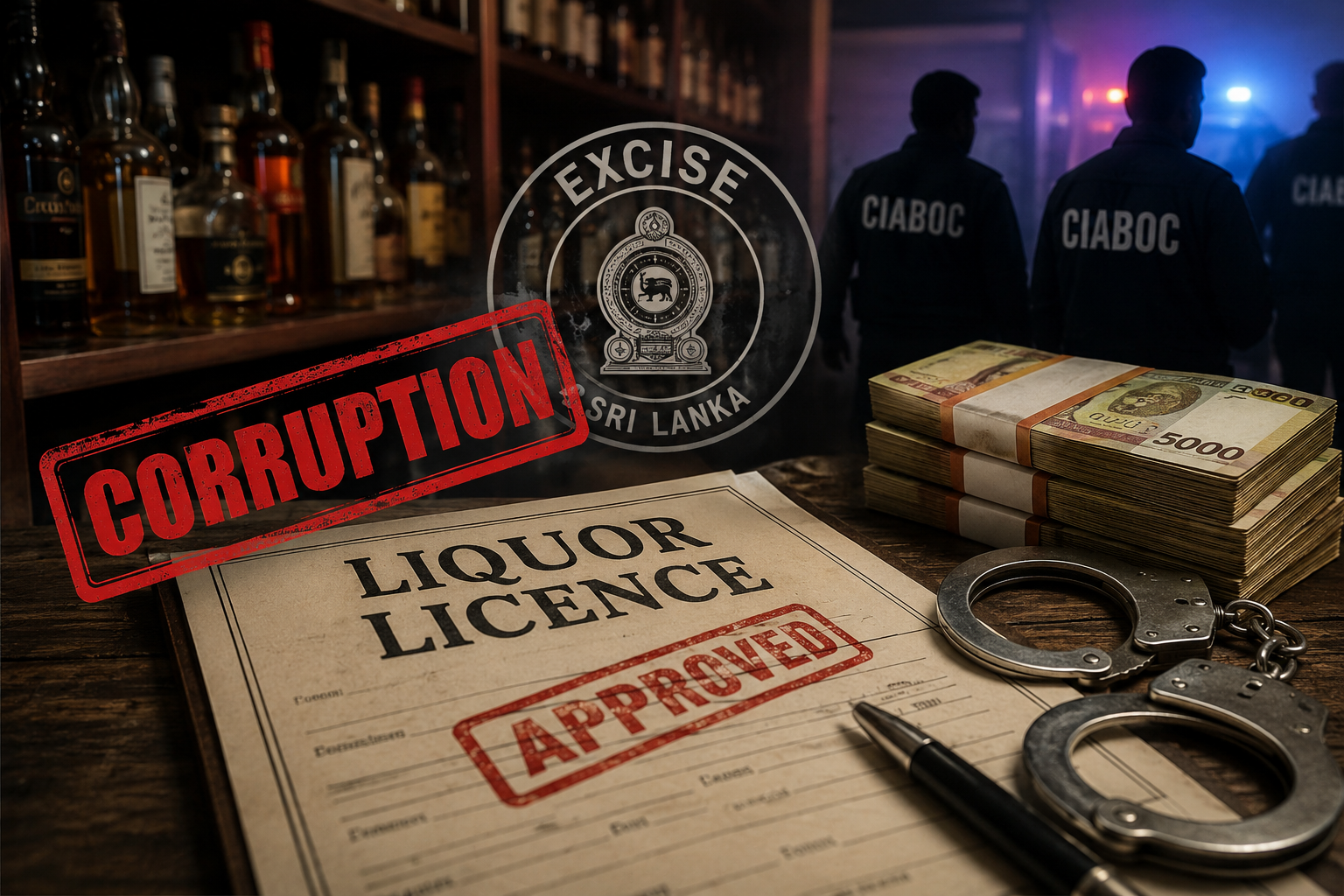
The Sri Lanka liquor licence racket has exposed alleged political favouritism, illegal leasing and billions in potential lost state revenue.
The Sri Lanka liquor licence racket has exposed a system where politically connected figures allegedly treat valuable permits as private assets. Investigators recently tracked a close associate of a veteran “bar manager” accused of taking heavy payments in return for exclusive distribution rights.
That inquiry follows other major anti-corruption arrests. They include the interception of a former “Justice Cellar Master’s” son, who allegedly accepted large payments to interfere with high-security lockups. Investigators also arrested the brother of a prominent regional manager after he allegedly accepted Rs. 27.5 million to secure a backdoor tap assignment.

These cases are not isolated bad batches. They point to a deeply rooted system that has survived successive changes in management. It has cost the public purse billions in lost revenue and weakened established procedures. The time has therefore come to drain the spoiled stock, clean the lines and rebuild the entire licensing process.
The allegations involving relatives and associates of former cellar masters may represent only the first drops from a contaminated still. They reinforce a long-standing public suspicion: premium and tightly controlled liquor licences are being traded privately for kickbacks, influence and political favour.
Political Favouritism Behind Liquor Permits
This rotten culture has long been visible across the establishment. It is widely alleged that liquor licences and profitable locations are allocated through backroom favouritism. Political figures from rival camps reportedly own bars either directly or through proxies.
The problem crosses party lines. Figures linked to both major political camps have faced accusations of arranging valuable permits for friends and associates in return for financial benefits. The sheer scale of the practice became clearer after revelations that the outgoing administration approved more than 300 new liquor licences during its final period in office.
Supporters may argue that those approvals remained within the law. However, the extraordinary volume raises serious questions about motive, fairness and political influence. It also creates a system where party affiliation, rather than merit or public need, can determine who gains access to a highly profitable state-controlled privilege.
Sri Lanka Liquor Licence Racket and Illegal Leasing
The most serious abuse, however, may be the widespread leasing of liquor licences. Under the rules, authorities grant a licence to a named holder for a specific location. The fraud begins when that licence is rented or sublet to another operator for a recurring payment.
Many of these valuable permits were obtained under previous governments and remain in the hands of politically connected individuals. By leasing them to third parties, the original holder profits from a state-granted privilege without operating the business, employing staff or managing the premises.
Meanwhile, the actual operator works in a poorly regulated grey area. The state risks losing excise duties, tax revenue and control over alcohol distribution. This informal subletting is not a minor technical violation. It allows a small group to hoard valuable licences while excluding legitimate entrepreneurs who cannot access the system fairly.
The result is a protected market shaped by influence rather than competition. It keeps the best taps in familiar hands and turns a public licensing power into a private income stream. Every unofficial lease further clouds responsibility when taxes go unpaid, regulations are breached or enforcement officers arrive.
Those with political connections can collect rent from licences, while compliant operators face barriers, delays and uncertainty. Such a system rewards middlemen and punishes those willing to follow the law.
A Full Recall and Transparent Reissue
Given the scale of the problem, minor adjustments will not be enough. The authorities should recall every active liquor licence and conduct a complete audit. They should verify the named holder, approved location, actual operator, ownership structure, tax record and compliance history of each licence.
After that review, the government should cancel irregular permits and introduce a new merit-based application process. This would not amount to an extreme intervention. It would represent basic administrative sanitation after years of alleged abuse.
For too long, secrecy has created fertile ground for influence peddling, licence brokering and illegal leasing. The alcohol industry is also a major source of government revenue. It therefore requires strict oversight, transparent records and equal enforcement.
Simply cancelling licences and reissuing them through the same opaque process would achieve little. The government must redesign the system from the ground up. A centralised digital platform, developed with the Excise Department, should manage applications, approvals, renewals, ownership details, transfers, compliance checks and tax records.
An open online register would allow the public, regulators and legitimate businesses to see who holds each licence and where it operates. Standardised digital applications would reduce discretionary decisions and remove brokers who profit from their access to officials.
Such a system would also strengthen revenue collection. Authorities could identify unpaid taxes, suspicious transfers, dormant licences and unauthorised operators more quickly. Recent closures of businesses accused of failing to settle taxes already show why stronger enforcement matters. A clean digital trail would make it harder for licence holders to hide behind proxies, informal agreements or shifting business names.
No More Quick Fixes
The latest anti-corruption arrests give the incoming administration a narrow opportunity to clean up the system. A comprehensive audit must not become another report that gathers dust. It should lead to immediate action against illegally transferred, leased or politically manipulated licences.
Quick fixes will no longer hide the decay. The government must recall active permits, verify every holder and reissue licences through a modern, digital and transparent process. Only then can it rebuild public confidence, create fair competition and protect the revenue owed to the state.
The public is watching closely. After years of allegations involving influence, family networks and political patronage, the time for excuses has run out.