New Rathna Rice fine over a control-price breach revives scrutiny of Sri Lanka’s rice market, large millers and weak price enforcement.
The New Rathna Rice fine imposed over a government-controlled price violation has renewed scrutiny of Sri Lanka’s politically sensitive rice market and its structure.
Rice is more than the country’s staple food. It is also one of Sri Lanka’s most closely watched agricultural and consumer commodities.
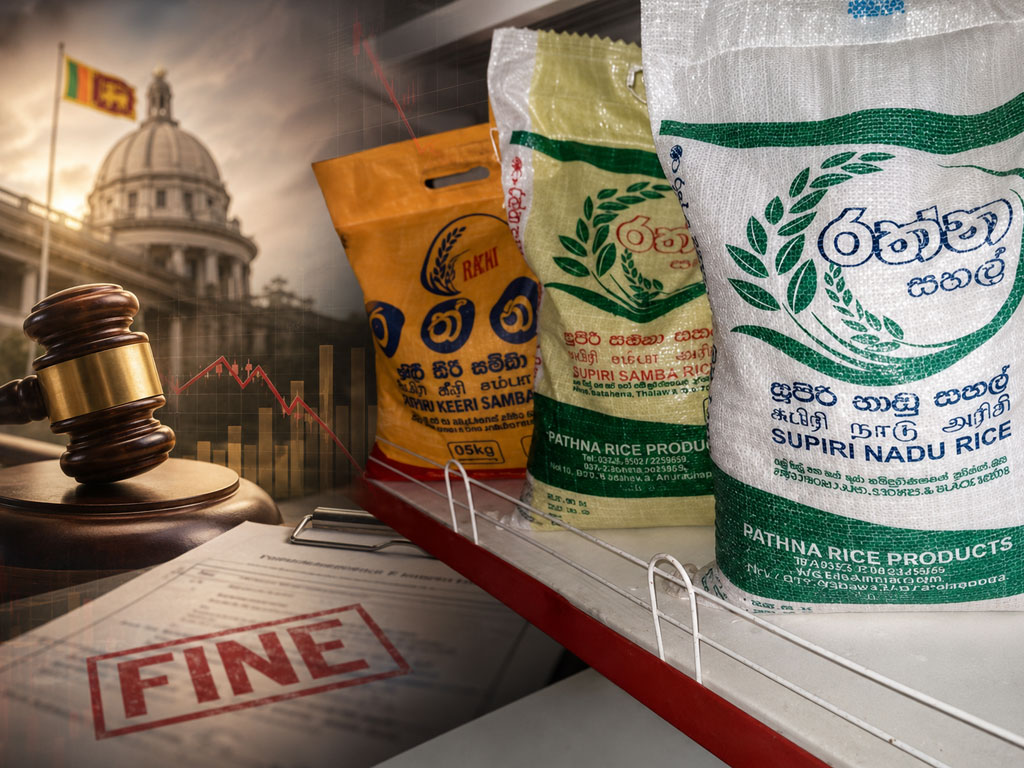
The Polonnaruwa Magistrate’s Court convicted New Rathna Rice Private Company and its Board of Directors on August 6, 2026. The court imposed a Rs. 1 million fine for violating the applicable government-controlled price.
The prosecution related to red Nadu rice priced at Rs. 225 per kilogram when the applicable maximum retail price was Rs. 220.
The Consumer Affairs Authority introduced the Rs. 220 maximum in May 2022 for locally produced white or red Nadu rice. At the time, Samba was capped at Rs. 230 and Keeri Samba at Rs. 260 per kilogram.
Sri Lanka has subsequently changed rice pricing arrangements. In December 2024, the Government announced a Nadu retail price of Rs. 230 per kilogram. The court case therefore concerns compliance with the price regime applicable to the alleged offence, not today’s retail price.
Get Breaking News First
on WhatsApp

New Rathna Rice Fine Adds to Wider Enforcement Drive
The judgment forms part of a wider campaign by the Consumer Affairs Authority against traders accused of exceeding controlled prices.
According to figures cited in the original account, courts have imposed fines ranging from Rs. 500,000 to Rs. 1 million in cases from Gampola, Galle and Welisara.
The same account says the CAA has conducted more than 3,500 operations and recovered over Rs. 54 million for the State.
However, enforcement raises a larger question. Can raids and court fines alone solve the structural problems affecting Sri Lanka’s rice market?
Critics have long argued that a small group of large-scale millers exercise disproportionate influence over supply.
Companies such as Araliya, New Rathna and Nipuna are frequently identified in discussions about market concentration.
Estimates cited in the original analysis suggest that the market share held by major operators increased from about 30% in 2011 to around 50% by 2019.
Large millers also possess storage and processing advantages that smaller competitors cannot easily match.
New Rathna itself says it maintains year-round paddy stocks of approximately 50,000 metric tonnes and operates a factory capable of producing about 400 metric tonnes of rice daily.
Storage Power Gives Large Millers an Advantage
Large commercial operators can buy substantial stocks during harvesting periods and hold them until market conditions change.
By contrast, the original analysis estimates that nearly 1,400 small and medium-scale mills process around 57% of the total paddy harvest.
Many face financing constraints, outdated infrastructure and inadequate storage.
That imbalance can leave smaller mills under pressure while operators with greater capital and silo capacity gain stronger influence during shortages.
Government price controls are intended to protect consumers. Yet rigid controls can also create complications when production, transport and financing costs rise faster than official prices.
If millers believe a controlled selling price falls below viable costs, they may reduce supplies reaching the formal market.
The original account alleges that such conditions have encouraged unofficial payments within wholesale trading, particularly around Pettah.
Those claims require enforcement evidence before they can be attributed to specific businesses.
Rice Price Controls Cannot Work in Isolation
Another weakness lies in agricultural information and public-sector intervention.
Sri Lanka still lacks a fully integrated real-time system covering production, stocks, milling capacity and market demand.
The Paddy Marketing Board has historically played a role in purchasing paddy and maintaining state stocks.
However, critics argue that insufficient buffer stocks weaken the State’s ability to intervene when private-market supplies tighten.
Price ceilings also become harder to enforce when authorities fail to adjust them in line with genuine production costs.
The New Rathna Rice fine is therefore important because it demonstrates that official price orders can carry real legal consequences.
However, one Rs. 1 million penalty cannot resolve the underlying market structure.
Sri Lanka needs stronger competition, reliable agricultural data and adequate public reserves. Small and medium millers also require better access to finance, technology and storage.
A more responsive pricing mechanism could protect consumers while allowing reasonable margins throughout the supply chain.
The ultimate goal should not simply be more prosecutions. It should be a rice market in which farmers receive fair prices, businesses compete transparently and consumers are protected from both artificial shortages and excessive prices.