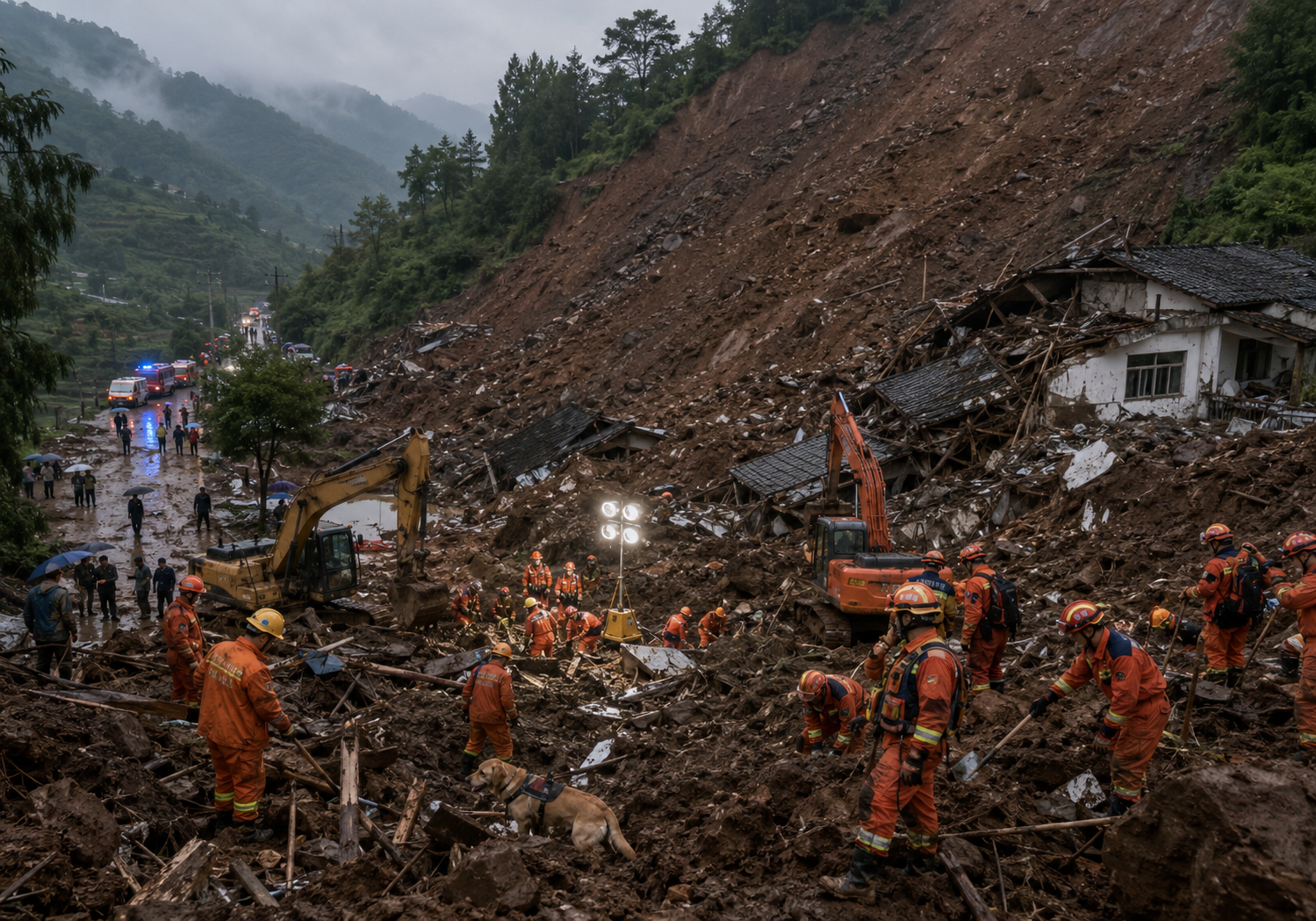
China landslide rescue teams are searching for 34 missing people after eight died and homes were buried in Chongqing’s Pengshui County.
A China landslide has killed at least eight people and left 34 missing after rock and soil buried residential buildings in Chongqing’s Pengshui County.
The disaster struck at about 9.08 a.m. on Friday, July 17, sending an estimated 18,000 cubic metres of debris down a mountainside. The material buried more than 10 residential buildings, according to Chinese state media and local authorities.

Rescue teams continued searching through the wreckage as fears of further collapses complicated the operation. Large unstable rocks remained above the disaster zone, forcing emergency workers to proceed cautiously.
Authorities evacuated more than 1,100 residents from nearby buildings and other areas considered vulnerable to additional ground movement. The operation covered homes on slopes and in low-lying areas within approximately one kilometre of the site.
China landslide leaves rescuers facing unstable terrain
More than 800 rescue personnel were reportedly mobilised during the initial emergency response. They included firefighters, specialist rescue teams and other emergency workers.
Crews used excavators, rescue dogs, detection equipment and drones to search the debris. However, the threat of secondary landslides limited how quickly heavy machinery could operate.
Officials said the landslide released about 18,000 cubic metres of rock and soil. One particularly large section of rock reportedly measured approximately 3,000 cubic metres.
The scale of the debris created a complex and dangerous rescue site. Workers had to remove loose material while monitoring the mountainside for signs of further movement.
Ten people were rescued following the landslide. Initial reports said two suffered serious injuries. A later update reported that one rescued resident had left hospital, while nine others remained in stable condition.
Emergency teams also cut water, electricity and gas supplies within the affected area to reduce additional dangers. Authorities dispatched tents, beds and other emergency supplies for residents forced from their homes.
The evacuations extended beyond the buildings directly buried by the landslide. Officials moved residents from 21 buildings considered exposed to possible secondary collapses.
Search continues for 34 missing residents
The confirmed death toll stood at eight, while 34 people remained missing as rescuers continued searching the rubble.
The number of missing residents has intensified pressure on emergency teams. However, unstable boulders and damaged terrain mean rescuers must balance speed with the danger of triggering another collapse.
The disaster occurred near the Wujiang River in a mountainous area known for steep slopes and complex karst terrain. Such landscapes can become particularly dangerous when water enters cracks, weakens soil and increases pressure within slopes.
Recent heavy rainfall was identified as a possible trigger. However, authorities have not announced a final cause, and an official investigation remains underway.
Chinese President Xi Jinping ordered emergency services to make every effort to locate the missing. He also directed authorities to investigate what caused the mountainside to collapse.
Xi called for improved monitoring of geological hazards and stronger measures to prevent further casualties, according to reports carried by Chinese state media.
Extreme weather raises wider disaster concerns
The tragedy has renewed attention on the risks facing communities built near unstable mountainsides.
Heavy rainfall can saturate soil, increase the weight of slopes and weaken the natural structures holding rock in place. However, several factors may contribute to a landslide, including local geology, drainage, construction and changes to the surrounding environment.
Investigators will therefore need to determine whether rainfall alone caused the collapse or whether other conditions increased the danger.
The disaster also highlights the importance of early warnings. Residents reportedly noticed small rockfalls and unusual sounds before the main collapse. Authorities began moving people from threatened areas, but the mountainside failed before everyone could reach safety.
China has expanded monitoring systems for floods, landslides and other weather-related hazards. Even so, rapidly developing disasters can leave communities with little time to escape, especially in steep and densely populated regions.
For the families of those missing in Pengshui County, the immediate focus remains the search.
Rescuers are continuing to examine the debris while geological specialists monitor the slope above them. Authorities have warned that the terrain remains unstable and that further movement cannot be ruled out.
The final scale of the tragedy may not become clear until teams reach the buildings buried beneath thousands of cubic metres of rock and soil. Until then, hundreds of rescue workers face a dangerous race to find the 34 residents who remain unaccounted for.