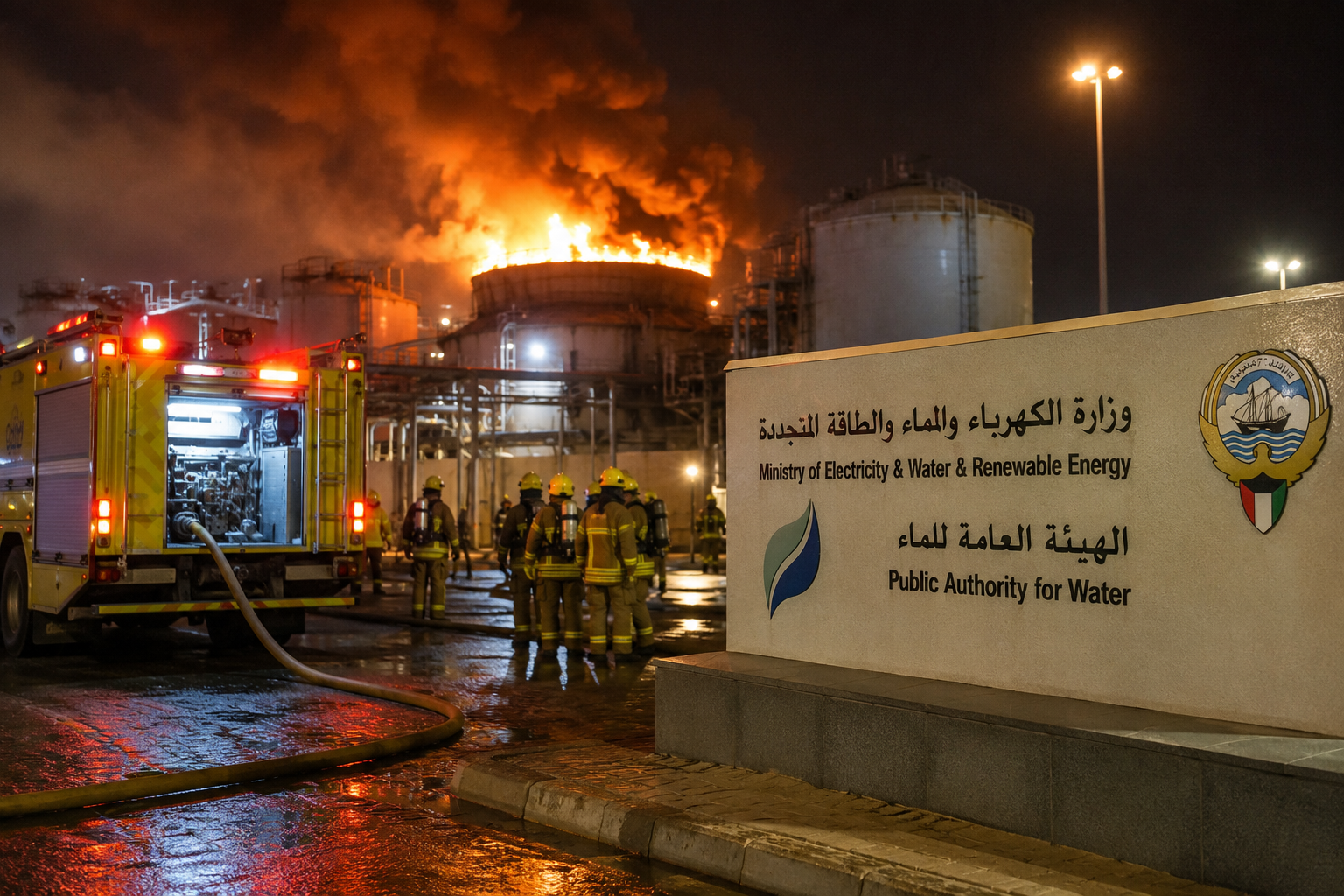
The Kuwait water plant attack has raised fears that strikes on desalination and power systems could trigger a wider humanitarian crisis.
The Kuwait water plant attack has raised urgent fears that the Middle East conflict is expanding from military targets to the water millions of civilians drink.
Kuwaiti authorities said an Iranian attack damaged part of a power generation and water desalination facility on Saturday. The incident caused a fire and forced the Ministry of Electricity, Water and Renewable Energy to activate emergency procedures.

Firefighters brought the blaze under control. Meanwhile, technical teams began assessing the damage and carrying out repairs.
The ministry said it took measures to prevent interruptions to electricity and water supplies. However, the reported strike exposed a critical vulnerability across Kuwait and the wider Gulf region.
Desalination plants are not simply industrial sites in these countries. They form the foundation of everyday civilian life.
An extended shutdown could affect drinking water, hospitals, schools, food production, sanitation and emergency services. It could also place millions of residents at risk during a period of intense summer heat.
The attack followed an escalating exchange of strikes involving Iran, the United States and US-aligned countries across the region. Iranian missiles and drones have reportedly targeted military facilities and strategic infrastructure in Gulf states hosting American forces.
At the same time, US strikes have damaged infrastructure in southern Iran, including electricity and desalination systems. This pattern has increased fears of retaliatory attacks against services used by civilian populations on both sides.
Kuwait water plant attack exposes a national vulnerability
Kuwait has extremely limited natural freshwater resources. It therefore relies heavily on seawater desalination to meet domestic drinking-water needs.
Estimates indicate that desalination provides more than 90 per cent of the water used for domestic and industrial purposes in Kuwait. The country began large-scale desalination in the early 1950s and has since developed an interconnected network of power stations, treatment facilities, pipelines, pumps and storage reservoirs.
Many Gulf desalination facilities operate alongside power stations because producing fresh water from seawater requires large amounts of energy. This arrangement improves efficiency, but it also creates a dangerous concentration of essential services.
A single strike can potentially damage both electricity generation and water production. Even when the main desalination equipment survives, damage to pumps, electrical controls, pipelines or transmission systems can interrupt the wider network.
Kuwait’s authorities said they acted to protect supplies following the latest fire. There was no immediate indication of a nationwide water shortage.
Nevertheless, the incident demonstrated how quickly a military exchange could threaten civilian survival.
Water shortages would have an immediate effect on hospitals and healthcare facilities. They could also disrupt sanitation systems, increase pressure on bottled-water supplies and leave vulnerable residents struggling to obtain safe drinking water.
Any prolonged interruption would prove particularly dangerous during the Gulf summer, when temperatures can become life-threatening and demand for water and electricity rises sharply.
Kuwait has a population of more than four million people. Expatriate workers account for a large share of the population, including many people living in densely populated residential areas with limited capacity to store emergency water.
Could an attack on desalination violate international law?
International humanitarian law requires parties to a conflict to distinguish between military objectives and civilian objects.
Under the customary principle of distinction, armed forces may direct attacks only against military objectives. They must not deliberately attack civilian infrastructure unless it has become a lawful military objective under the rules of war.
Drinking-water installations receive additional protection because civilians depend on them for survival.
The Geneva Conventions’ Additional Protocols prohibit attacks intended to destroy, remove or render useless objects indispensable to the civilian population. These objects expressly include drinking-water installations and supplies.
However, the legal assessment depends on several facts that have not yet been independently established.
Investigators would need to determine what weapon struck the facility, which section suffered damage and whether the attacker intentionally targeted the plant. They would also need to establish whether any part of the complex supported military operations.
Even where a facility qualifies as a military objective, an attacker must still consider proportionality. International humanitarian law prohibits attacks expected to cause excessive civilian harm compared with the concrete and direct military advantage anticipated.
Combatants must also take feasible precautions to minimise civilian casualties and damage.
Therefore, damage to a dual-use power and desalination facility does not automatically prove a war crime. However, intentionally attacking a civilian water system, or knowingly causing disproportionate harm to civilian water supplies, could constitute a serious violation.
The International Committee of the Red Cross has repeatedly warned that water infrastructure enjoys several layers of protection during armed conflict. It has also stressed that attacks can produce indirect harm far beyond the immediate blast zone.