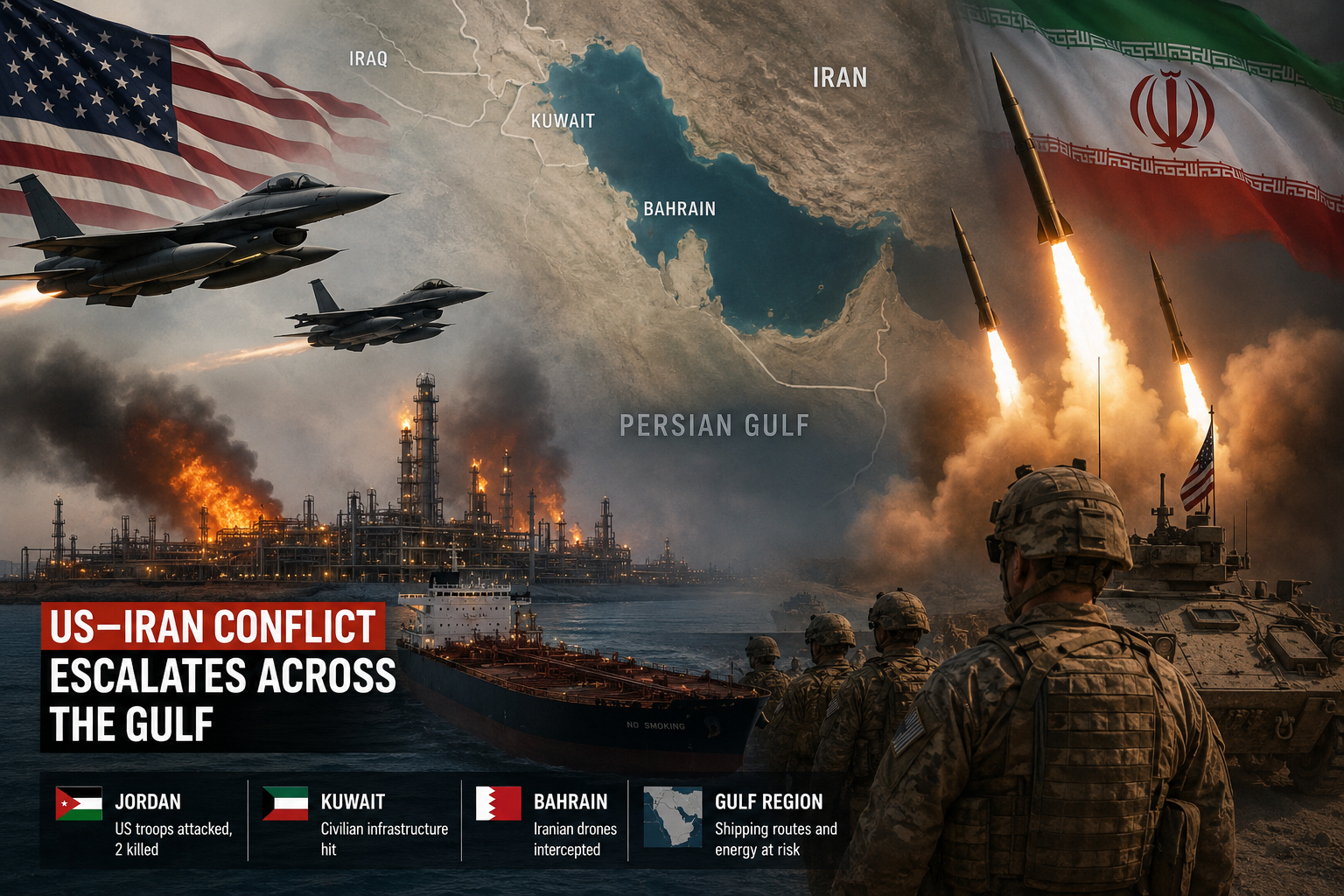
US Iran war escalation deepens as American strikes continue and Iranian attacks hit Jordan, Kuwait, Bahrain and vital Gulf infrastructure.
The US Iran war escalation entered an increasingly dangerous phase on Monday as American strikes continued for a ninth consecutive night and Iranian attacks spread across Jordan, Kuwait, Bahrain and other parts of the Gulf.
The expanding confrontation has moved beyond direct attacks inside Iran. Military bases, shipping routes, energy facilities and civilian infrastructure across the region now face growing danger.

The United States launched its latest strikes against Iranian military targets after an Iranian attack in Jordan killed two American service members. Another US service member remained missing after the attack, according to US military statements reported over the weekend.
Four other American personnel received treatment for injuries and later returned to duty.
The deaths increased pressure on Washington to intensify its campaign. They also turned Jordan into one of the conflict’s most important flashpoints.
US Central Command said American forces had completed an eighth consecutive night of attacks by Sunday. The campaign entered its ninth night on Monday, with strikes reportedly targeting Iranian command centres, missile facilities and military positions.
US Iran War Escalation Spreads Beyond Iran
The latest violence follows the collapse of an interim ceasefire agreement reached about a month earlier.
Since that breakdown, Washington and Tehran have exchanged attacks across a widening geographical area. Iran has targeted locations linked to the US military, while American forces have struck sites that Washington says support Iranian attacks and threats to regional shipping.
Jordan has become especially vulnerable because it hosts US military personnel and sits between Iraq, Syria, Israel and Saudi Arabia.
Iran had previously claimed attacks against a US Army base in Jordan. However, the deaths reported after Friday’s strike marked a more serious development and raised fears of stronger American retaliation.
The conflict has also spread deeper into the Gulf.
Kuwait and Bahrain reported further Iranian missile and drone activity over the weekend. Both countries host important American military facilities and have strengthened their defensive readiness as the confrontation expands.
Kuwait condemned what it described as an Iranian attack on civilian infrastructure. Reports said power and water desalination facilities were affected, although authorities extinguished a resulting fire and began repair work.
The threat to desalination facilities is particularly serious. Kuwait relies heavily on desalinated seawater for its drinking-water supply. Any prolonged disruption could therefore affect civilians as well as military operations.
Bahrain also reported defensive action against an Iranian aerial attack. The country hosts the US Navy’s Fifth Fleet, making it strategically important to American maritime operations in the Gulf.
Civilians and Infrastructure Face Growing Risks
The US Iran war escalation now threatens much more than military installations.
Missiles, drones and falling debris have placed residential areas, airports, ports, energy facilities and public utilities at risk. Regional governments are also facing pressure to protect civilians without becoming direct participants in the war.
Qatar reported intercepting an incoming missile, while a child suffered injuries from shrapnel, according to regional reports. Kuwait and Bahrain also activated defensive systems during the renewed attacks.
Meanwhile, the Strait of Hormuz has become another centre of confrontation.
The narrow waterway carries a significant share of internationally traded oil. Any prolonged disruption could affect fuel prices, shipping insurance, airline routes and energy security far beyond the Middle East.
Reports of attacks on tankers and Iranian threats against oil and gas movements have already increased market anxiety. Brent crude moved above $90 a barrel as traders assessed the risk of further disruption.
Gulf stock markets also declined amid fears that the conflict could increase inflation and weaken regional economic activity. Markets in Qatar, Bahrain and Kuwait recorded losses as investors reacted to the latest strikes.
However, the humanitarian consequences remain the greatest concern.
Civilian casualties have risen inside Iran, while communities in neighbouring countries face missile warnings and possible damage to essential services. Military personnel stationed across the region also remain exposed as Iran searches for ways to answer continued American attacks.
Jordan Becomes a Critical Flashpoint
Jordan’s role in the confrontation deserves particular attention.
The country has long maintained close security ties with Washington. However, its geographical position makes it vulnerable to missiles, drones and military activity crossing several neighbouring conflict zones.
The deaths of the two US service members could draw Jordan further into a confrontation it has tried to contain. They may also force Washington to increase protection around its regional bases.
Tehran has argued that its attacks target American military operations rather than neighbouring populations. Nevertheless, strikes launched toward bases in populated countries create an unavoidable risk to civilians.
Kuwait, Bahrain and Jordan must now balance their relationships with Washington against the danger of further Iranian retaliation. At the same time, damage to water, power or transport systems could quickly turn a military crisis into a broader humanitarian emergency.
The widening conflict has also weakened hopes of an early diplomatic breakthrough.
Although American officials have said negotiations remain possible, repeated strikes and rising military deaths have narrowed the political space for compromise. Iranian leaders have warned that the US will face consequences for intensifying the campaign.
Gulf Region Braces for Further Attacks
The next phase may depend on whether both sides continue expanding their target lists.
Washington says its operations aim to reduce Iran’s ability to threaten US forces and commercial shipping. Iran, however, presents its missile and drone attacks as retaliation for American strikes.
That cycle creates an increasingly dangerous pattern. Each attack produces pressure for another response, while neighbouring countries absorb more of the risk.
The US Iran war escalation has therefore developed into a regional security crisis rather than a confrontation confined to two countries.
Jordan is mourning American military deaths on its territory. Kuwait is protecting essential water and power infrastructure. Bahrain faces threats near a major US naval hub. Meanwhile, commercial vessels continue navigating one of the world’s most strategically important waterways.
Unless Washington and Tehran restore a diplomatic channel, the ninth consecutive night of US strikes may not represent the peak of the crisis.
Instead, it may mark the beginning of an even more destructive phase, with civilians, public infrastructure and the wider Gulf economy increasingly caught between two heavily armed adversaries.