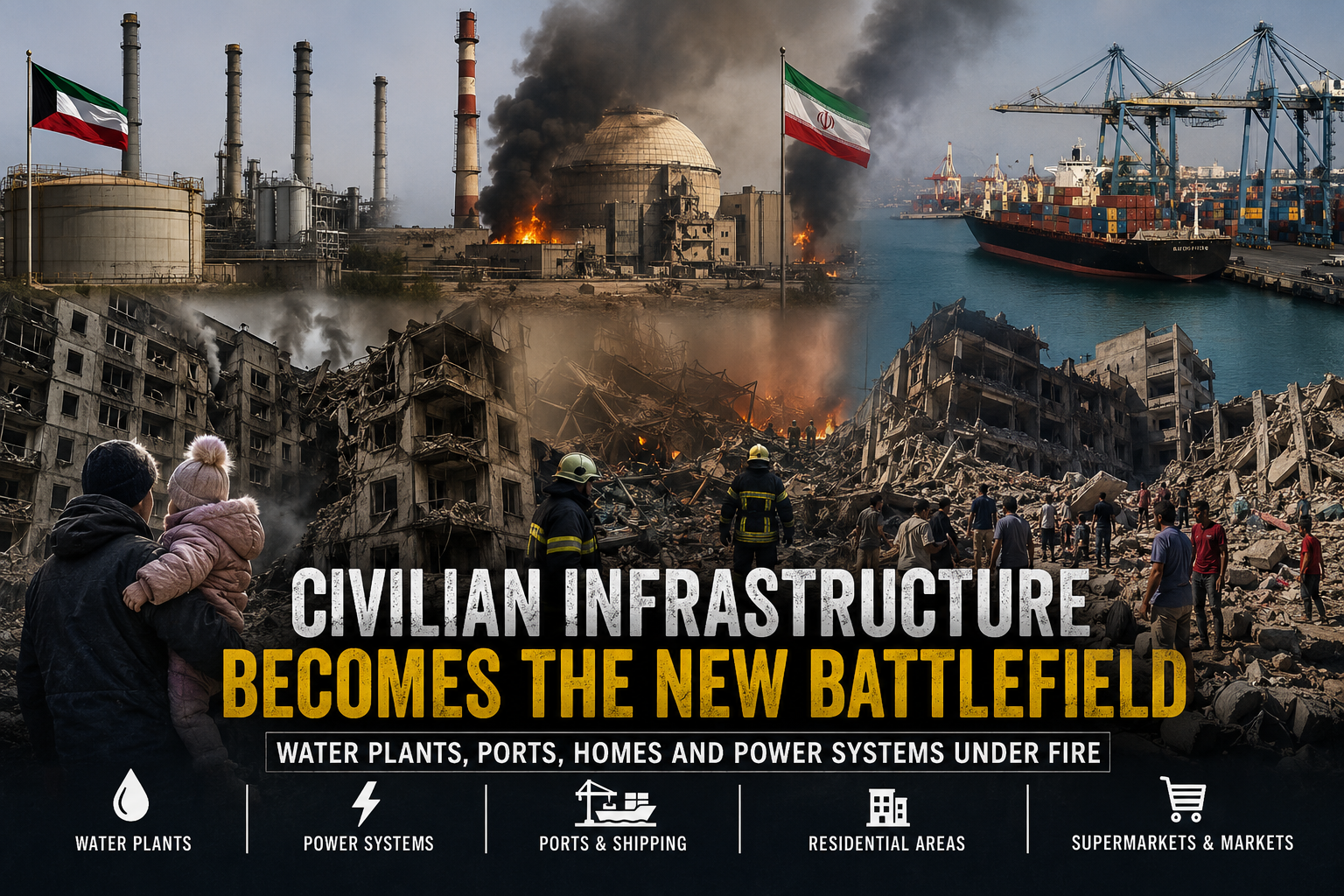
Civilian infrastructure attacks on water, power, homes and shipping are exposing populations and the global economy to widening wartime risks.
Civilian infrastructure attacks are turning the systems that sustain daily life into critical pressure points across several expanding conflicts.
Recent strikes have damaged a power and water desalination plant in Kuwait, coastal and nuclear-related facilities in Iran, ports and commercial shipping around the Strait of Hormuz, and residential buildings in Kyiv and Gaza.
Each incident has its own military and political context. However, together they raise a wider question.

Are contemporary wars increasingly designed to disable the systems that keep civilian populations alive?
Water plants, electricity networks, ports, roads and food distribution centres are not simply buildings. They form interconnected systems. Damage to one facility can affect hospitals, homes, sanitation, telecommunications and emergency services far beyond the original target.
The consequences can also cross national borders. Disrupted shipping in the Strait of Hormuz has already intensified concerns about global energy supplies and inflation. Brent crude rose above $90 a barrel as attacks and maritime insecurity reduced confidence in one of the world’s most important trade routes.
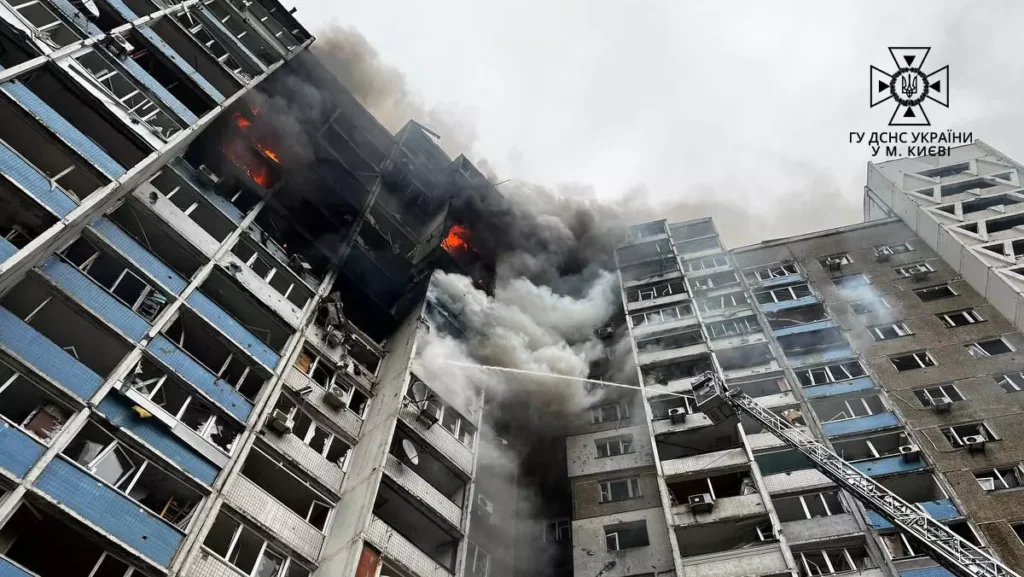
Civilian infrastructure attacks spread across the Gulf
The dangers became particularly clear after an Iranian attack damaged a Kuwaiti power generation and water desalination plant.
Kuwait’s Ministry of Electricity, Water and Renewable Energy said the strike caused a fire and damaged several electricity-generation units. Emergency measures were activated to stabilise the national grid and protect water supplies.
The attack mattered far beyond the physical damage. Kuwait depends heavily on desalination because it has few natural freshwater resources. Therefore, an extended shutdown could affect drinking water, hospitals, businesses and sanitation across the country.
Reports also indicated that more than one Kuwaiti power and desalination facility had faced attacks during the escalation. The incidents demonstrated how quickly a military confrontation involving the United States and Iran could threaten civilian survival systems in neighbouring Gulf states.
Iran, meanwhile, accused the United States of striking an under-construction nuclear power facility in Khuzestan. The International Atomic Energy Agency said the site contained no nuclear material and called for restraint.
United States strikes have also targeted Iranian missile facilities, military logistics, command centres and coastal surveillance capabilities. Washington argues that such operations seek to prevent further Iranian attacks on American forces and global shipping.
Nevertheless, the proximity of military, industrial and civilian systems creates serious risks. A strike intended to disable surveillance or missile infrastructure can interrupt nearby electricity, communications, roads and water supplies.
Nuclear installations carry an additional danger. Even when a site contains no nuclear material, repeated attacks near nuclear facilities can generate public fear and increase the risk of miscalculation.
Ports and shipping become strategic pressure points
The Strait of Hormuz has become another major battlefield.
The waterway connects Gulf energy producers with international markets. A large share of the world’s seaborne oil passes through the strait, making any disruption economically significant.
Recent hostilities have involved attacks on commercial vessels, threats against shipping and strikes on port or coastal infrastructure. Iran has warned that shipping will remain unsafe while American attacks continue. The United States has responded by striking capabilities it says Iran uses to threaten maritime traffic.
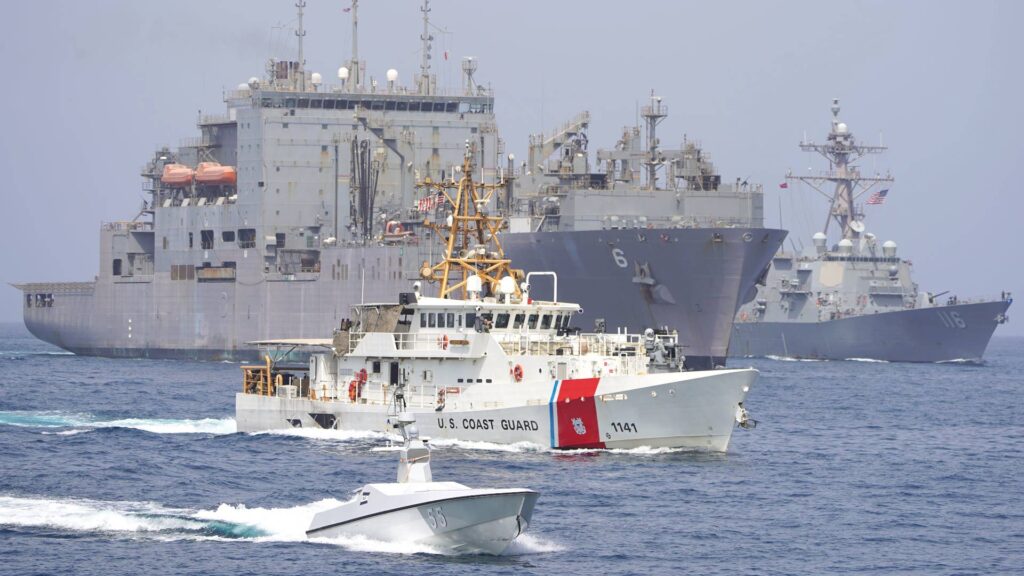
These operations show why transport networks now carry both military and civilian importance.
Ports can support armed forces, but they also handle food, medicine, fuel and commercial goods. Cargo vessels may transport materials with strategic value while remaining civilian-operated ships crewed by workers from several countries.
When shipping slows, insurance premiums rise. Freight costs follow. Oil and gas prices can then increase before any physical shortage reaches consumers.
That economic pressure spreads through aviation, electricity generation, food production and road transport. Countries far from the battlefield may face higher prices because a tanker route or loading terminal has become unsafe.
Attacks on transport systems can therefore produce strategic leverage without directly attacking distant populations. Yet those populations still bear the cost.
Kyiv and Gaza show the immediate human consequences
The impact becomes more visible when missiles strike residential and commercial areas.
Russia launched one of its largest ballistic missile barrages against Kyiv on July 19. Ukrainian officials said residential buildings, warehouses, a dormitory and a supermarket were among the structures damaged.
At least one person died in Kyiv, while 16 others suffered injuries, according to President Volodymyr Zelenskyy. Separate attacks elsewhere in Ukraine caused additional deaths and injuries.
Kyiv Mayor Vitali Klitschko said three of the wounded were in serious condition. One resident told Reuters that an explosion tore a balcony door from its frame and struck him on the head.
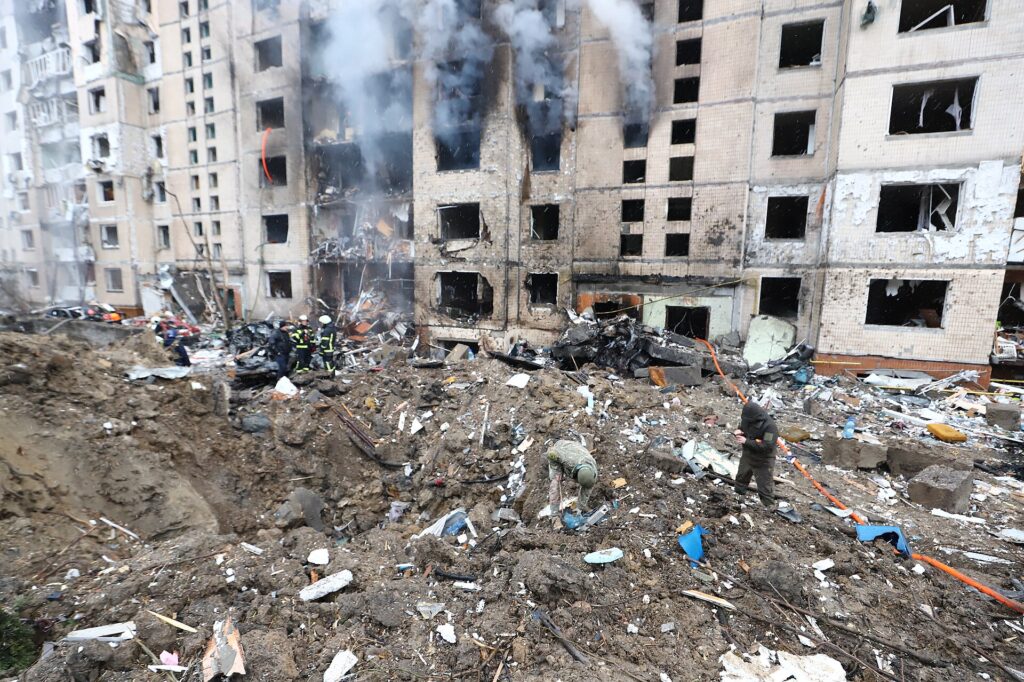
Russia maintains that its strikes target military-related facilities. However, the scale and frequency of missile and drone attacks continue to expose homes, shops and essential services.
Previous attacks on Ukraine’s energy infrastructure have disrupted electricity, heating, water distribution and sanitation. The United Nations Human Rights Monitoring Mission has warned that damage to power systems produces effects far beyond the facilities initially hit.
In Gaza, the danger extends to homes and civilian gatherings.
An Israeli strike on a funeral reportedly killed seven people and wounded 22 others. The Israeli military said it had targeted a militant and acknowledged that civilians may have suffered harm.
Days earlier, another strike killed a man, his wife and their six-year-old daughter, according to Palestinian health officials. Those deaths occurred as efforts to advance the United States-brokered ceasefire faced growing difficulties.
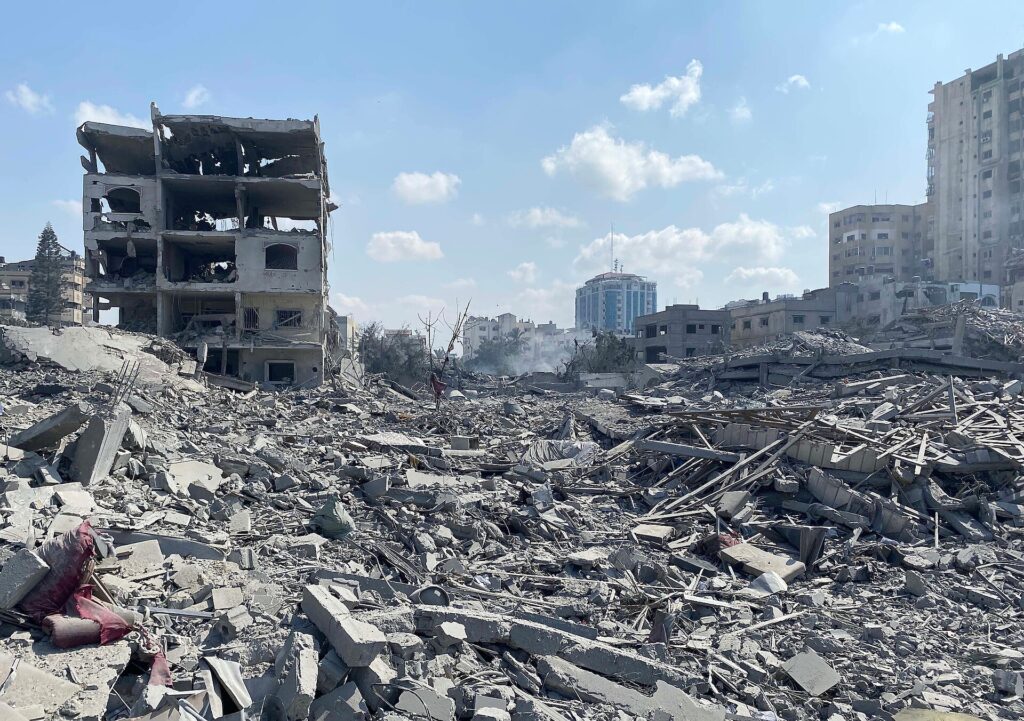
Israel says its operations target Hamas and other armed groups. Hamas-led fighters killed about 1,200 people and abducted 251 during the October 7, 2023, attacks, according to Israeli figures.
However, repeated strikes on homes, funeral gatherings and densely populated areas continue to raise questions about distinction, proportionality and precautions.
What international humanitarian law requires
International humanitarian law does not prohibit every attack on infrastructure.
An object may become a military objective when its nature, location, purpose or use contributes effectively to military action and its destruction offers a definite military advantage.
Even then, attacking forces must distinguish between military objectives and civilian objects. They must also assess whether expected civilian harm would be excessive compared with the concrete and direct military advantage anticipated.
Parties must take feasible precautions to avoid or reduce civilian deaths, injuries and damage. Indiscriminate attacks remain prohibited.
Some civilian systems receive heightened protection.
Article 54 of Additional Protocol I to the Geneva Conventions prohibits attacks intended to destroy, remove or render useless objects indispensable to civilian survival. These include drinking water installations, water supplies, food-producing areas and irrigation works.
The International Committee of the Red Cross has stressed that water infrastructure, personnel and supply systems must remain protected during armed conflict.
Legal assessments still depend on the circumstances of each attack. Investigators must examine the target, available intelligence, expected military advantage, foreseeable civilian damage and precautions taken.
Infrastructure may also serve both civilian and military purposes. That dual use does not remove all legal protection. Instead, it makes proportionality and precaution assessments more important.
Disabling a system can harm millions
Modern cities depend on tightly connected networks.
Electricity powers water pumps. Water supports hospitals and sanitation. Fuel moves food and medicine. Ports supply power stations, factories and transport fleets. Telecommunications coordinate emergency responses.
As a result, destroying one facility can trigger several failures.
A damaged electricity station may stop water production. A closed port may delay fuel deliveries. A strike on a road or bridge may prevent ambulances from reaching hospitals. A supermarket fire may remove a neighbourhood’s immediate access to food.
These indirect consequences often last longer than the original explosion.
They can also affect more people than the initial strike. Civilians who live far from a targeted facility may lose water, power, income or medical care without appearing in the first casualty count.
That is why contemporary conflict cannot be understood only through the number of missiles launched or buildings destroyed.
The wider measure is how many people lose access to the systems required for survival.
The attacks reported in Kuwait, Iran, the Strait of Hormuz, Kyiv and Gaza do not prove that every party follows one coordinated strategy. The conflicts involve different actors, objectives and legal arguments.
However, they reveal a disturbing common vulnerability.
As wars expand, civilian survival increasingly depends on infrastructure that is concentrated, interconnected and difficult to replace. Once those systems enter the battlefield, the distinction between a frontline and a civilian community becomes dangerously thin.
Protecting water, power, transport and food networks is therefore not a secondary humanitarian concern. It is central to protecting civilian life and preventing local wars from producing global consequences.