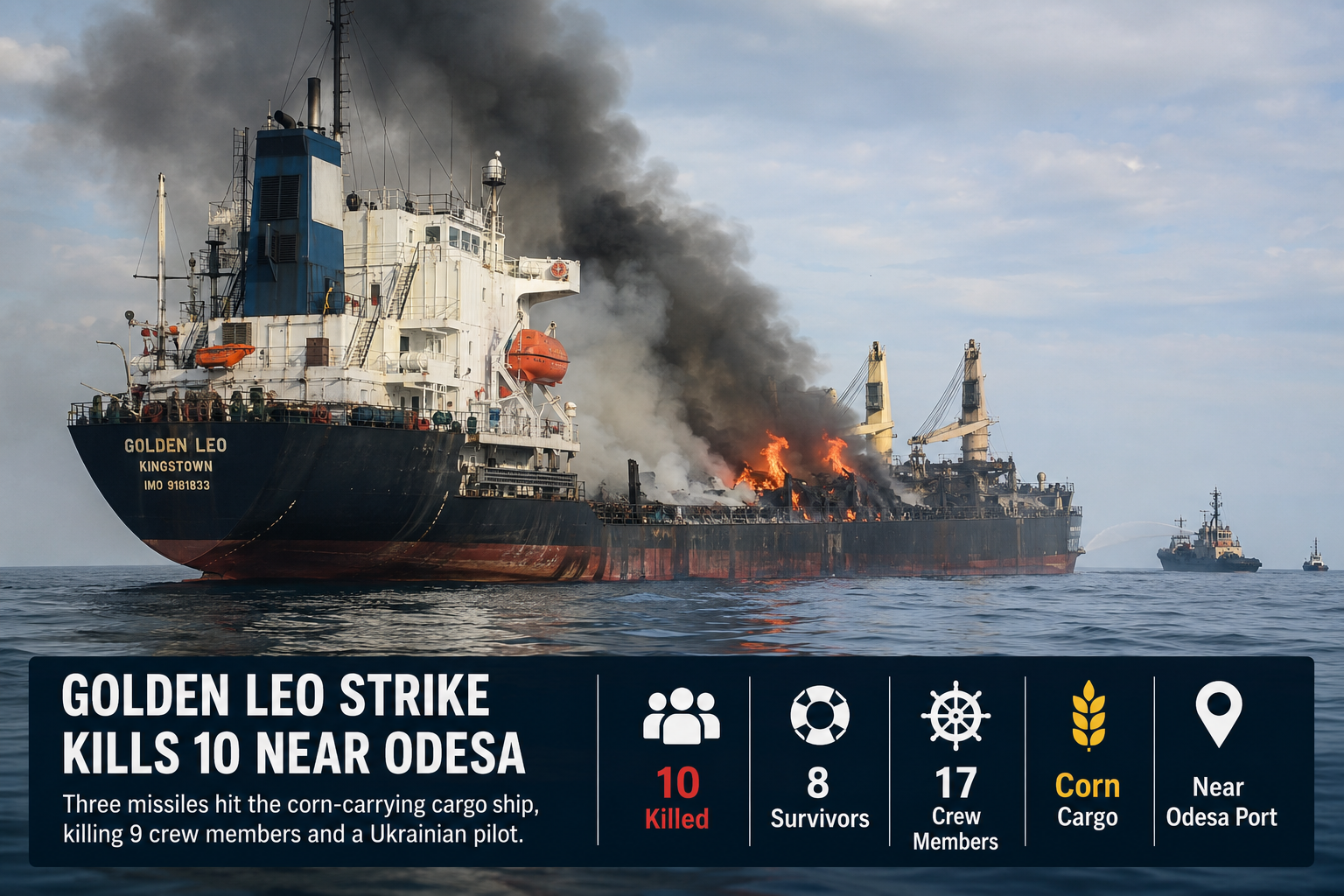
The Golden Leo strike killed 10 people near Odesa and exposed mounting threats to civilian sailors, grain exports and Black Sea shipping.
The Golden Leo strike has exposed a dangerous new phase in the Black Sea war after Russian missiles reportedly killed 10 people aboard a civilian corn-carrying vessel near Odesa.
Three cruise missiles hit the Guinea-Bissau-flagged Golden Leo as it travelled near Ukraine’s southern port. The attack caused a major fire and triggered an overnight search-and-rescue operation, according to Ukrainian authorities.

The dead included crew members from India and Syria, as well as a Ukrainian maritime pilot. Eight of the vessel’s 17 crew members survived.
However, the attack represents more than another deadly incident in the Russia-Ukraine war. It raises serious questions about whether commercial vessels, civilian sailors and grain carriers can continue operating safely in one of the world’s most important agricultural shipping corridors.
Four Indian Sailors Killed in Golden Leo Strike
India’s Ministry of External Affairs confirmed that four Indian nationals died in the attack. Another Indian crew member suffered injuries.
Five Indian nationals were reportedly among the ship’s 17-member crew. New Delhi condemned the attack and stressed the need to protect commercial vessels, civilian crews and freedom of navigation.
The full death toll included nine crew members and a Ukrainian maritime pilot, according to the updated Reuters account. The pilot was apparently in addition to the 17 listed crew members, indicating that 18 people were aboard when the missiles struck.
The deaths underline the international nature of merchant shipping. Civilian vessels frequently carry multinational crews who may have no connection to the countries fighting around them.
For these sailors, the Black Sea is no longer simply a difficult commercial route. It has increasingly become an active conflict zone involving cruise missiles, drones, naval operations and attacks on port infrastructure.
Russia had not publicly acknowledged striking the Golden Leo at the time of the updated reports. Ukraine attributed the attack to Russian forces, while Russia separately said it had targeted fuel infrastructure in the Odesa area.
What We Know About the Golden Leo
The Golden Leo is a general cargo vessel built in 1998. It sails under the Guinea-Bissau flag and carries the International Maritime Organization identification number 9181833.
Maritime tracking records list the vessel as approximately 100 metres long and 18.3 metres wide. It has a deadweight capacity of about 7,334 tonnes.
Shipping records identify Mumbai-based Ocean Grace Shipping Ltd as the registered owner. Friends Shipping Co SA is listed as the vessel’s commercial and safety manager.
The Golden Leo was carrying corn when it came under attack. That cargo makes the incident particularly significant because Ukraine remains a major supplier of grain to international markets.
The strike also followed other attacks affecting ships and port facilities around Odesa. Reuters described it as the deadliest incident during a renewed escalation affecting maritime routes in the Black Sea.
Black Sea Grain Capacity Falls by One-Third
Ukraine has reportedly lost around one-third of its Black Sea grain-export capacity because of intensified Russian missile and drone attacks.
Before the latest escalation, ports in the Odesa region could handle approximately six million tonnes of grain each month. Their estimated capacity has now fallen to about four million tonnes.
More than 90% of Ukraine’s grain and vegetable oil exports normally pass through its principal Black Sea ports. Therefore, repeated attacks do not only damage individual buildings or vessels. They weaken the entire network connecting farms, storage facilities, railways, ports and international buyers.
Four of Ukraine’s 13 major grain terminals had reportedly stopped buying grain amid the disruption. Kernel Holding also suspended operations at the port of Chornomorsk.
Ukraine had forecast agricultural exports of about 43 million tonnes during the 2026–27 season. However, continued damage to ports and transport links could make that target increasingly difficult to reach.
Ukraine usually accounts for approximately 6% of global wheat exports and 11% of corn exports. Consequently, prolonged disruption could affect markets far beyond Europe.
Civilian Ships Face Rising War Risks
The immediate threat is now whether shipowners and crews will continue accepting voyages into the region.
Every successful attack on a commercial vessel can increase war-risk insurance premiums. It can also raise freight charges, delay departures and encourage shipping companies to avoid Ukrainian ports entirely.
Those costs may eventually reach countries that depend on imported wheat and corn. Buyers across Africa, Asia and the Middle East remain particularly exposed to disruption in Black Sea agricultural trade.
Russia is also facing growing pressure on its own maritime exports. Ukrainian attacks reportedly forced restrictions on shipping through the Sea of Azov, an important route for Russian grain and other commodities.
The result is a widening conflict in which both Russian and Ukrainian maritime systems face disruption. Ports, oil facilities, cargo ships and export routes have increasingly become part of the battlefield.
The Golden Leo strike may therefore become a defining incident. It demonstrates that civilian crews can die even when their vessel carries an agricultural commodity rather than weapons.
Ten people lost their lives aboard a ship transporting corn. Unless security conditions improve, the wider cost could include fewer vessels entering the Black Sea, weaker grain-export capacity and higher prices across countries far removed from the war.