Train selfie accidents reveal how excitement, social validation and reduced risk awareness can turn Sri Lanka’s scenic journeys into tragedy.
Recent train selfie accidents reveal a dangerous psychological pattern that can transform Sri Lanka’s most joyful and scenic journeys into life-threatening experiences.
On July 19, news emerged that a foreign tourist had suffered serious injuries after falling from a moving train near Agaliyawala on the Nanu Oya-Badulla route. Authorities admitted her to Nuwara Eliya Hospital.
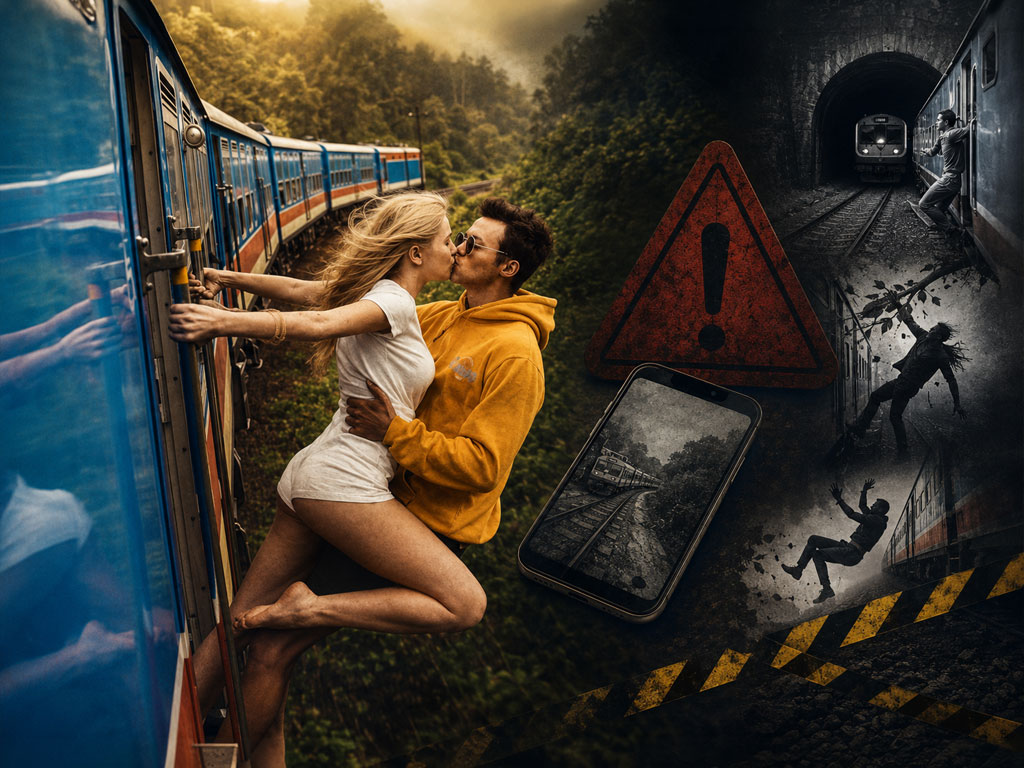
According to railway and hospital sources, the tourist had reportedly been leaning or hanging from the train doorway while attempting to take a selfie.
This was not an isolated event.
Sri Lanka’s Upcountry Railway Line has gained international recognition for its scenery. Forbes has named it among the world’s most beautiful railway journeys.
However, the route’s popularity has created a darker reality. Several sections have also become dangerous locations for extreme photographs and social media content.
Around Ella, the Nine Arches Bridge, Idalgashinna, Demodara, Magiya and Agaliyawala, passengers regularly hang from train doors or sit on footboards.
Some lean dangerously outside moving carriages to capture photographs. They may then collide with tree branches, tunnel walls, posts or other trackside structures.
Foreign tourists are not the only victims. Sri Lankan travellers also engage in the same behaviour.
The Railway Department and Sri Lanka Police repeatedly issue warnings. Yet many passengers continue to ignore them.
Fines and penalties alone may not solve this problem because a powerful psychological process can temporarily weaken a person’s ability to recognise danger.

Train Selfie Accidents and the Psychology of Escape
Psychology recognises “diversion” as a natural human desire to temporarily escape stress, anxiety and the monotony of everyday life.
People seek this escape in different ways. A journey, celebration or unfamiliar environment may provide emotional distance from routine pressures.
For many modern travellers, particularly those accustomed to highly organised and scheduled lives, Sri Lanka’s hill-country railway is more than transportation.
It becomes an entrance into another world.
Cool air, tea estates, waterfalls, mist-covered mountains and the movement and rhythm of the train stimulate the nervous system.
The environment may lower stress while producing feelings of excitement, freedom and happiness.
During what can be described as a peak euphoric moment, a person may become so emotionally absorbed that rational judgment weakens.
The frontal regions of the brain help people evaluate consequences and control impulses. Intense excitement can temporarily reduce attention to those protective functions.
As a result, the instinctive question, “Is this dangerous?” may lose its power.
Another thought takes control:
“I want to experience this moment more freely and capture it more beautifully.”
That emotional shift can explain why an otherwise careful person suddenly leans from a moving train.
The Threat of Deceptive Euphoria
I describe the resulting condition as “deceptive euphoria.”
The happiness itself may feel genuine. However, it becomes deceptive when it creates a false sense of safety.
As rational risk assessment fades, the person’s instinct for self-preservation can also weaken.
This psychological pattern does not apply only to railway journeys.
Similar behaviour can appear when people consume alcohol and then enter deep reservoirs, rivers or the sea. The person feels liberated, confident or unusually capable.
Yet the actual danger remains unchanged.
People often describe such conduct as “taking a risk.” However, the deeper motivation may involve a desire to escape fear, frustration or other pressures.
Alcohol and drugs can produce artificial forms of this temporary happiness.
On Sri Lanka’s hill-country railway, nature itself can create intense excitement. However, the final consequence may be equally tragic when that emotional state leads to reckless behaviour.
The mountains remain beautiful. The train continues moving. Tunnel walls and branches do not become safer because a traveller feels free.
Social Media Validation Makes the Risk Worse
Modern social media culture adds another psychological pressure.
Many travellers no longer feel satisfied simply experiencing a beautiful place. They feel compelled to prove publicly that they were there.
The thought becomes:
“I am in paradise. I must show everyone how free and happy I am.”
Instead of fully experiencing the journey, the traveller begins planning how to display it.
Likes, comments and shares become part of the experience itself.
A normal photograph may no longer appear sufficient. The person wants a more dramatic image that others have not captured.
That desire encourages increasingly dangerous poses.
One passenger stands near the doorway. Another leans farther out. Someone else hangs from the train while holding a phone.
Each image raises the standard for the next person.
Social media then rewards the most dramatic content without revealing the danger behind it.
A photograph may receive thousands of likes. Viewers may imitate it without seeing the near fall, the approaching tunnel or the branch that narrowly missed the passenger.
The “Selfitis” Trap
The excessive need to take and publish self-images has sometimes been described as “selfitis.”
The word may sound humorous, but the behaviour can carry serious consequences when self-presentation becomes more important than safety.
At the most dangerous moment, a person may behave as though one unique photograph is worth more than life itself.
A photograph taken on a railway track or from a moving carriage may appear extraordinary on Instagram.
However, behind that image stands a human life that can disappear in seconds.
A moving train offers almost no opportunity to correct a mistake. A passenger who loses balance may fall beneath the carriage, strike the ground or collide with an obstacle.
The photograph may survive on the phone even when the person does not.
That is the tragedy of train selfie accidents. A device captures the moment, but the traveller loses the future that should have followed it.
Beauty Requires a New Safety Culture
Sri Lanka’s Upcountry Railway Line is a national asset. Its beauty should be promoted and protected.
However, the country also needs a cultural shift in how travellers experience that beauty.
The central problem is not the train. It is the mind that becomes convinced that nothing bad will happen.
The thought “nothing will happen to me” should be recognised as a warning sign.
Deceptive euphoria is real because intense excitement can change perception, judgment and impulse control.
Travellers should pause when they feel unusually fearless. That feeling may not indicate safety. It may signal that emotion has begun overpowering reason.
Social media literacy must also teach a simple truth: one human life is worth more than any like, comment or share.
No one gives likes to a death certificate.
Tourists should understand that the most meaningful memories are not necessarily those presented to strangers online. A journey can remain valuable even when it is not transformed into public content.
Rail Authorities and Travellers Share Responsibility
The Railway Department has introduced open observation carriages with protective side barriers. Such measures can allow passengers to enjoy scenic routes more safely.
However, authorities must do more.
They should install clear warning signs at known danger points. These signs should use multiple languages and internationally recognisable symbols.
Announcements inside trains should warn passengers before tunnels, narrow sections and areas with branches close to the carriage.
Railway staff should intervene when passengers hang from doors or occupy unsafe footboards.
Tour operators, hotels and social media travel pages should also stop promoting photographs that normalise dangerous behaviour.
Yet institutional measures cannot replace individual responsibility.
Travellers must follow instructions, respect barriers and recognise the physical limits of a moving train.
Freedom does not mean reckless conduct.
Real freedom means experiencing a moment safely, consciously and without surrendering control to impulse.
Sri Lanka’s scenic railways should create lifelong memories, not final photographs.
A joyful journey that ignores self-preservation can become a person’s last journey. The selfie taken without care may become the final image of a life that ended for the approval of strangers.
By Dr. Susruth Wijewardhana
Public Health Medical Officer, Provincial Teaching Hospital
SOURCE:- VINVIDA.LK