A single Sri Lankan gazette notification may have helped the country avoid a higher United States tariff, giving local exporters an unexpected advantage over dozens of competing nations.
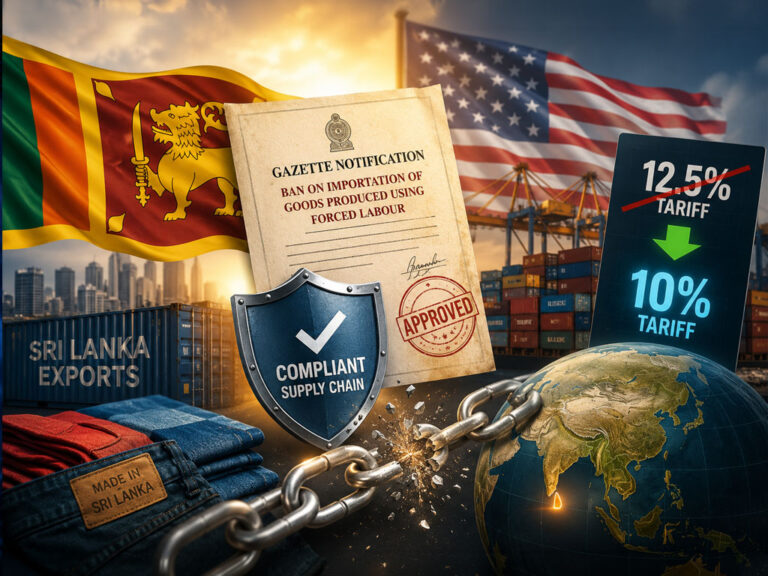
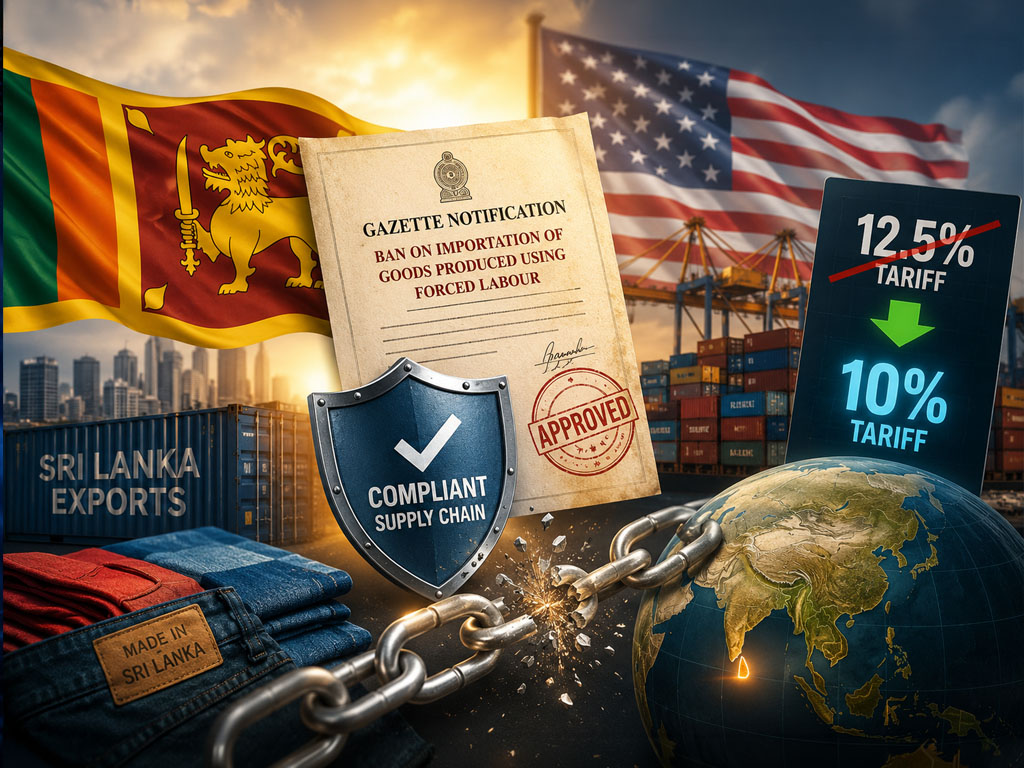
At first, Sri Lanka appeared set to face an additional 12.5% tariff under the Trump administration’s latest trade measures. However, the final rate reportedly fell to 10%, creating a potentially valuable 2.5 percentage-point advantage for Sri Lankan exporters.
Behind that reduction lies a policy decision that initially attracted little public attention.
On July 10, Sri Lanka issued a gazette notification banning the importation of goods produced using forced labour. The move aligned the country more closely with strict United States rules targeting forced labour in international supply chains.
What appeared to be a routine regulatory decision may therefore have helped Sri Lanka steer away from a much heavier trade burden.

From a 12.5% Threat to a 10% Tariff
The Office of the United States Trade Representative reportedly planned to impose a 12.5% additional tariff on Sri Lanka and several other countries.
However, when the final list emerged, Sri Lanka appeared in the lower 10% category.
A difference of 2.5 percentage points may not sound significant. Yet the impact becomes much larger when applied to millions of dollars in exports.
Sri Lanka sends large volumes of garments and other products to the United States each year. Every container carries costs that influence whether local exporters can compete against suppliers from other countries.
For those companies, a 2.5% tariff advantage could translate into substantial savings.
It could also help Sri Lankan products remain attractive to American buyers comparing prices across multiple manufacturing destinations.
The timing of the July 10 gazette notification is therefore important.
Sri Lanka formally prohibited goods made using forced labour shortly before the revised US tariff framework took effect. That decision signalled that the country was prepared to strengthen supply-chain controls and comply with standards strongly promoted by Washington.
Why Washington Cares About Forced Labour
The tariff relief should not be viewed simply as an act of generosity towards Sri Lanka.
The United States uses trade policy to pressure countries into supporting its economic and strategic priorities.
One of those priorities is preventing products linked to forced labour from entering the American market.
US authorities have placed particular focus on supply chains connected to China, including allegations involving production in Xinjiang.
American restrictions can block goods suspected of containing materials produced through forced labour. However, supply chains are often complex.
Raw materials may leave one country, enter another for manufacturing and later reach the United States as finished products.
For example, Chinese-origin materials could potentially pass through manufacturing centres such as Sri Lanka, Bangladesh or Vietnam before entering the US market.
That creates a major enforcement challenge.
The Trump administration’s approach effectively places greater responsibility on exporting countries. They must demonstrate that their products and imported inputs do not involve prohibited labour practices.
Countries unable to provide that assurance may face higher trade barriers.
Sri Lanka’s gazette notification helped show that its official policy had moved in the same direction as the United States.
Sri Lanka Joins the Lower Tariff Group
Sri Lanka reportedly joined 17 other countries in the lower 10% tariff category.
The group included India, Bangladesh, the United Kingdom, Canada and Malaysia.
Meanwhile, nearly 40 other countries reportedly remained subject to the higher 12.5% surcharge.
That difference could become crucial in competitive industries such as apparel.
International buyers often compare prices, delivery times, manufacturing capacity and compliance standards before placing orders.
A lower tariff can make one country more attractive than another, even when production costs remain similar.
Sri Lanka therefore appears to have gained more than a temporary tax reduction. It may have secured a stronger competitive position in the US market.
The outcome also demonstrates that international labour standards do not always create an economic disadvantage.
In this case, stronger regulation appears to have produced a direct commercial benefit.
The Gazette Was Only the First Step
However, issuing the gazette notification does not guarantee that Sri Lanka will retain the lower rate indefinitely.
The country must now prove that exporters are following the policy in practice.
Apparel manufacturers and other businesses may need to trace every stage of their supply chains.
They must know where raw materials originated, how suppliers produced them and whether any part of the process involved forced labour.
US authorities may also require companies to provide records, supplier declarations, audit reports and other evidence.
Large manufacturers may already have the systems needed to meet these requirements.
However, smaller exporters could face greater difficulties.
They may struggle with the cost of audits, documentation and supplier verification. Some may also lack the technology or staff required to trace complex international supply chains.
Therefore, the tariff advantage comes with a serious responsibility.
Sri Lanka cannot simply introduce a prohibition on paper. Customs officials, manufacturers and exporters must enforce it consistently.
One weak supplier or poorly documented shipment could create wider reputational problems for the country’s export sector.
A Timely Decision With a Major Payoff
When Sri Lanka first announced the forced-labour import ban, many may have viewed it as another administrative rule with little immediate impact.
Some may even have questioned whether authorities would enforce it.
Yet the decision now appears far more important.
By acting before the new tariff structure took effect on July 24, Sri Lanka positioned itself to avoid the higher 12.5% surcharge.
It was similar to seeing a danger ahead and changing direction before reaching it.
The move shows how a single regulatory decision can influence international trade, export competitiveness and foreign policy.
However, it also raises a larger geopolitical question.
Sri Lanka has aligned itself with a major United States policy aimed partly at restricting Chinese-linked supply chains.
China remains one of Sri Lanka’s most important economic and political partners.
The immediate tariff benefit is clear. The longer-term diplomatic consequences are less certain.
For now, however, one carefully timed gazette notification appears to have helped Sri Lanka escape a costly tariff trap and secure a valuable advantage in one of its most important export markets.