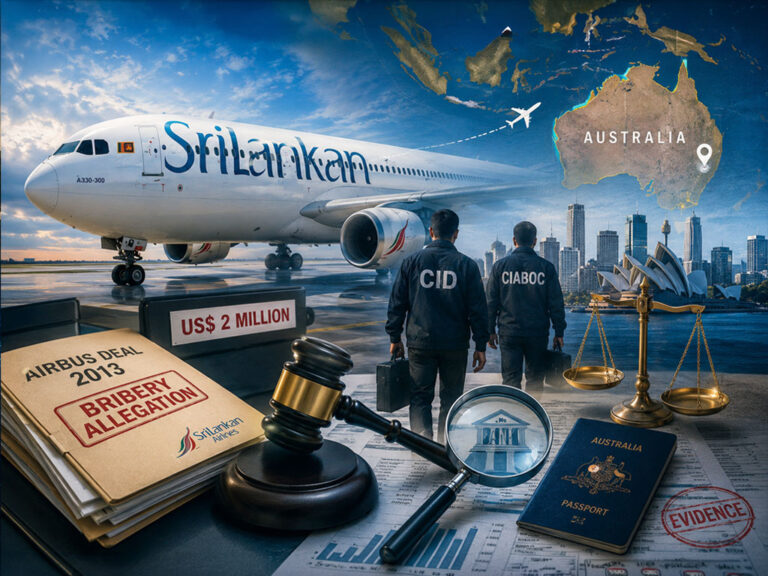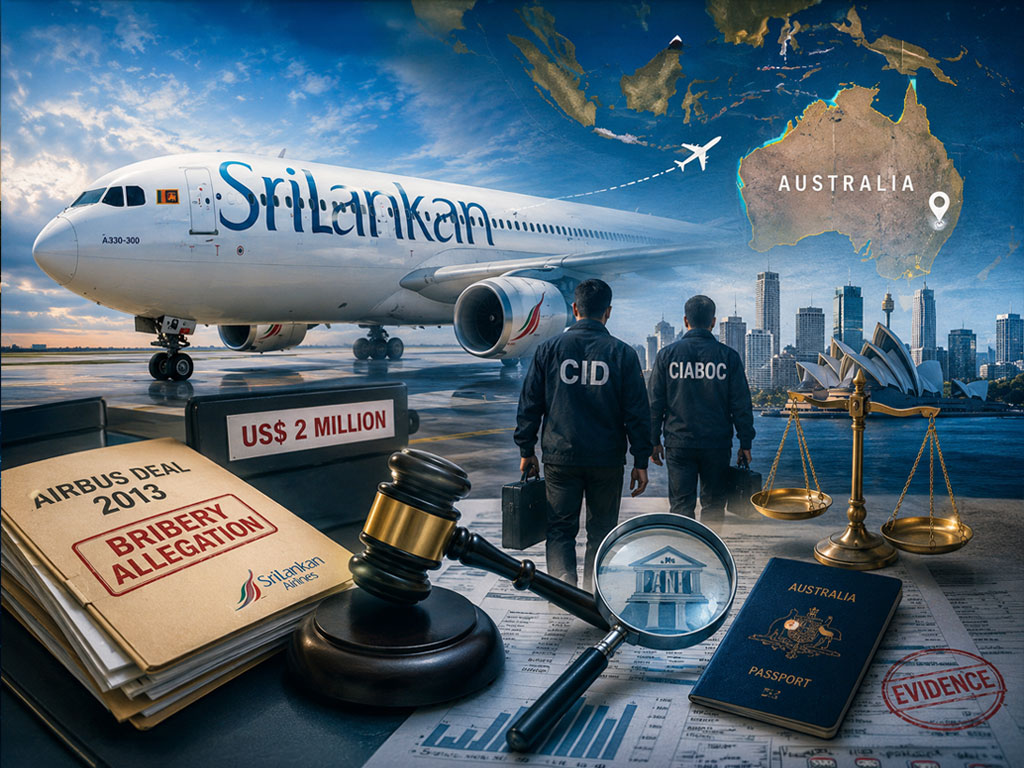
The SriLankan Airbus bribery probe has expanded to Australia as CID and CIABOC investigators seek evidence linked to the US$2 million payment.
The SriLankan Airbus bribery probe has expanded to Australia, where investigators are seeking evidence linked to an alleged US$2 million payment and related financial transactions.
A joint team from the Criminal Investigation Department and the Commission to Investigate Allegations of Bribery or Corruption travelled to Australia for the inquiry.
The mission reflects the government’s increasing use of international cooperation to investigate politically sensitive corruption and cross-border financial crime allegations.
Investigators are expected to seek banking information, witness statements and other records that may support court proceedings in Sri Lanka.

SriLankan Airbus Bribery Probe Targets Australian Links
The investigation concerns SriLankan Airlines’ controversial aircraft procurement programme and an alleged payment connected to Airbus.
Court proceedings and international investigations previously revealed allegations that Airbus offered approximately US$16.84 million in improper payments linked to the proposed purchase and lease of aircraft. About US$2 million was allegedly transferred in December 2013.
The current Australian mission reportedly focuses on Priyanka Niyomali Wijenayake, the wife of the late former SriLankan Airlines CEO Kapila Chandrasena.
Investigators are also examining allegations involving Shamindra Rajapaksa, a son of former minister Chamal Rajapaksa. Reports state that courts have issued warrants against Wijenayake and Rajapaksa, who remain overseas.
Chandrasena died in May 2026. Therefore, the investigation now continues in relation to the remaining suspects, financial transactions and other individuals allegedly connected to the case.
The Bribery Commission and CID have pursued separate proceedings before the Colombo Chief Magistrate’s Court and Fort Magistrate’s Court.
Investigators Seek Statement From Nimal Perera
The team also intends to gather information from businessman W.D. Nimal Perera, who is reportedly living in Australia.
The Bribery Commission previously informed court that an account associated with Perera allegedly received money connected to the Airbus transaction.
Investigators are expected to examine how the funds moved between overseas accounts and whether further transfers reached individuals or companies in Sri Lanka.
The information collected could support requests for international police cooperation, financial intelligence and assistance from Australian authorities.
Modern corruption cases often require investigators to obtain foreign bank records, company-registration documents, immigration information and statements from witnesses living outside Sri Lanka.
As a result, domestic agencies cannot complete such inquiries without cooperation from other jurisdictions.
Government Defends Cross-Border Investigations
Supporters of the government’s anti-corruption programme argue that overseas investigations mark a break from earlier failures to pursue politically connected suspects.
They say corruption has caused major financial losses, weakened public institutions and damaged investor confidence.
According to this argument, pursuing evidence abroad demonstrates that influential suspects cannot avoid investigation simply by leaving Sri Lanka.
However, opposition parties have questioned whether authorities apply the same standards to every case.
Opposition figures allege that investigators are focusing heavily on individuals linked to previous governments while moving slowly on complaints involving people connected to the current administration.
They have also accused the government of using anti-corruption investigations to reshape the political landscape before future elections.
These remain political allegations. Authorities must establish any criminal responsibility through admissible evidence and independent court proceedings.
Transparency Will Determine Public Confidence
Legal analysts say the success of the SriLankan Airbus bribery probe will depend on fairness, transparency and respect for due process.
Foreign missions may provide valuable documents and testimony. However, the number of overseas inquiries alone cannot prove that an anti-corruption campaign is effective.
Credible prosecutions supported by properly obtained evidence could strengthen confidence in Sri Lanka’s justice system.
In contrast, lengthy investigations without indictments, trials or judicial decisions could deepen public frustration.
Investigators must therefore protect the rights of suspects while pursuing evidence impartially, regardless of political connections.
The Australian mission could become an important stage in tracing the alleged Airbus payments. Its long-term significance will depend on whether the evidence leads to transparent proceedings and enforceable court outcomes.