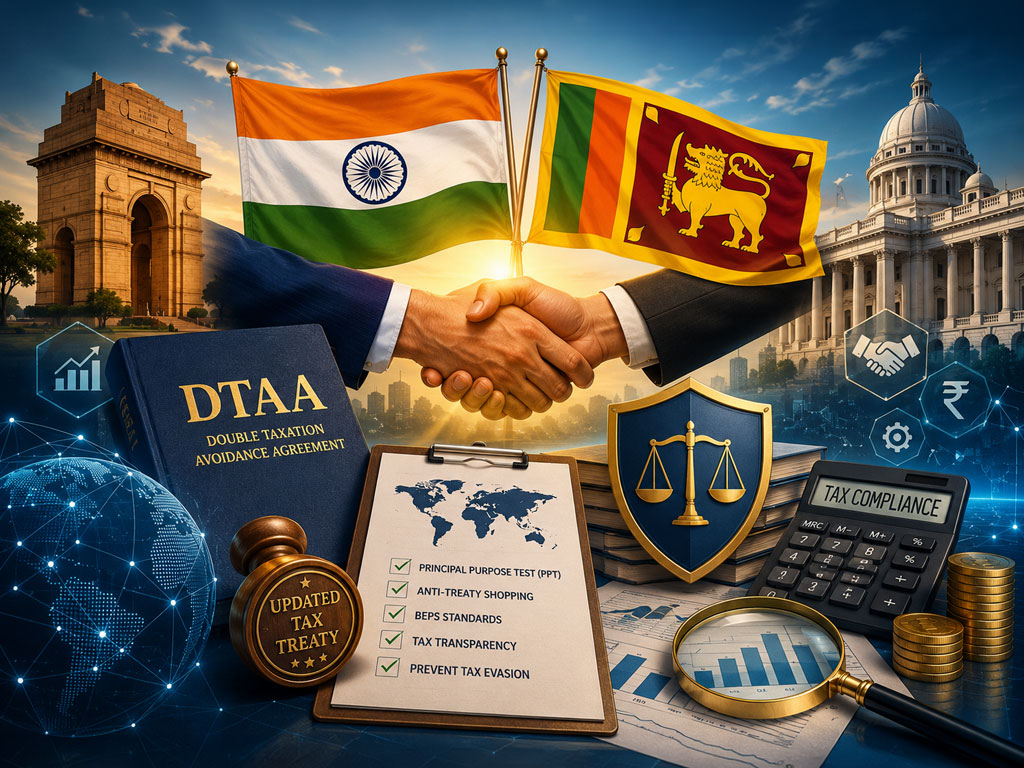
The India Sri Lanka tax treaty adds a Principal Purpose Test, increasing scrutiny of cross-border investments, financing and treaty benefits.
The India Sri Lanka tax treaty has entered a stricter phase, with new anti-abuse rules set to reshape cross-border investments and business structures.
Sri Lanka and India have updated their Double Taxation Avoidance Agreement to strengthen safeguards against international tax avoidance and treaty shopping.
The amended protocol was signed in December 2024 and reportedly took effect in June 2026. India has notified that the revised provisions will apply from the financial year beginning April 1, 2027.
The development has attracted attention among businesses, investors and tax professionals because it could affect how companies structure transactions between the two countries.

India Sri Lanka Tax Treaty Adds Principal Purpose Test
The most significant amendment is the introduction of the Principal Purpose Test, commonly known as the PPT.
Under this rule, tax authorities may deny treaty benefits when obtaining a tax advantage was one of the principal purposes behind a transaction or corporate arrangement.
The treaty’s preamble has also been revised. It now clarifies that eliminating double taxation should not create opportunities for tax evasion, avoidance or treaty shopping.
These changes reflect the OECD and G20 Base Erosion and Profit Shifting framework. The international standard seeks to prevent companies from exploiting gaps between national tax systems or routing transactions through jurisdictions mainly to secure treaty advantages.
Businesses Must Prove Commercial Substance
Sharmeen Thilakaratne, Tax Leader and Partner at Deloitte Sri Lanka and Maldives, said businesses must now demonstrate the genuine commercial purpose behind international transactions.
Legal documentation alone may no longer prove that a structure qualifies for treaty relief.
Tax authorities are likely to examine holding companies, financing arrangements, licensing agreements and indirect asset transfers more closely.
Companies may therefore need stronger evidence showing that their structures have real business functions, employees, decision-making processes and economic substance.
However, tighter rules could also increase compliance, legal and administrative expenses. Smaller investors and businesses with complex regional operations may face the greatest pressure.
Sri Lanka Faces Wider Treaty Reform Challenge
The changes have also highlighted delays in modernising Sri Lanka’s wider network of tax treaties.
Sri Lanka has not joined the OECD’s BEPS Multilateral Instrument. The mechanism allows participating governments to introduce anti-abuse standards across several bilateral treaties without renegotiating each agreement separately.
Without that route, Sri Lanka must negotiate individual amendments with each treaty partner.
That process could slow reforms while international taxation standards continue to change rapidly.
Authorities must protect government revenue and prevent artificial arrangements designed mainly to avoid tax. However, they must also ensure that enforcement does not create uncertainty or discourage legitimate foreign investment.
The success of the revised India Sri Lanka tax treaty will depend on clear guidance, consistent enforcement and a balanced approach that separates genuine commercial activity from abusive treaty structures.