Sri Lanka human rights diplomacy faces scrutiny after Colombo abstained from the UN vote extending Volker Türk’s mandate.
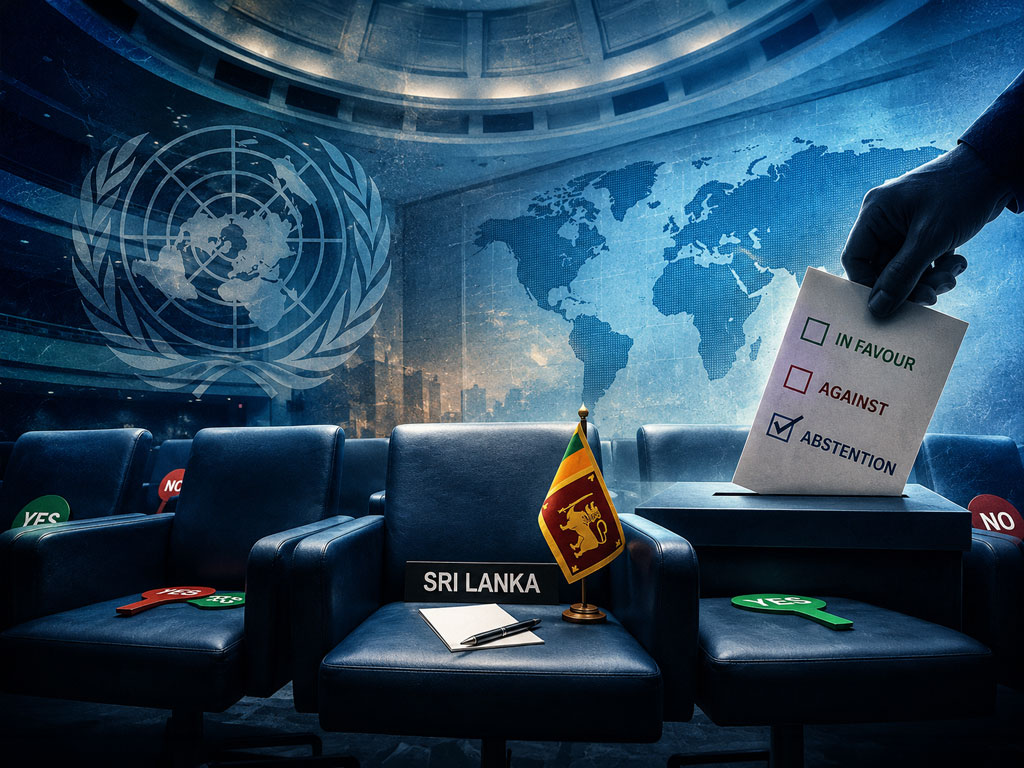
Sri Lanka human rights diplomacy has come under renewed scrutiny after the government abstained from a United Nations General Assembly vote extending Volker Türk’s mandate as UN High Commissioner for Human Rights.
The decision has raised questions over whether Colombo weakened its recent message of greater engagement with international human rights institutions.
The abstention appears particularly notable because of the government’s relationship with Türk during the past year. The current administration invited him to Sri Lanka, making him the first UN High Commissioner for Human Rights to visit the country since 2016.
During the four-day visit, Türk travelled to Kandy, Jaffna and Trincomalee. His itinerary included the Chemmani mass graves site. Government leaders presented the visit as evidence of a renewed willingness to engage with international partners.
Get Breaking News First
on WhatsApp

Türk Report Offered a More Constructive Assessment
Türk’s report to the 60th session of the UN Human Rights Council added further significance to Sri Lanka’s decision.
Unlike several earlier assessments from the Office of the High Commissioner for Human Rights, the report recognised that Sri Lanka had received a historic opportunity to advance accountability, truth and reconciliation.
It linked that opportunity to a government holding a broad public mandate. However, Türk also stressed that official promises required concrete implementation.
Despite that warning, observers generally viewed the report as more constructive than several previous assessments of Sri Lanka.
Against this background, the decision to abstain rather than support Türk’s continuation has raised concerns about the consistency of Colombo’s foreign policy.
Diplomats often view voting patterns as symbolically important. An abstention does not amount to direct opposition. However, observers may still interpret it as reluctance to endorse an official who recently acknowledged positive developments within the country.
Sri Lanka Human Rights Vote Creates Diplomatic Ambiguity
Critics may also question the diplomatic appearance of Sri Lanka’s position.
Colombo joined only 13 countries that abstained, while 144 nations, including China, supported Türk’s continuation in office.
Several governments with longstanding disputes involving UN human rights mechanisms voted against the extension. Sri Lanka did not join that group. However, its neutral position still separated it from most of the international community.
The government may argue that the abstention reflected one major policy disagreement rather than personal opposition to Türk.
Colombo has repeatedly rejected the OHCHR Sri Lanka Accountability Project, known as OSLAP. It maintains that externally managed accountability efforts could deepen divisions and should give way to nationally led processes.
However, critics argue that supporting Türk’s renewed mandate would not automatically have meant accepting every recommendation from his office.
Countries frequently support international appointments while continuing to challenge individual policies through negotiations and formal diplomatic channels.
Ultimately, the abstention has reopened debate about the direction of Sri Lanka’s human rights diplomacy.
Whether observers regard the vote as a careful defence of national sovereignty or an unnecessary diplomatic ambiguity will depend on the government’s next steps.
Its progress on reconciliation, accountability and institutional reform will matter more than a single vote in New York. Those measurable outcomes are likely to shape international perceptions of Sri Lanka in the years ahead.