By Roshan Jayasinghe
What a Traffic Light Revealed About Money, Survival and the Human World
At an ordinary traffic light, the movement of commerce opened an extraordinary question: did humanity create money to serve life, or have we gradually arranged life to serve money?
Before the Light Changed
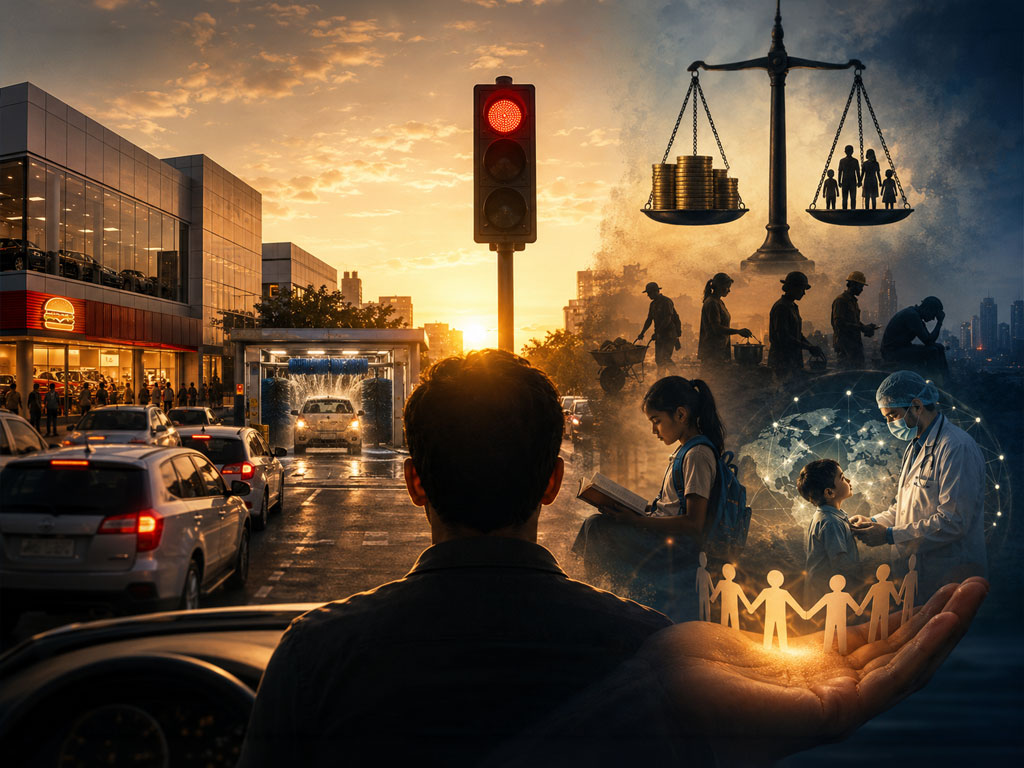
While driving to work, I stopped at a traffic light and looked at the world around me. People were sitting in their cars, going from one place to another. Shops were open. A dealership stood nearby with rows of vehicles waiting to be sold. A fast food restaurant was serving customers. A car wash was already moving vehicles through its tunnel. Signs, buildings, machines, traffic and people were all participating in the commercial movement of another ordinary day.
At first there was nothing unusual about what I was seeing. This is the world we have become accustomed to. Yet while I remained still and waited for the light to change, the ordinary scene began to reveal something larger.
Behind every open door was a human being who had awakened, prepared for work, entered traffic and exchanged another part of life for income. Behind every business were people stocking, cleaning, cooking, selling, repairing, managing, calculating and worrying about whether enough money would come in. Some were born nearby. Others had crossed cities, states, oceans and borders in search of safety, opportunity or a way to provide for their families. Each person carried a private history, individual abilities, likes, dislikes, aspirations, responsibilities and fears, yet for much of the day all of that human difference was being directed into one shared requirement: earning enough money to continue living inside the structure we have created.
We call this an economy. Seen from a traffic light, it is also human time being exchanged so that the entire arrangement can continue.
Get Breaking News First
on WhatsApp

What Are We Sustaining?
There is nothing wrong with contribution. The restaurant feeds people. The dealership provides transportation. The car wash cares for something people use. Shops distribute what communities need and enjoy. Work can provide purpose, skill, connection and dignity. Human beings have always contributed to one another because no individual can produce everything required for life alone.
The deeper question is not why we work. It is what our work has ultimately been organized to serve.
We work to pay for shelter, food, transportation, health, education and the ability to rest. We build systems to make those things available. The systems then require money to operate, and earning that money consumes much of the time and energy of the very people the systems were meant to serve. Many spend their healthiest years trying to afford the conditions required to remain healthy. Parents lose time with children so they can provide for those children. People travel great distances seeking survival, then devote most of their waking lives to maintaining the structure that granted them access to it.
This does not mean the whole arrangement is without value. It means the arrangement must remain open to examination.
Did we create a system to make living possible, or has living gradually become the fuel that keeps the system moving?
Money Is a Tool, Not a Measure of Life
Money is a human invention. It allows a person who grows food to exchange value with someone who builds a home, teaches a child or repairs a machine. It can coordinate contribution across a society too large for direct exchange. Used carefully, it is an efficient tool.
Money itself does not eat, breathe, feel pain, raise children, care for an aging parent or stand beside someone who is grieving. It has no consciousness and no human need. Yet we have allowed access to many of the necessities of life to depend almost entirely upon possessing enough of it.
When a number decides who can obtain care, who can live in safety, who can continue learning, who has time to recover and who must remain afraid, the tool is no longer merely coordinating life. It is governing life.
We then begin confusing price with value. A person earning a great amount may be treated as more important than someone quietly caring for a disabled family member. A corporation may be called successful while the community surrounding it becomes less healthy. Clean water, trusted friendship, patient parenting, public knowledge and peace may produce no immediate financial return, even though life cannot remain whole without them.
What carries the highest price is not always what holds the greatest value.
Money can measure an exchange. It cannot measure a human being.
A Traffic Ticket and the Weight of Circumstance
My thoughts moved from the traffic light to the effect of a traffic ticket. Roads are shared spaces, and rules are necessary. Driving carelessly can harm another person. Responsibility matters. A humane society should never confuse compassion with the absence of accountability.
Yet consider what happens when accountability is expressed mainly as a fixed amount of money.
The same fine may be a minor inconvenience to one person and a serious crisis to another. One person pays it immediately without changing anything else in life. Another may be choosing between that payment, rent, food, medicine, fuel or something a child needs. If the second person cannot pay on time, the system may read financial inability as disregard. The amount can increase, the problem can become more difficult, and a penalty intended to correct one action can begin affecting employment, family stability and the ability to recover.
The number may be equal on paper while the human consequence is completely unequal.
If the true purpose is public safety and responsible behavior, then the most intelligent response is the one most likely to create a safer and more responsible future. That may include education, a reasonable payment based on ability, time to pay, community contribution or another corrective action connected to the actual risk or harm. Circumstance should not excuse everything, but neither should a system pretend that circumstance does not exist.
Compassion does not remove responsibility. It makes responsibility intelligent.
A correction that destroys a person’s stability may satisfy a rule while defeating the human purpose the rule was created to serve.
How Fear Becomes Greed
We often speak about greed as though it begins and ends inside one selfish individual. Personal choices certainly matter. People can knowingly take far more than they need while others are denied what they require to live. That should be questioned clearly.
But greed is also encouraged by an environment that teaches every person that security must be purchased continuously, that falling behind can become dangerous, and that having more than others is evidence of success. When fear of losing shelter, health, status or opportunity is built into daily life, accumulation can begin to feel like protection. When institutions reward extraction, endless growth and control, the fear of not having enough can become the power to prevent others from having enough.
Understanding this does not excuse greed. It helps us see its roots.
Competition can encourage discovery and excellence, but it becomes destructive when the prize is the right to live securely and the cost of losing is hardship. The success of one person does not require the suffering of another. The dignity of one community does not require the humiliation of another. The strength of one nation does not require control over another nation.
We have repeatedly confused being above others with being safe among them.
This same misunderstanding appears between individuals, businesses, communities and countries. Power gathers because people fear losing power. Wealth gathers because people fear losing wealth. Control expands because those who possess it begin believing that more control will finally bring security. Yet a world organized around everyone trying to stand above everyone else cannot become secure. It can only become an increasingly unstable structure with human beings supporting its weight from below.
Harmony Does Not Mean Sameness
A harmonious human society would not require everyone to think alike, live alike or desire the same things. Harmony is not uniformity. It is the ability of different lives to exist without turning difference into domination.
Each person has individual preferences, knowledge, abilities, aspirations and ways of contributing. One may build a business. Another may teach. Another may care for children, repair machines, grow food, create art, study nature, protect a community or listen patiently to someone who is suffering. These contributions are not identical, but all arise within the same human continuum. No one begins life outside nature, and no one remains alive without receiving from other forms of life and from other human beings.
A humane structure would respect individual effort and achievement while placing a secure foundation beneath every life. It would not need to make everyone financially identical. It would recognize that food, shelter, basic health, education, safety and human dignity should not become weapons through which one person can control another.
Enterprise can be rewarded without poverty being used as motivation. Innovation can be encouraged without making deprivation its price. Responsibility can be expected without humiliation. Individual freedom can be protected without abandoning our responsibility to one another.
The question is not whether one person may have more. The question is whether having more gives that person the power to decide who is permitted to live with dignity.
Education and Health: The First Guarantees of Human Respect
If human respect is to mean more than a beautiful intention, it must be visible in the conditions we guarantee to every life. Two of the clearest and most important are education and health.
Education must be freely available to every human being, regardless of birthplace, family income, social position, gender, religion or nationality. Education is where a human life begins to understand itself. It is where a person learns how the body works, how the natural world supports life, how knowledge is tested, how consequences are examined and how individual abilities can be developed into meaningful contribution.
Education should not exist only to prepare a person for employment. It should prepare a human being for life. A child should learn how to think, evaluate, analyze, question and distinguish observable truth from interpretation. A child should learn not only how to compete, but how to cooperate, how to recognize manipulation, how to care for the living world and how to recognize the human in another human being.
Teachers, facilities, books, technology and learning resources require real human effort and material support. Saying that education should be free does not mean that this effort has no value. It means society accepts the responsibility of supporting it together rather than placing a financial barrier between a human mind and the knowledge it needs. The knowledge accumulated across generations is a human inheritance. It should be held as a public trust for humanity, not reserved only for those who can afford admission.
No child should begin life with a smaller horizon because of the financial condition into which that child was born. No adult should be denied the opportunity to continue learning, develop a useful skill or correct an earlier lack of opportunity. When knowledge is withheld by price, society does not merely limit one individual. It limits the intelligence, creativity and contribution available to everyone.
Health must stand beside education as an equal human guarantee. The body is the first home through which every human experience becomes possible. A person cannot fully learn, work, create, care or participate when preventable illness is ignored or treatment is withheld. Access to preventive care, physical and mental health support, nutritious food, clean water, body education, medicine and necessary treatment should not depend upon wealth, employment, nationality or social position.
Health care also requires trained people, facilities, research, equipment and shared resources. These costs are real, but illness should not become a financial punishment, and vulnerability should never become an opportunity for control. A person should not have to prove financial value before receiving care for human life.
Education enables life to understand and develop itself. Health enables life to continue. To guarantee both is not charity offered by those above to those below. It is one of the clearest ways a human society can demonstrate respect for every person within it.
The guarantee should be simple:
Every human being will receive the education needed to understand life, develop individual potential and contribute responsibly to our shared planet, together with the health care needed to protect and continue that life. Neither will be denied because the person cannot afford it.
What Could We Build Instead?
I do not claim to possess a complete economic design for humanity. Any system affecting billions of different people must be examined carefully, tested against lived reality and continuously corrected. Replacing one rigid ideology with another would only rename the structure while preserving the same danger.
But we can begin with clearer human measures.
A humane economy would keep money as a useful means of exchange without making it the sole passport to existence. It would recognize caregiving, parenting, mentoring, learning, protecting nature and strengthening community as real contributions even when a market does not attach a large price to them. It would design accountability to correct harm and restore responsibility, not to multiply suffering because a person began with fewer resources.
It would ask whether work leaves people enough life in which to be human. It would ask whether a business succeeds by creating genuine value or by transferring hidden costs to workers, communities and nature. It would ask whether a law produces the outcome for which it was written. It would judge decisions by observable consequences rather than by authority, tradition or a beautiful explanation.
Such a society would not measure progress only by how much money moved. It would also look at whether children were secure, whether elders were cared for, whether people could obtain treatment, whether knowledge was freely available, whether air and water remained healthy, whether families had time together, whether preventable suffering was declining and whether people felt able to participate meaningfully in the world they were sustaining.
These are not sentimental measurements. They are evidence of whether a human system is serving human life.
This correction does not have to wait for one perfect worldwide design. It can begin wherever people are willing to make a clear commitment and examine the result. A community can ensure that no child is excluded from education because of cost. A nation can guarantee basic preventive and emergency care before illness becomes catastrophe. Public spending can be made visible, outcomes can be measured, successful programs can be shared and failures can be corrected without hiding them. Change becomes believable when a human principle is translated into a practical commitment and its consequences can be seen.
The purpose of efficiency should be to release human energy for living, learning, creating and caring. Efficiency without humanity merely helps an unhealthy structure operate faster.
The Other Side of the Coin
Human nature contains anger, fear, selfishness and the desire to control. We should not deny that side of the coin. But human nature also contains empathy, cooperation, courage, generosity, love and the ability to become aware of our own behavior.
Every day, parents sacrifice for children. Strangers help people they may never meet again. Workers cooperate across differences. Communities rebuild after disaster. People share knowledge, donate blood, care for animals, protect forests and sit beside the dying without expecting payment. This side of humanity is not an imaginary ideal. It is also observable reality.
Yet many of our institutions are designed as though fear, punishment and competition are the only forces upon which society can rely. When people are placed repeatedly in conditions of insecurity and rivalry, they often behave defensively. We then point to that behavior as proof that human beings can be governed only through more fear, punishment and rivalry.
We create the condition and then call the consequence human nature.
The universal capacity available to us is awareness. We can notice what we are doing, examine what it produces and choose whether to continue. Awareness does not guarantee that we will choose well, but without it we repeat inherited arrangements as though no alternative can exist.
Seeing the positive side of the coin does not mean pretending the negative side is absent. It means refusing to give the negative side permanent authority over what humanity is allowed to become.
When the Light Turned Green
The light changed, and the traffic began moving again. People continued toward jobs, shops opened their doors, vehicles entered the car wash, food was prepared, money changed hands and the commercial world continued exactly as it had before I stopped.
No complete answer arrived at that intersection. But the question remained with me.
Inside every passing vehicle was not merely a worker, customer, taxpayer, offender, owner, immigrant, debtor or consumer. There was a living human being carrying a reality that no label or financial number could fully explain.
The economy is not ultimately the buildings, brands, accounts, laws or markets we have created. It is the living time, effort, intelligence and trust of human beings. When the human being disappears from our measurements, efficiency can become cruelty. When the human being is restored to the center, efficiency can become a form of compassion.
The aim is not a world without effort, enterprise, responsibility or difference. It is a world in which none of them is permitted to erase human worth.
A Living Human Manual cannot dictate one final economic system for every generation. It can preserve a first question against which every system should be tested:
Does this arrangement help life to live with dignity, or does it require life to be diminished so the arrangement can survive?
If the answer is the second, correction is not foolishness. Correction is responsibility.
Money can remain a tool. It must not become our master.
Law can protect. It must not become blind to circumstance.
Work can be a contribution. It must not consume the person who contributes.
Power can coordinate. It must not place one human life above another.
Education can develop the human mind. It must not be reserved for those who can pay.
Health care can protect human life. It must not be withheld until money gives permission.
We do not need to become identical.
We need to remember that we are equally alive.
Author’s Note
This reflection is not offered as a final explanation or a fixed political program. It began with an ordinary observation while I was stopped in traffic and with a question about the human consequences of systems we rarely pause to examine. These thoughts should remain open to correction through evidence, lived experience and demonstrated consequence. The invitation is simple: before defending any economic, legal or political arrangement, let us ask whether it serves life, and whether we are willing to change it when it does not.
About the Author
Roshan Jayasinghe is a writer and observer of human systems. His work explores the gap between man made constructs and lived humanity, with a focus on how economics, trade and everyday choices intersect with questions of fairness, responsibility and inner alignment. Through essays for publications in The Morning Telegraph, he aims to remind readers that they are not passengers in a fixed machine, but active custodians of a shared world.