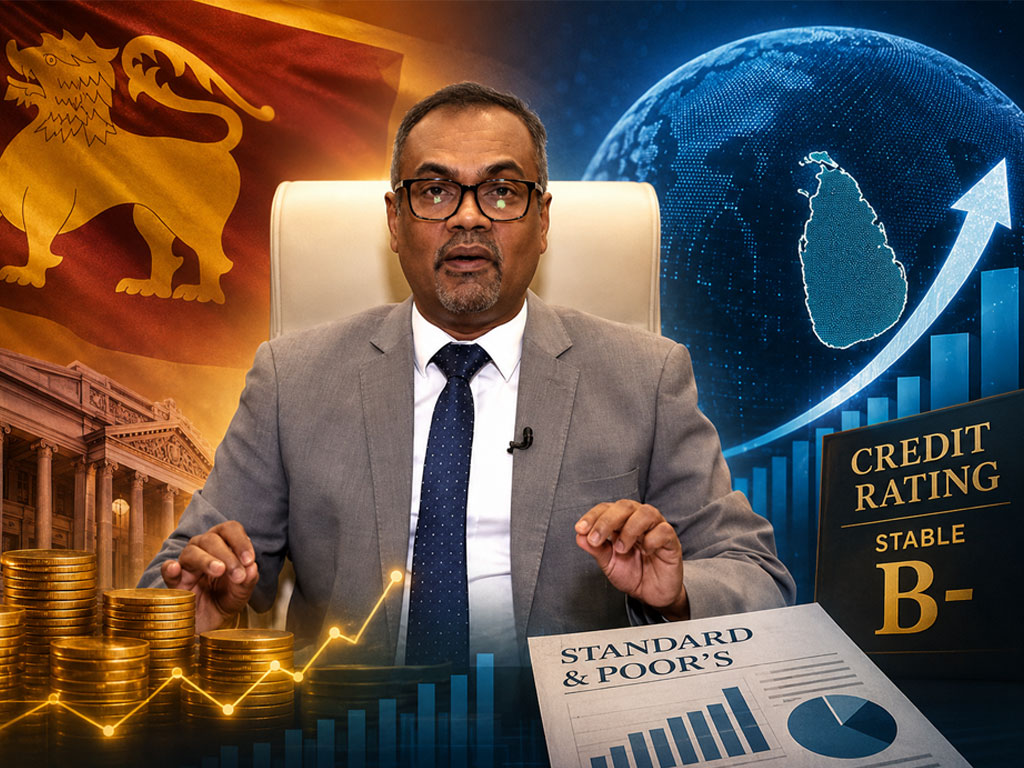
Sri Lanka debt transparency ranked fourth globally as improved reserves, policy stability and creditor relations lifted investor confidence.
Sri Lanka debt transparency has reportedly risen to fourth place globally, with Deputy Finance Minister Dr. Anil Jayantha Fernando crediting consistent policies, political stability and stronger creditor relations.
The Labour Minister and Deputy Minister of Finance and Planning said Sri Lanka achieved notable progress in international financial assessments despite facing internal and external economic shocks.
Fernando referred to the latest Standard & Poor’s assessment released in July 2026. He said the Government had maintained Sri Lanka’s sovereign credit rating at a stable level despite difficult conditions.
“According to the latest S&P rating conducted in July 2026, the Government has been able to maintain Sri Lanka’s credit rating at the same level,” Fernando said.
He identified the effects of Cyclone Ditwah and the military situation in the Middle East as major pressures on the economy.
However, he said the Government maintained stability by keeping the country on its established economic path.
“Despite internal and external shocks such as the impact of Cyclone Ditwah and the military situation in the Middle East, we were able to maintain this stability by not altering the economic trajectory,” he said.
“We see this as a special achievement.”
Get Breaking News First
on WhatsApp

Transfer and Convertibility Rating Improves
Fernando highlighted Sri Lanka’s progress in its Transfer and Convertibility rating, commonly known as the T&C rating.
This assessment measures the likelihood that investors can convert local currency into foreign currency and transfer profits, debt repayments or interest payments abroad.
The rating plays an important role in investor confidence because it reflects a country’s ability to provide access to foreign exchange.
Sri Lanka’s T&C rating stood at the highly risky CCC level in 2022. It improved to CCC+ in 2025 before reaching B- in 2026.
Fernando attributed that improvement to stronger macroeconomic policies and political stability.
He said increased foreign exchange liquidity and the accumulation of official reserves had contributed significantly to the improved assessment.
“This progress is attributed to macroeconomic policies and political stability,” the Minister said.
“The improvement is particularly due to foreign exchange liquidity and reserve accumulation. The B- status is noteworthy and should be specially appreciated.”
According to Fernando, the rating shows that international financial institutions have recognised changes in Sri Lanka’s economic management.
He said the assessment carries greater value than unverified opinions circulated through social media.
Reserves Increased Without Restricting Imports
Fernando said Sri Lanka increased its foreign reserves without imposing severe import restrictions or deliberately contracting the economy.
Instead, he credited the Central Bank’s strategic interventions and a stable monetary policy.
The Government, he said, allowed economic activity to continue while strengthening the country’s foreign exchange position.
“This is an international institution with the understanding, experience and expertise to assess these matters, not what social media commentators say,” Fernando said.
“Therefore, this should be given special attention.”
He said the B- rating also reflected improvements in Sri Lanka’s debt transparency and its relationship with creditors.
Fernando linked those developments to the information and policy framework presented through the International Monetary Fund programme.
He argued that stronger reserves, transparent borrowing records and clearer creditor relations had improved perceptions of Sri Lanka’s ability to meet external obligations.
Sri Lanka Debt Transparency Shows Major Progress
Fernando said Sri Lanka had previously suffered from serious weaknesses in debt reporting and financial record-keeping.
He noted that even official audit reports had raised questions about where borrowed funds were recorded.
According to the Minister, unclear debt records damage trust because investors cannot accurately assess a country’s liabilities or repayment position.
“Even some audit reports showed that we didn’t know where borrowed money was recorded,” he said.
“Without debt transparency, investor confidence collapses.”
Fernando said the latest assessment showed Sri Lanka had made substantial progress in developing creditor relationships and improving the disclosure of public debt.
He said the improvement was particularly significant when compared with the country’s position in 2025.
Sri Lanka reportedly received 43.67 points out of a possible score of 50 in the latest assessment.
That represented an increase of 6.34 points from the 37.33 points recorded in 2025.
“Among the countries evaluated in 2026, we have ranked fourth,” Fernando said.
He argued that the progress in investor relations and debt disclosure also helped raise the Transfer and Convertibility rating to B-.
The ranking, he said, showed that Sri Lanka’s economic policies had produced measurable international recognition.
Economic Growth Reaches 5.1 Per Cent
Fernando also highlighted Sri Lanka’s economic growth during the first quarter of 2026.
He said the economy recorded growth of 5.1 per cent during the period.
According to the Minister, that performance reflected the Government’s decision to maintain policy consistency despite economic and geopolitical pressures.
“Despite various obstacles, maintaining correct policies enabled us to achieve remarkable economic growth,” he said.
“In the first quarter of 2026, we achieved 5.1 per cent economic growth, which is very significant.”
Fernando said effective revenue collection remained essential for protecting public services and maintaining state investment.
The Government monitors revenue performance daily, he added, because weak collection could disrupt planned expenditure.
According to Fernando, the authorities had met their revenue targets as scheduled.
By July 2026, the Government had reportedly collected 63.5 per cent of the revenue expected for the full year.
He said this performance created confidence that the authorities could meet or exceed the 2026 target.
“Therefore, we can easily reach and exceed the planned revenue targets for 2026,” Fernando said.
He added that stronger collection would help ensure that budgeted expenditure could support the public and fund state services.
Interest Payments Continue to Restrict Development
Despite the improved indicators, Fernando acknowledged that Sri Lanka continues to face major economic challenges.
He identified the burden of debt accumulated by previous governments as one of the most serious obstacles.
According to the Minister, Sri Lanka paid more than Rs. 2,500 billion in interest during 2025 alone.
That level of debt servicing restricts the funding available for infrastructure, public services and other development priorities.
Fernando described part of the earlier borrowing as irresponsible and unnecessary.
However, he said the Government was gradually addressing the problem through medium-term borrowing and debt-management strategies.
International institutions had recognised the progress made through those measures, he added.
The Government is gradually moving towards treasury bonds and longer-term borrowing arrangements with lower and more stable interest rates.
Fernando said this approach would help protect debt sustainability and reduce exposure to sudden increases in borrowing costs.
“The report notes that Sri Lanka has shown signs of maintaining debt sustainability through such measures,” he said.
Unproductive Loans Remain a Challenge
Fernando also criticised the use of borrowed money for projects that failed to generate sufficient economic returns.
He said some previous loans had financed highly unsuccessful or unproductive ventures.
Those liabilities remain part of the country’s debt burden even when the original projects no longer provide meaningful benefits.
“This is a challenge we are managing,” he said.
At the same time, Fernando said Sri Lanka must build an economy capable of withstanding natural disasters, geopolitical disruption and international commodity shocks.
The effects of conflict in the Middle East remain a particular concern because Sri Lanka depends heavily on imported fuel.
Fernando said the Government had already strengthened the economy’s resilience to some extent.
He also referred to structural changes aimed at reducing the country’s dependence on fuel imports.
Such reforms, he said, would help protect foreign exchange reserves and limit Sri Lanka’s exposure to sudden changes in global energy prices.
Policy Stability Seen as Key to Further Progress
Fernando said policy consistency, political stability and proper governance had played decisive roles in the country’s recent economic gains.
He argued that maintaining a predictable economic direction helped strengthen reserves, improve investor confidence and support revenue collection.
The Government now intends to build on that stability while addressing debt costs and the weaknesses created by unsuccessful past investments.
Fernando said continued public and institutional cooperation would remain important as Sri Lanka works to consolidate its recovery.
“For achieving these victories, it is important to note that maintaining policy consistency, political stability and proper governance have been crucial,” he said.
“With everyone’s contribution, we will continue to build on this stability and provide the benefits the public deserves.”
The latest results, according to the Minister, show that improved Sri Lanka debt transparency, disciplined revenue collection and stronger creditor relationships are beginning to reshape international confidence in the economy.