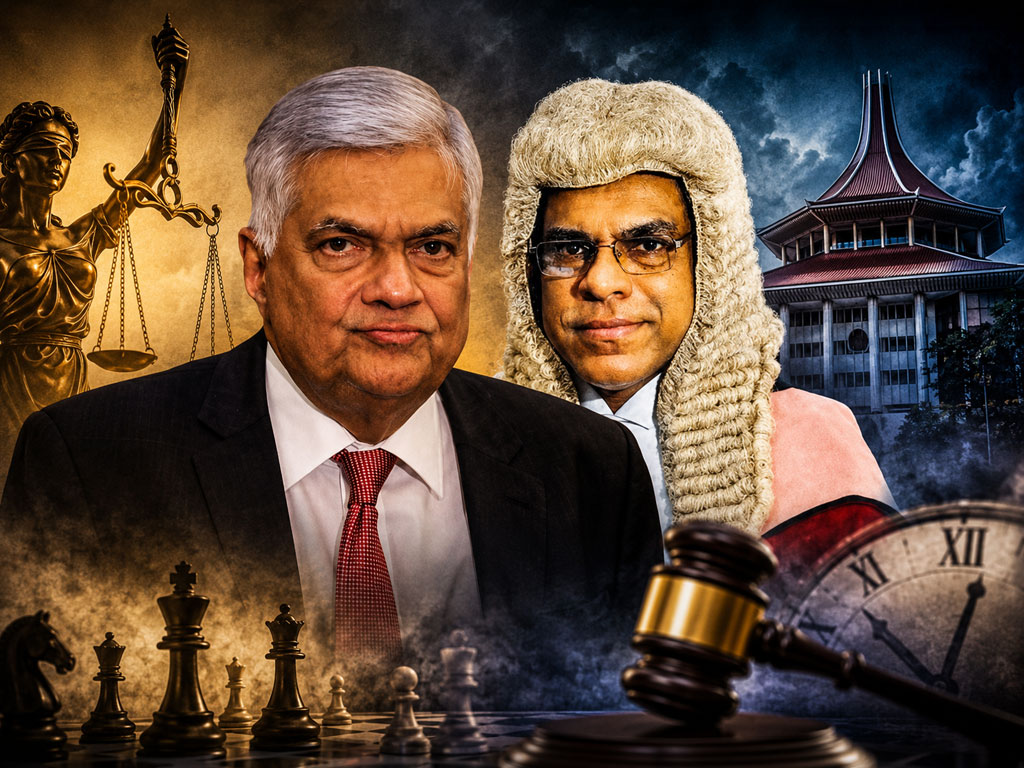
The judicial retirement age debate has become entangled with Ranil Wickremesinghe’s legal case and opposition efforts to block the reform.
The judicial retirement age controversy has become entangled with Ranil Wickremesinghe’s legal battle, opposition politics and the Government’s push for constitutional reform.
The central argument advanced in this commentary is that the Attorney General may be delaying further action against the former President until Chief Justice Preethi Padman Surasena retires.
No evidence establishing such an arrangement has been publicly presented. However, the allegation has become part of the political narrative surrounding both Wickremesinghe’s case and the proposed extension of superior court judges’ tenure.
Wickremesinghe already faces proceedings connected to allegations that public funds supported a 2023 visit to Britain. He denies wrongdoing and received bail following his arrest in August 2025.
Get Breaking News First
on WhatsApp

Why Chief Justice Surasena’s Tenure Matters
Preethi Padman Surasena became Sri Lanka’s 49th Chief Justice on July 27, 2025.
The Government has since considered raising the retirement ages of Supreme Court and Court of Appeal judges. Any such move would require a constitutional amendment because Article 107(5) presently fixes the retirement age of superior court judges.
The source article argues that extending Surasena’s tenure by two years would disrupt an alleged strategy to postpone charges until after his retirement.
That remains an interpretation rather than an established fact.
Nevertheless, the timing has given the controversy political force. If the amendment succeeds, Surasena could remain Chief Justice longer than expected. The author argues that this could increase the likelihood of significant proceedings against Wickremesinghe taking place during his tenure.
Ranil Steps Into the Opposition Campaign
Wickremesinghe recently joined opposition efforts against extending the retirement ages of superior court judges.
The opposition has framed the proposal as a threat to judicial independence. The Bar Association of Sri Lanka and other legal organisations have also raised concerns about changing the tenure of serving judges without broad consultation.
The source portrays Wickremesinghe as attempting to dominate an opposition meeting convened by Opposition Leader Sajith Premadasa.
It also presents the gathering as an alliance of politicians motivated less by constitutional principle than concern over their own legal exposure.
Those characterisations are political opinions, not proven findings.
Still, the meeting placed Wickremesinghe alongside Sajith Premadasa, Namal Rajapaksa and other opposition figures resisting the proposed amendment.
Judicial Retirement Age Opposition May Help the Government
The article argues that the opposition may have unintentionally strengthened the Government’s position.
Before the opposition campaign gathered momentum, the administration had not publicly explained the proposal in full. It appeared cautious about public reaction.
However, once prominent opposition politicians began organising against it, the Government reportedly moved towards presenting the proposal for Cabinet consideration.
The commentary claims this gave the administration a valuable political opportunity.
Instead of defending the reform only as an administrative measure, the Government can now portray resistance as an effort by established political figures to protect themselves.
That does not prove the amendment is necessary or constitutionally sound. However, it changes the political terrain on which the debate will unfold.
The opposition must now explain why extending judicial tenure would undermine independence, while the Government can question the motives of those leading the campaign.
A Political Strategy That May Have Backfired
The source argues that the opposition’s strategy has divided the political field more clearly than the Government could have achieved alone.
Namal Rajapaksa called for opposition unity. Sajith Premadasa convened the meeting. Wickremesinghe attended and assumed a prominent role.
According to the article, that combination allowed the Government to associate resistance to the amendment with politicians facing public suspicion or legal controversy.
Again, participation in an opposition campaign does not prove corruption or criminal responsibility.
However, politics often depends as much on perception as evidence.
The source maintains that opposition leaders attempted to throw a political weapon at the Government but allowed it to explode within their own camp.
Some political strategies operate openly. Others succeed quietly, with their consequences becoming clear only after the damage occurs.
In this case, the campaign against the amendment may have helped the administration present itself as the force supporting stronger judicial continuity and accountability.
The constitutional questions remain serious. Judicial independence, consultation and the effect on future appointments still require careful examination.
Yet politically, the opposition may have handed the Government an unexpected advantage.
The judicial retirement age proposal is no longer only a legal or administrative debate. It has become tied to Ranil Wickremesinghe’s case, the credibility of the opposition and wider public demands for accountability.
For a Government still learning to exercise state power, an opposition that repeatedly weakens its own message may prove its greatest political gift.