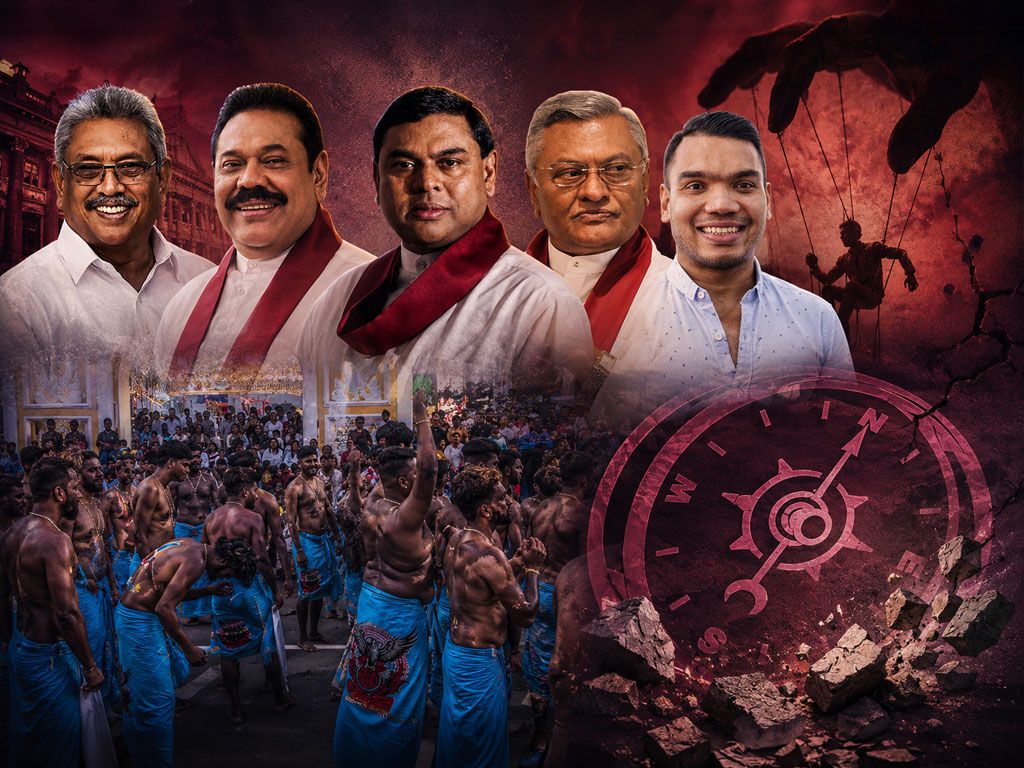
Government losing control of its political message may be restoring credibility to the Rajapaksas through its handling of the Kavadi dispute.
The image of a government losing control has emerged through its response to the Devundara Kavadi dispute, which may be strengthening the Rajapaksa political narrative instead of weakening it.
The current administration appears to believe that society will once again accept statements from figures such as Namal Rajapaksa in the way it did during the height of Rajapaksa influence.
One example is the claim: “We stopped the Kavadi in the perahera, Your Reverence.”
However, this assumption reflects a poor understanding of ideology and political discourse.
The Rajapaksas’ words no longer carry the automatic authority they once possessed. That does not mean they can never recover it. In fact, the present government may now be helping them rebuild that authority.
Get Breaking News First
on WhatsApp

Why Old Political Symbols Have Lost Their Power
Political discourse often operates around what theorists describe as “master signifiers.”
In Sri Lanka, concepts such as “nation,” “religion,” “perahera” and “culture” once formed the central symbols of the Rajapaksa political project. They helped organise public consent around a particular form of nationalism and Sri Lankan capitalism.
Ideology gains strength when such symbols connect with the underlying fantasies, anxieties and desires that exist within society.
During the Rajapaksa era, and even before it, these terms worked as “points de capiton,” or quilting points. They connected separate political ideas and gave them a shared meaning.
Today, however, that ideological fantasy has largely collapsed.
The same words can still be repeated, but they no longer carry their former symbolic power. A government that fails to recognise this change may mistakenly believe ideology is simply a collection of slogans, headlines or emotionally charged words.
Political meaning does not always exist when a statement is first made. Society can give that statement meaning later through its response.
Power is therefore created retroactively.
Government Losing Control of the Political Narrative
Namal Rajapaksa continues to follow the political path established by Mahinda Rajapaksa. However, his statements do not currently possess automatic social authority.
The JVP-led government still holds greater influence through its promise to catch and imprison fraudsters, corrupt officials, criminals and those who enabled them.
Its political narrative also rests on ending bribery and irregularities, treating people fairly and transforming Sri Lanka into a country comparable with Singapore.
Yet the opposition, led by the Rajapaksas, has helped shape the Devundara Kavadi controversy.
When the Government responds with excessive fear and allows the dispute to dominate its political message, it gives the Rajapaksas’ interpretation greater legitimacy.
The administration should not have sent a large delegation, including the Public Security Minister, Ministry Secretary and Police Chief, to Matara.
By giving the incident such extraordinary importance, the Government elevated the status of those accused of dancing Kavadi while under the influence of drugs.
Authorities should instead have investigated the relevant Kavadi groups and enforced the law where evidence justified action. Most ordinary citizens would likely have supported firm and lawful enforcement.
Instead, the Government’s response created the impression that those involved had forced the state to retreat.
The message now being communicated is simple: “Look, the government is afraid of us.”
That perception benefits the Rajapaksa-led opposition. By mishandling the dispute, the Government may be restoring the very symbolic authority that the Rajapaksas had previously lost.