The Sri Lanka Cricket constitution faces legal, political and representation challenges that could derail reform before implementation.
The proposed Sri Lanka Cricket constitution may look modern, but its survival depends on overcoming legal conflicts, political resistance and concerns about representation.
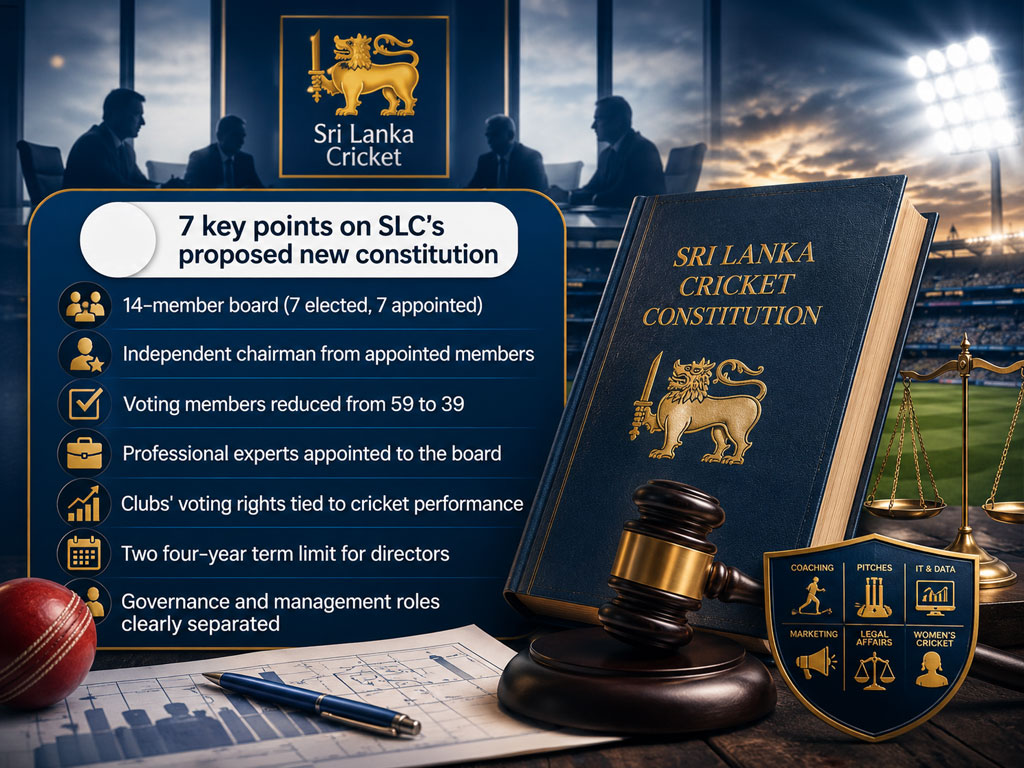
The draft promises a smaller 14-member board, with seven elected members and seven appointed professional directors. It also proposes an independent chairman, a reduced voting structure and a clearer division between governance and management.
Technical areas such as coaching, pitches, technology, marketing, legal affairs and women’s cricket would also receive greater attention.
However, reform cannot be judged only by the language used in a press briefing. The more difficult test is whether the proposal can survive Sri Lanka’s Sports Law, domestic cricket politics, opposition from clubs, district exclusion and concerns from schools.
It must also prove that it will keep cricket representative rather than transferring control from one powerful group to another.
That is where the proposed structure may face its greatest difficulties.
Get Breaking News First
on WhatsApp

Sri Lanka Cricket Constitution Faces a Sports Law Conflict
The first and most serious concern is whether the proposed constitution can operate within Sri Lanka’s existing Sports Law.
Sports Law No. 25 of 1973 continues to give the Minister of Sports broad powers over national sports associations.
Sections 32 and 33 allow the Minister to suspend or cancel the registration of a national sports body. The law also allows interim arrangements to continue the organisation’s functions.
Public reports from June 2026 showed the Ministry using those sections to suspend other national sports bodies and place them under the Ministry Secretary.
That creates an immediate contradiction.
Sri Lanka Cricket cannot easily claim to be creating an independent and professionally governed structure while the country’s central sports legislation still permits ministerial intervention in elected bodies.
Unless the Sports Law changes, any new SLC constitution may remain exposed to the same political interference that has repeatedly damaged Sri Lankan sport.
A constitution cannot deliver genuine autonomy when it remains subordinate to an old law that grants the Minister sweeping powers.
Who Would Really Control Sri Lanka Cricket?
The second problem concerns the balance of authority within the proposed board.
The new structure would contain seven elected members and seven appointed independent directors. However, the chairman would have to come from the appointed group.
Supporters may present that arrangement as a move towards professionalism and independence.
Many clubs may interpret it differently.
They may see the plan as transferring authority away from elected cricket stakeholders and placing it in the hands of professionals who did not face the membership at an election.
Sri Lanka Cricket rests on clubs, schools, districts, provinces, players, coaches and administrators who have supported the game for decades.
If elected representatives cannot hold the chairmanship, clubs are likely to ask why those who campaign, contest elections and remain answerable to members should operate under a chairman they did not elect.
That question could become one of the proposal’s biggest political weaknesses.
An Appointed Chairman Could Face a Legitimacy Crisis
The requirement that the SLC chairman must always come from the appointed directors marks a fundamental change.
It could weaken the influence of long-established election blocs. However, it could also create a serious legitimacy problem.
An unelected chairman may struggle to command authority among elected stakeholders, especially when clubs already fear losing influence.
Independence can be valuable. Yet independence without democratic acceptance may be viewed as another form of control.
Opponents may instead portray the chairman as the preferred candidate of a committee, ministerial process or elite panel.
Perception matters greatly in Sri Lankan cricket.
If the chairman does not receive a direct mandate, critics will immediately ask who selected that person, who influenced the appointment and whose interests the chairman represents.
Without a transparent and trusted selection process, the new office could become a permanent source of dispute.
Reduced Voting Rights Could Create New Exclusion
The plan to reduce voting membership to 39 entities may become another major point of conflict.
Sri Lanka Cricket’s existing voting system has faced years of criticism for being oversized and vulnerable to bloc voting. Reformers have therefore argued for a smaller electorate and stronger accountability.
However, fewer votes do not automatically produce a fairer system.
A reduced electorate can also exclude genuine participants.
Clubs and associations may suspect that the new arrangement is intended not to clean up cricket, but to remove opposition and concentrate influence.
Performance-based voting may sound reasonable, but it carries risks unless the criteria remain public, independent and consistently enforced.
Who decides that an association is inactive?
Who measures performance?
Who verifies participation?
Could a club lose its vote because it lacks resources rather than because it acted improperly?
Could larger clubs influence the standards in ways that protect their own positions?
Unless the constitution answers those questions clearly, the reduced electorate may invite legal challenges, political resistance and new claims of manipulation.
District Cricket Risks Losing Its Direct Voice
Another weakness is the apparent absence of direct district representation.
If district associations receive representation only through provincial bodies, many grassroots voices could disappear from the national structure.
Sri Lanka’s cricket future cannot depend only on Colombo clubs, major institutions and elite provincial administrators.
District cricket matters because it identifies talent outside established pathways. Rural cricket matters because many young players begin far from the country’s traditional centres of influence.
Without direct and meaningful district representation, reform may appear designed by a small circle for that same circle.
A provincial filter may seem administratively tidy. However, it could reduce grassroots accountability and weaken the link between national decision-makers and local cricket communities.
Sri Lanka Cricket needs professional management, but it also needs credibility outside Colombo.
The current proposal may not provide enough of that rural legitimacy.
School Cricket Cannot Be Treated as an Afterthought
The absence of meaningful school representation creates another serious concern.
Sri Lanka’s cricketing identity remains deeply connected to school cricket. Many leading players developed through the school system before entering clubs or national selection pathways.
Schools also create traditions, rivalries, discipline, spectators and early competitive standards that sustain the game across generations.
A constitution that promises to reform cricket while giving schools no proper voice may fail to reflect how Sri Lankan cricket actually develops.
If schools remain outside the decision-making structure, critics will ask a simple but powerful question.
How can Sri Lanka Cricket reform the future while excluding the place where much of that future begins?
Any credible governance model should therefore define how school cricket will contribute to national planning without allowing representation to become another source of vote-bank politics.
MCA Exclusion Makes the Structure Look Incomplete
The Mercantile Cricket Association also appears to have no place in the proposed framework.
That could become another weakness.
Mercantile cricket has long offered workplace competition, sponsorship links and continuity for players outside school and club pathways.
A complete exclusion of the MCA may therefore make the reform appear narrow.
The purpose of reform should not simply be to reduce the number of voting entities.
It should identify which institutions genuinely contribute to the game and determine how those contributors can receive a fair, proportionate voice.
The key question is not who can most easily be removed.
It is who continues to serve cricket and deserves meaningful representation.
Independent Experts Can Still Become Political Appointees
The proposed board would reserve appointed positions for professionals such as a chartered accountant, information technology specialist, marketing expert, lawyer and former cricketer.
Those skills could improve oversight, but qualifications alone do not guarantee independence.
Sri Lanka has repeatedly seen people described as independent professionals become aligned with political, commercial or social networks.
A lawyer may hold undisclosed conflicts. A marketing specialist may have commercial interests. A former cricketer may retain strong loyalties. An accountant may be connected to established power centres.
An IT specialist could be selected for convenience rather than proven excellence.
The central issue is therefore not the list of professional categories. It is the appointment process.
Who nominates the directors?
Who evaluates their qualifications?
How will conflicts of interest be declared and tested?
What information will the public and cricket membership receive?
Without a transparent mechanism, the independent-director model could become a new gatekeeping system.
It may simply replace elected club politics with unelected professional politics.
Governance and Management Must Be Separated in Practice
The proposal’s effort to separate governance from management is one of its strongest features.
The board should set policy and monitor performance. The chief executive and professional staff should manage daily operations.
However, Sri Lankan institutions often make this distinction on paper while ignoring it in practice.
Board members interfere, committees overlap, officials pressure staff, selectors face influence and procurement decisions become personalised.
Unless the constitution contains strong enforcement provisions, the governance-management division may become another decorative promise.
The chief executive must receive protection from improper interference.
Management appointments must follow professional and transparent recruitment procedures. Board members should face clear consequences when they cross into daily operations without authority.
Otherwise, the same habits will continue beneath a new constitutional structure.
Women’s Cricket and Technology Cannot Repair Structural Flaws
The proposal’s attention to women’s cricket, coaching, pitch curation and technology, including iHawk-style systems, is positive.
Sri Lanka needs better playing surfaces, stronger coaching and more organised support for women’s cricket.
It also needs performance data and clearer disciplinary systems.
However, those improvements cannot compensate for weaknesses in legality, representation or legitimacy.
A constitution does not become progressive simply because it refers to women’s cricket and technology.
If clubs reject the board structure, schools feel excluded, districts lose their voices and the Sports Law remains unchanged, technical upgrades alone will not rescue the reform.
Modern tools are useful only when they operate inside a structure that stakeholders recognise as lawful, fair and accountable.
The ICC Risk Has Not Disappeared
Sri Lanka Cricket has already faced international consequences over political interference.
In 2023, the ICC suspended SLC after the Sports Minister removed the elected board and appointed an interim committee.
Reuters reported that the ICC moved the Under-19 World Cup from Sri Lanka to South Africa after the suspension. Sri Lanka’s national teams, however, remained permitted to compete internationally.
That history remains relevant.
Any new constitution must avoid both actual political capture and the appearance of political control.
If stakeholders believe the structure emerged from a minister-appointed process rather than a genuinely accepted consultation, critics may argue that the reform itself resulted from political intervention.
That would create a dangerous contradiction.
The ICC expects good governance, but it also requires cricket boards to remain free from improper government interference.
A constitution designed to prevent political influence must not appear to have been produced through the same influence it claims to remove.
Why the Proposed Structure May Not Survive
The proposal may fail for several interconnected reasons.
It may conflict with the existing Sports Law. It may give appointed directors too much authority. It may weaken elected clubs and exclude districts, schools and the MCA.
It may also create an unelected chairman who lacks a clear stakeholder mandate.
The model could project independence while creating another elite power centre and inviting court action from excluded organisations.
That does not mean the entire proposal lacks value.
Sri Lanka Cricket needs a smaller and more accountable electorate. It needs qualified professionals, term limits and stronger governance standards.
It also needs meaningful reform in women’s cricket and a cleaner separation between directors and management.
However, successful reform must be modern and legitimate.
The proposal may use modern language. Its greatest challenge will be proving that the process and outcome command genuine acceptance.
Reform Must Not Replace One Power Bloc With Another
Sri Lanka Cricket does not need cosmetic change.
It does not need old club politics replaced by control from an unelected professional class. It does not need a powerful chairman who lacks democratic legitimacy.
Nor should it push grassroots cricket away from national decisions or treat schools and districts as secondary.
Professionals should not receive appointments without full transparency.
Real reform must reduce corruption without destroying representation.
It must limit vote-bank politics without silencing legitimate stakeholders. It must professionalise administration while retaining democratic credibility.
The structure must also satisfy ICC governance expectations without conflicting with Sri Lanka’s legal framework.
Most importantly, reform should resolve conflict rather than create another permanent battlefield.
If the Transformation Committee wants the new Sri Lanka Cricket constitution to survive, it must answer the most difficult question before proceeding.
Is the proposal genuinely designed to democratise and professionalise Sri Lanka Cricket, or does it simply change the identity of those who control the game?