Madol Doova has reached Swedish schoolchildren through a Stockholm Embassy programme promoting Sri Lankan literature and cultural exchange.
STOCKHOLM — Martin Wickramasinghe’s celebrated novel Madol Doova has reached a new generation of readers in Sweden through a special literary programme introducing Swedish schoolchildren to Sri Lankan literature, culture and traditions.
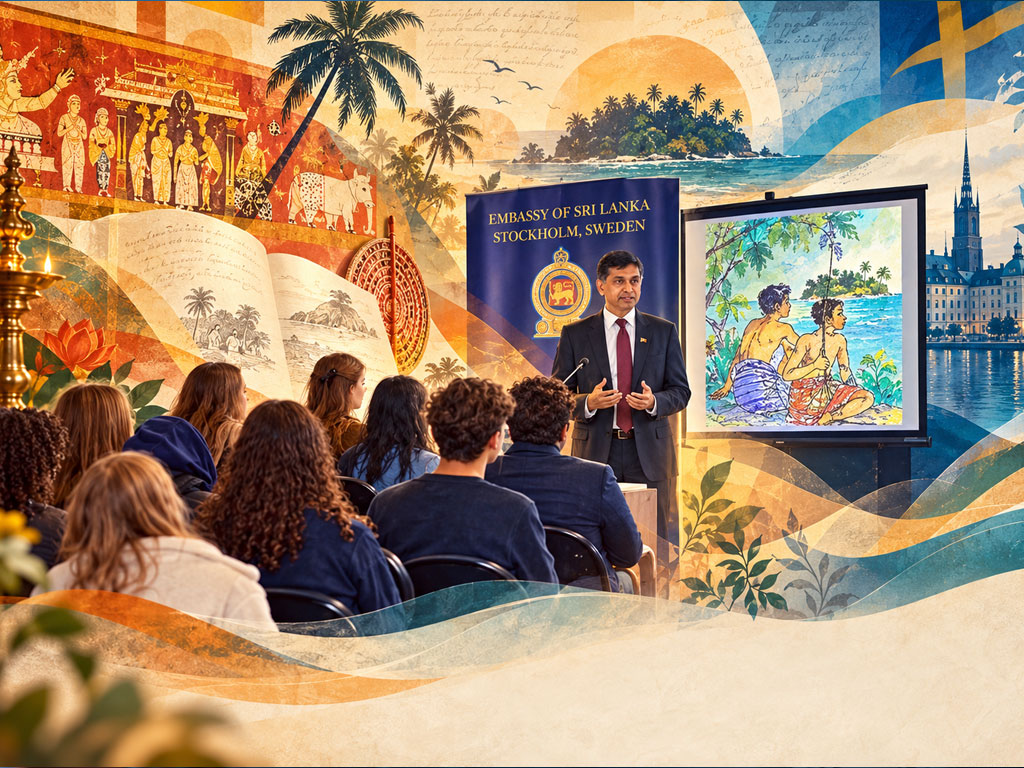
Organised by the Embassy of Sri Lanka in Stockholm, the programme centred on the Swedish translation of Madol Doova and formed part of the mission’s cultural diplomacy efforts to strengthen people-to-people ties between Sri Lanka and Sweden.
The children were introduced to the novel’s story and characters, together with aspects of Sri Lankan culture and traditions reflected in Wickramasinghe’s work.
Translator Priyanwada M. Banduwardana, who translated Madol Doova into Swedish, read a selected chapter from the Swedish edition before joining the students for an interactive discussion.

Literature Opens a Window to Sri Lanka
The session gave the children an opportunity to explore the world portrayed in Madol Doova while learning more about Sri Lanka beyond the pages of the book.
Discussion focused on the story, the country and its cultural setting, allowing students to consider how literature can communicate traditions and experiences across languages and national boundaries.
Madol Doova is closely associated with rural Sri Lankan life and childhood adventure, themes that have helped the novel retain its place among the country’s best-known literary works.
Translation gives those themes a different dimension, allowing readers unfamiliar with Sri Lanka to encounter the characters and their environment through their own language.
Following the reading, the children participated in a creative drawing activity inspired by the book, using their imagination to interpret scenes, characters and ideas from the story.
Sri Lankan Culture Beyond the Page
The programme extended beyond literature.
At its conclusion, the students were served traditional Sri Lankan refreshments and Ceylon Tea, offering another introduction to the country through its food and hospitality.
The combination of reading, discussion, art and cuisine allowed the Embassy to present Sri Lankan culture as an experience rather than simply a subject of study.
Official information from Sri Lanka’s Ministry of Foreign Affairs describes the initiative as part of the Embassy’s efforts to promote Sri Lankan literature and art in Sweden while fostering stronger people-to-people connections between the two countries.
Literature as Cultural Diplomacy
The Stockholm programme also illustrates the role literature can play in diplomacy.
Relations between countries are traditionally associated with government meetings, trade, security and formal agreements. Cultural diplomacy offers another channel, using literature, art, food and shared experiences to build understanding between communities.
For younger audiences in particular, stories can provide an accessible introduction to countries they may know little about.
Sri Lanka and Sweden established diplomatic relations in 1949, while the Sri Lankan Embassy in Stockholm opened in 1970. The mission is also accredited to several Nordic and Baltic countries.
Against that wider diplomatic background, introducing Swedish children to Madol Doova represents a small but tangible form of cultural engagement.
For a Sri Lankan novel to be read, discussed and interpreted by schoolchildren in a Nordic classroom setting also demonstrates how translation can extend the life of national literature far beyond its original linguistic audience.
As Madol Doova continues its journey across languages and cultures, its arrival among young Swedish readers adds another chapter to the international reach of Sri Lankan literature.