
By Marlon Dale Ferreira
Former NOCSL President Warned Sri Lanka Was Walking Towards Olympic Trouble
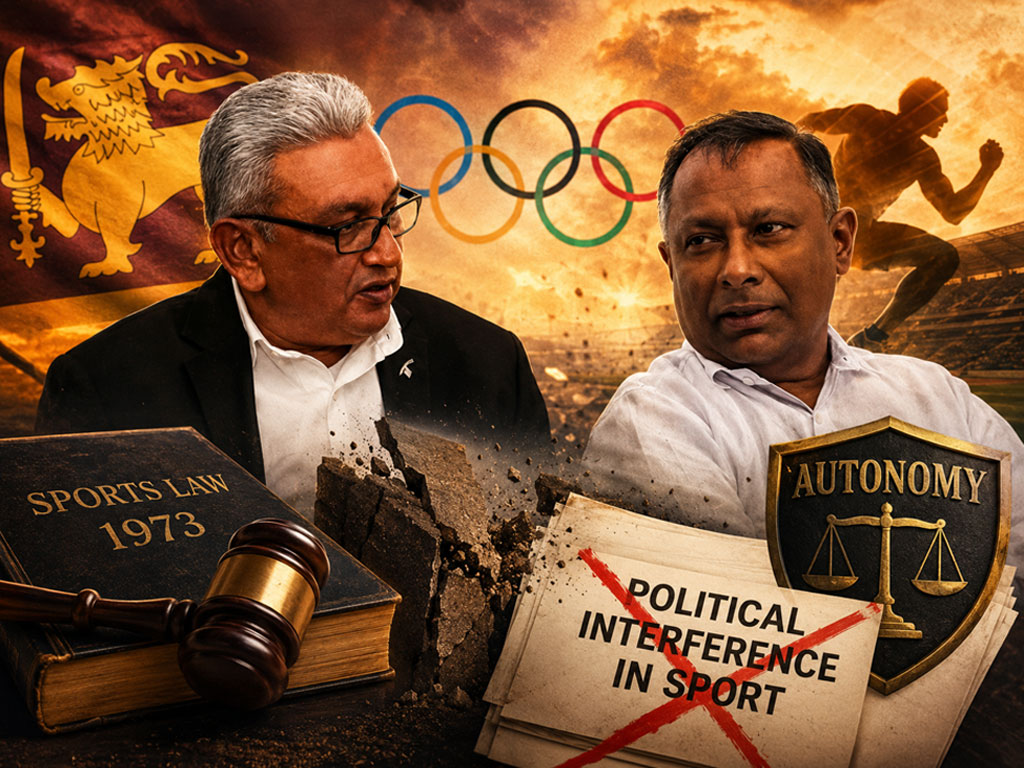
Sri Lanka Sports Law reform was Suresh Subramaniam’s enduring demand as he warned political interference could bring Olympic consequences.
In his prime as President of the National Olympic Committee of Sri Lanka, Suresh Subramaniam had one ambition that stood above almost everything else.
He wanted Sri Lanka’s outdated Sports Law changed.
In an exclusive interview conducted by Next TV in 2022, sports journalist Marlon Dale Ferreira spoke to Suresh Subramaniam, who expressed deep concern over Sri Lanka’s Sports Law, enacted in 1973 and now more than 53 years old.
To him, this was not merely an old piece of legislation.
It was a dangerous legal weapon that allowed political interference in sport.
Subramaniam believed Sri Lanka could not continue operating under a law written for another era while claiming to follow modern Olympic governance standards.
He repeatedly warned that the International Olympic Committee had already raised concerns with Sri Lanka over political interference in national sports bodies.
According to him, the IOC had warned Sri Lanka, given deadlines, and even extended those deadlines when successive governments asked for more time.
Yet nothing changed.
Ministers Came And Went, But The Law Remained
Subramaniam’s frustration was clear.
He believed one of the reasons successive Sports Ministers failed to rewrite the law was simple.
Changing the Sports Law would reduce their own power.
For decades, Sri Lanka’s Sports Ministers have had sweeping authority to interfere with elected national sports associations.
At the centre of the controversy are Sections 32 and 33 of the Sports Law.
Section 32 gives the Minister of Sports the power to refuse, suspend or cancel the registration of a national sports association under certain grounds, including misconduct, inactivity, failure to perform duties or obstruction of ministry policies.
Section 33 then allows the minister to introduce interim arrangements to continue the functions of a suspended or deregistered association.
In practice, this means an elected sports body can be removed and replaced with an interim structure.
That power has been used repeatedly in Sri Lankan sport.
This is exactly what Subramaniam feared.
He believed such powers created a direct clash with the Olympic Charter, which requires national sports bodies to remain autonomous and free from improper political interference.
The Warning From Kuwait And Pakistan
During the exclusive interview, Subramaniam referred to other countries that had suffered consequences over similar issues.
He mentioned Kuwait and Pakistan as examples of nations that had faced international sporting sanctions due to political interference.
His fear was that Sri Lanka could one day face the same fate.
He was not speaking as an alarmist.
He was speaking as someone who had dealt with the Olympic system, understood its rules, and knew the danger of ignoring repeated international warnings.
Subramaniam said the IOC had not remained silent.
It had warned Sri Lanka.
It had given deadlines.
It had extended those deadlines.
However, Sri Lanka’s political leadership kept changing. Sports Ministers came and went almost as if they were walking through saloon doors.
Each new minister promised reform.
Each new minister spoke about change.
Yet the 1973 Sports Law remained.
Cricket Shows Why The Problem Still Matters
The current situation in Sri Lanka Cricket shows why Subramaniam’s warning still matters.
Once again, a duly elected Executive Committee is said to have been asked to step aside and make way for an interim arrangement, this time labelled as a Cricket Transformation Committee.
To critics, the name may have changed, but the concern remains the same.
Can a Sports Minister remove an elected sporting body and replace it with a handpicked structure while Sri Lanka still claims to respect international sporting autonomy?
That was the heart of Subramaniam’s argument.
He did not deny that sports bodies could suffer from corruption, mismanagement or poor governance.
However, he believed those problems should be addressed through modern law, proper regulation, transparent investigations and fair process.
They should not be handled through unlimited ministerial power.
Protecting Athletes Under The Olympic Charter
Despite his concerns about political interference, Subramaniam used his position as NOCSL President to protect Sri Lankan athletes and officials wherever possible.
Under his leadership, the National Olympic Committee worked to ensure that athletes were not punished for administrative or political failures.
One example was Sri Lanka Rugby.
During his tenure, Sri Lankan rugby teams were allowed to compete in Asian events in China and Dubai under the Olympic flag.
That decision gave athletes a chance to represent themselves on the international stage even when the country’s sporting administration faced difficulty.
Subramaniam also permitted boxer Niraj Wijewardena to travel to Taipei, where he eventually won a bronze medal at an international meet.
These decisions reflected his larger belief.
Athletes should not pay the price for political battles, administrative chaos or governance failures.
No Olympic Medals, But A Fight For Accountability
Sri Lanka did not win an Olympic medal during Subramaniam’s eight-year presidency at the NOCSL.
But his supporters argue that his legacy cannot be measured only in medals.
They say he worked to protect athletes, defend the Olympic Charter and clean up the system from within.
One of his major actions was to push for accountability inside the National Olympic Committee.
He supported the removal of officials accused of fraud and misconduct where possible.
He also ensured that a financial forensic audit covering the years 2015 to 2024 was completed.
That audit reportedly exposed serious corruption and financial irregularities during that period.
For Subramaniam, sports governance was not only about winning medals.
It was also about protecting institutions, preventing abuse and ensuring that those entrusted with sport did not exploit it for personal or political gain.
Will Sunil Kumara Gamage Honour His Wish?
Before his death, Subramaniam extended his fullest support to the current Minister of Sports, Sunil Kumara Gamage.
Now the question is whether the minister will honour the late NOCSL President’s long-standing wish.
Will he finally change Sri Lanka’s outdated Sports Law?
Or will he repeat the same pattern followed by previous ministers?
Subramaniam’s concern was clear.
Sri Lanka cannot keep changing sports constitutions while leaving the country’s main Sports Law untouched.
It cannot speak about reform while preserving the very law that allows political interference.
It cannot claim to protect sport while keeping in place powers that allow elected bodies to be suspended and replaced at ministerial discretion.
If Minister Gamage truly wants to reform Sri Lankan sport, then the first step should not be another committee.
It should be a complete and credible overhaul of the 1973 Sports Law.
A Legacy That Still Demands Action
Suresh Subramaniam’s warning should not be forgotten.
He saw the danger before many others were willing to admit it.
He understood that Sri Lankan sport could not survive under a law that gave politicians the power to enter, remove, replace and control elected sports bodies.
He knew the IOC was watching.
He knew Sri Lanka had been warned.
He knew that the country was playing with fire.
His final wish was not personal.
It was institutional.
He wanted Sri Lankan sport to be protected from political interference and aligned with modern Olympic governance standards.
Now, the responsibility falls on Minister Sunil Kumara Gamage.
If he is serious about reform, he must do what previous ministers failed to do.
He must change the Sports Law.
Not after another international warning.
Not after another sports body is suspended.
Not after another scandal.
But now.
Editors note:
The Morning Telegraph conveys its deepest sympathies to Ranjitha, the beloved wife of the late Suresh Subramaniam, his children, relatives, family members, friends, and all those who mourn his passing during this time of deep bereavement and grief.
Suresh Subramaniam served sport, country, and community with dedication, dignity, and commitment. His loss will be deeply felt by many who knew him, worked with him, and respected his contribution to Sri Lankan sport.
At this painful hour, we take comfort in the blessed assurance that he is now safe in the presence of our Lord.
May the Lord God, Jesus Christ, and the Holy Spirit bring comfort, strength, peace, and healing to his beloved wife Ranjitha, his children, and all members of his family and circle of friends.
The Morning Telegraph stands with the family in prayer and sympathy during this difficult time.
May his soul rest in eternal peace.

Suresh Subramaniam’s effort to remove any political interference in Sport was completely correct and laudable. He was a champion tennis player in his day and a sportsman of great integrity. He continued to contribute towards the betterment of Sports Administration thereafter. A fitting tribute to his legacy is for the Government and other powers to bring to fruition his efforts to improve Sports in all their forms.
Rex Olegasegarem