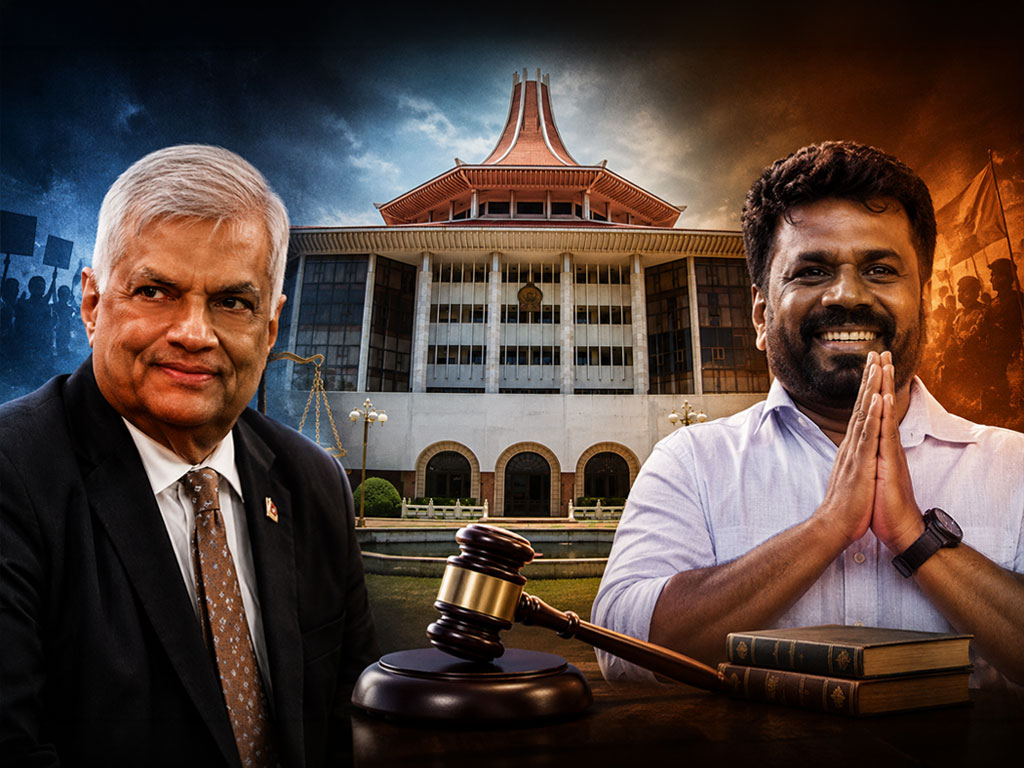
Sri Lankan political and judicial figures amid the judicial retirement age dispute and concerns over judicial independence.
The proposed judicial retirement age extension has reopened an old struggle between Sri Lanka’s Executive and Judiciary, while raising questions about the motives of both government and opposition politicians.
The Government wants to raise the retirement age of superior court judges through the proposed 22nd Constitutional Amendment. Supporters present it as an administrative measure. However, the legal profession sees a constitutional issue involving judicial independence and state power.
Sri Lanka’s history offers several warnings. Political interference affected the judiciary during the impeachment of Chief Justice Neville Samarakoon under J.R. Jayewardene.
Critics also cite the appointment of Sarath N. Silva during President Chandrika Kumaratunga’s tenure, ahead of senior judges including Mark Fernando. The impeachment of Chief Justice Dr. Shirani Bandaranayake under Mahinda Rajapaksa remains another defining example.
Some politicians linked to earlier interventions now appear publicly as defenders of judicial independence. That contradiction has deepened suspicion around the current campaign.
Get Breaking News First
on WhatsApp

Judicial Retirement Age Plan Divides the Legal Community
The Government argues that experienced judges should remain in office to help clear a backlog exceeding 1.1 million cases.
The Bar Association of Sri Lanka and the Judicial Service Association have raised broader concerns. They argue that a retirement age unchanged for roughly 50 years should not be altered for political convenience.
They also warn that extending the service of existing superior court judges without first filling current vacancies could delay promotions.
Junior judges may lose opportunities to move through the judicial hierarchy, affecting morale and weakening the system from within.
The proposal is not simply a staffing decision. It affects appointments, promotions, institutional independence and public confidence in the Constitution.
Allegations Over the Opposition’s Motives
This commentary argues that some opposition figures opposing the amendment are motivated by personal legal concerns rather than constitutional principle.
The opposition group includes politicians facing investigations, proceedings or allegations of corruption.
The article describes them politically as the “bail or suspicion” camp.
It further alleges that protecting former President Ranil Wickremesinghe lies at the centre of the campaign. These claims remain political allegations and have not been established by a court.
The source says the Criminal Investigation Department has presented evidence connected to an alleged misuse of Rs. 16.6 million in public funds.
It also accuses the Attorney General of delaying indictments until Chief Justice Preethi Padman Surasena retires in December 2026.
The article provides no established evidence proving such a strategy. However, the allegation forms the central political argument advanced by the author.
According to that argument, a Trial-at-Bar appointed during Chief Justice Surasena’s tenure could expose Wickremesinghe to greater legal risk.
If the proposed amendment extends the Chief Justice’s term by two years, potentially until 2028, the alleged delaying strategy would become difficult to sustain.
Judicial Independence Cannot Become a Political Shield
The opposition has demanded a referendum and invoked legal principles such as Nemo iudex in causa sua, meaning no person should judge their own case.
The source argues these claims seek to ensure the Chief Justice retires on schedule.
It portrays the campaign as a political operation designed to protect individuals facing legal danger.
That allegation does not remove the legitimate constitutional concerns surrounding the Government’s proposal.
Arbitrarily changing judicial tenure could itself threaten the separation of powers and create damaging perceptions of political influence.
Yet using judicial independence as cover for personal legal survival would be equally destructive.
Sri Lanka therefore faces two dangers at once.
The Government must not alter the Constitution to serve political needs. Opposition politicians must not turn judicial independence into a shield against accountability.
The judicial retirement age dispute will test whether either side genuinely respects the rule of law, or whether both are using the Judiciary as another battlefield in their struggle for political survival.