By Roy Denish.
The Chemmani mass grave has yielded 478 sets of remains as families demand an international investigation into the discoveries.
JAFFNA, Sri Lanka — The Chemmani mass grave has yielded 478 sets of human remains, making it Sri Lanka’s largest known mass grave as court-supervised excavations continue through a third phase.
The discoveries include headless skeletons, children’s remains and a body found with a raincoat and sock. Meanwhile, the Criminal Investigation Department told the Jaffna Magistrate’s Court that investigators have not yet determined whether a crime occurred at the site.
During proceedings, the CID requested permission for scientific testing and forensic analysis to establish the age of the skeletal remains.
Unusual Chemmani Mass Grave Burial Examined
Lawyers representing families of the disappeared drew attention to unusual evidence surrounding the 467th set of remains. It appeared linked to a coffin, raincoat and sock.
Counsel V.S. Niranjan told reporters that the items raised questions about whether authorities had conducted the burial legally. He said the matter would require further judicial examination.
The court ordered officials to obtain outstanding soil sample reports and university assessments. An expert panel, including archaeologist Professor Raj Somadeva and Judicial Medical Officer Dr. Chellaiya Pranavan, will work with legal representatives to decide the next steps when the case returns on August 5.
Across 95 excavation days over three phases, teams have fully exhumed 464 of the 478 identified sets of remains. Authorities approved 56 working days for the ongoing third phase.
Recent excavations have uncovered infant remains, children’s bones, clothing, feeding bottles, toys and beads.
Families Demand International Investigation
Chemmani has now exceeded the Mannar Sathosa mass grave, where investigators recovered 376 sets of remains. However, authorities have not begun formally identifying those found at Chemmani.
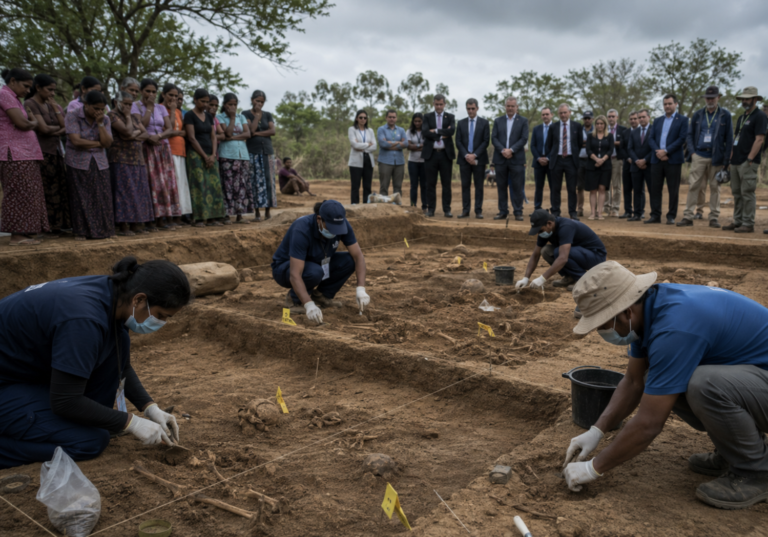
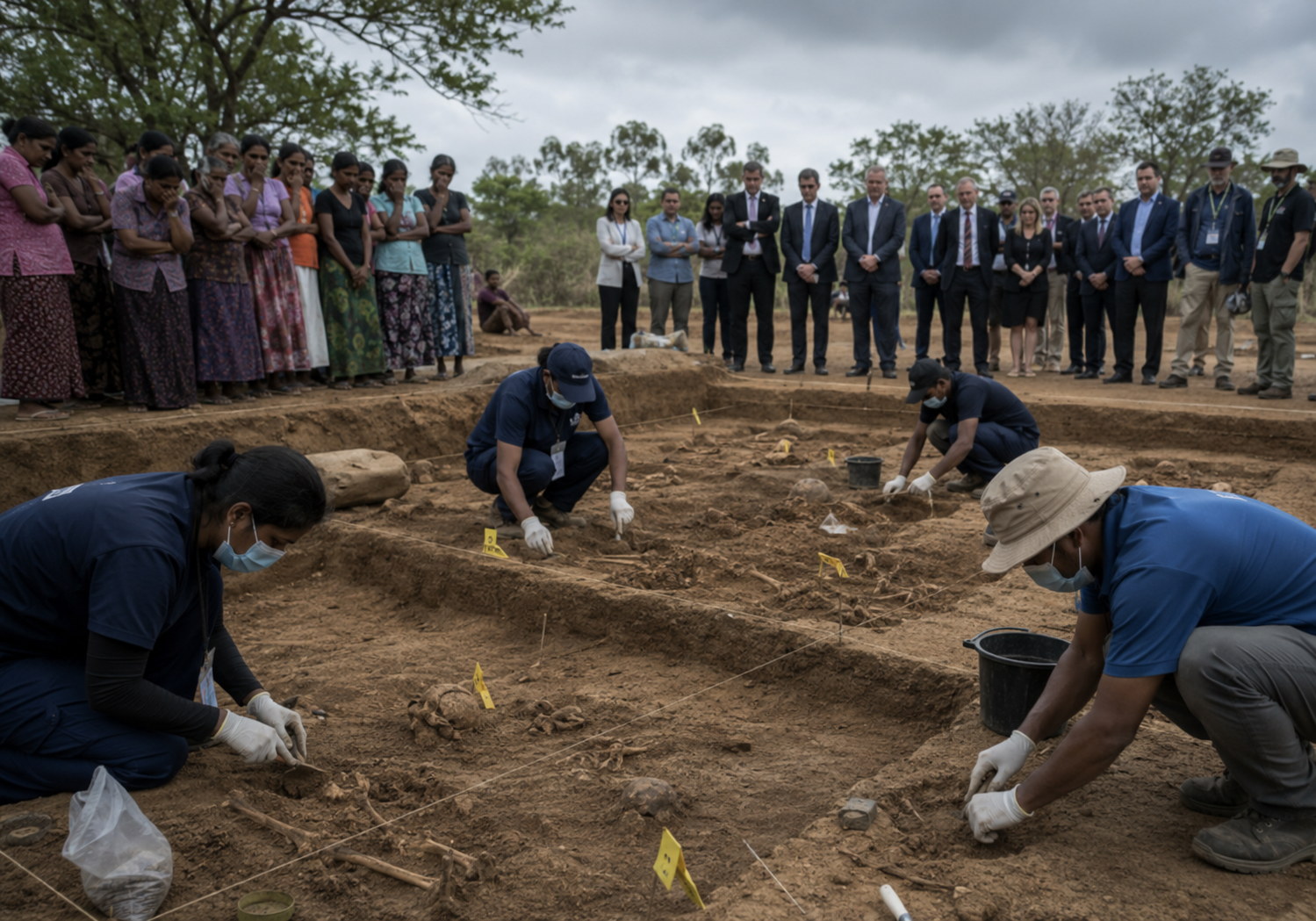
Relatives of the forcibly disappeared also gathered at Chemmani junction during a visit by a European Union delegation. EU Ambassador Carmen Moreno joined the German, French, Italian and Dutch ambassadors at the site.
The families submitted a memorandum calling for an international investigation. They accused the Sri Lankan state of concealing evidence and delaying accountability.
Yogarasa Kanagaranjini, president of the Association for Relatives of the Enforced Disappeared in the North and East, said the delegation’s response to the families’ appeals was unsatisfactory. Their demand adds pressure for a credible process capable of establishing who was buried at Chemmani and how they died.