Iran war talks face new pressure after six people are killed in a Red Sea attack and a US strike hits a ship near the Gulf of Oman.
Six people have been killed in a Houthi attack on a cargo vessel as Iran war talks face a fresh setback and violence threatens two critical shipping routes.
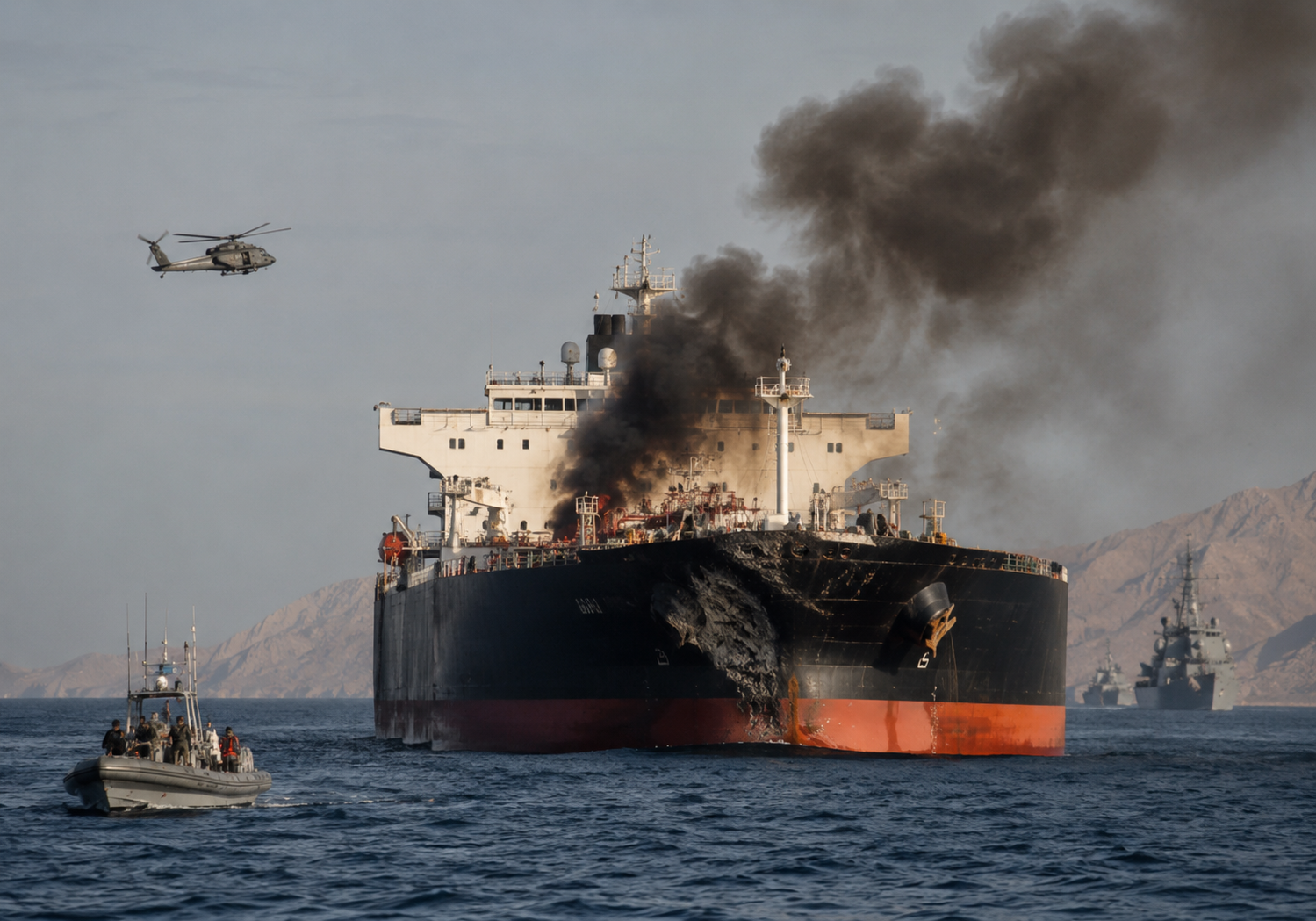
Four crew members aboard the Egyptian-owned cargo ship Tihamah died in Tuesday’s attack in the Bab el-Mandeb Strait, according to Yemen’s Transport Ministry. Officials identified the victims as three Pakistani nationals and one Indonesian.
Two Yemeni rescuers from the anti-Houthi National Resistance Forces were later killed when the Houthis struck again after rescue teams reached the vessel, Yemen’s Coast Guard said. Ten others were injured, including seven crew members, two Coast Guard personnel and one National Resistance Forces member.
If confirmed, the deaths aboard Tihamah would be the first fatalities from a Houthi shipping attack since the Iran war began on February 28. The vessel was anchored northeast of Yemen’s Perim Island when the strike occurred.
The Houthis later said they had attacked a vessel carrying Saudi military equipment through the Bab el-Mandeb Strait. However, they did not name the ship. Saudi authorities had not immediately responded to the claim.
US Strike Adds Pressure as Iran War Talks Falter
Hours later, a separate confrontation unfolded near the Gulf of Oman, adding further pressure as Iran war talks struggled to regain momentum.
U.S. Central Command said a Navy MH-60 helicopter fired two Hellfire missiles at the Panama-flagged Vela Nova and disabled its steering gear.
The U.S. military said the vessel ignored repeated warnings to stop while attempting to sail toward an Iranian port in violation of Washington’s naval blockade. Maritime sources placed the ship about 71 nautical miles, or 131 kilometres, off Pakistan’s coast.
Both incidents unfolded near major global shipping routes as hopes for a diplomatic breakthrough between Washington and Tehran weakened.
Iran has maintained that the Strait of Hormuz will remain closed unless the United States accepts its conditions for ending the war.
Iran’s top security official, Mohsen Rezaei, said Washington must change its behaviour and meet Tehran’s demands before the strategic waterway can reopen. Those demands include releasing frozen Iranian assets and ending conflicts elsewhere in the region, including Lebanon and Gaza.
Iran had earlier said talks with Oman over new shipping lanes through Hormuz were in their final stages. However, Foreign Minister Abbas Araqchi said an agreement on the lanes alone would not automatically reopen the strait.
Oil Climbs as Shipping Risks Grow
The worsening maritime crisis quickly affected global energy markets.
Brent crude futures rose 1.4% on Tuesday to settle at $88.91 a barrel. U.S. West Texas Intermediate crude gained 1.3% to $83.20. Both benchmarks posted their highest closing levels since July 31 as hopes for a rapid U.S.-Iran settlement faded.
Before the war, roughly one-fifth of global oil and liquefied natural gas flows passed through the Strait of Hormuz. Traffic has since plunged. Only six vessels crossed the strait on Monday, compared with roughly 125 to 140 per day before the conflict.
Commercial traffic through the Bab el-Mandeb Strait has also fallen sharply. An average of 32 ships per day passed through the waterway last week, compared with about 50 before the Houthis announced their latest blockade.
Pakistan and Qatar had recently raised hopes that Washington and Tehran were moving closer to an arrangement. However, Tuesday’s attacks and sharper rhetoric from both sides have renewed doubts over whether a deal can be reached soon.
With violence now affecting both the Red Sea and the approaches to Hormuz, the crisis is placing two of the world’s most important maritime chokepoints under growing pressure at the same time.