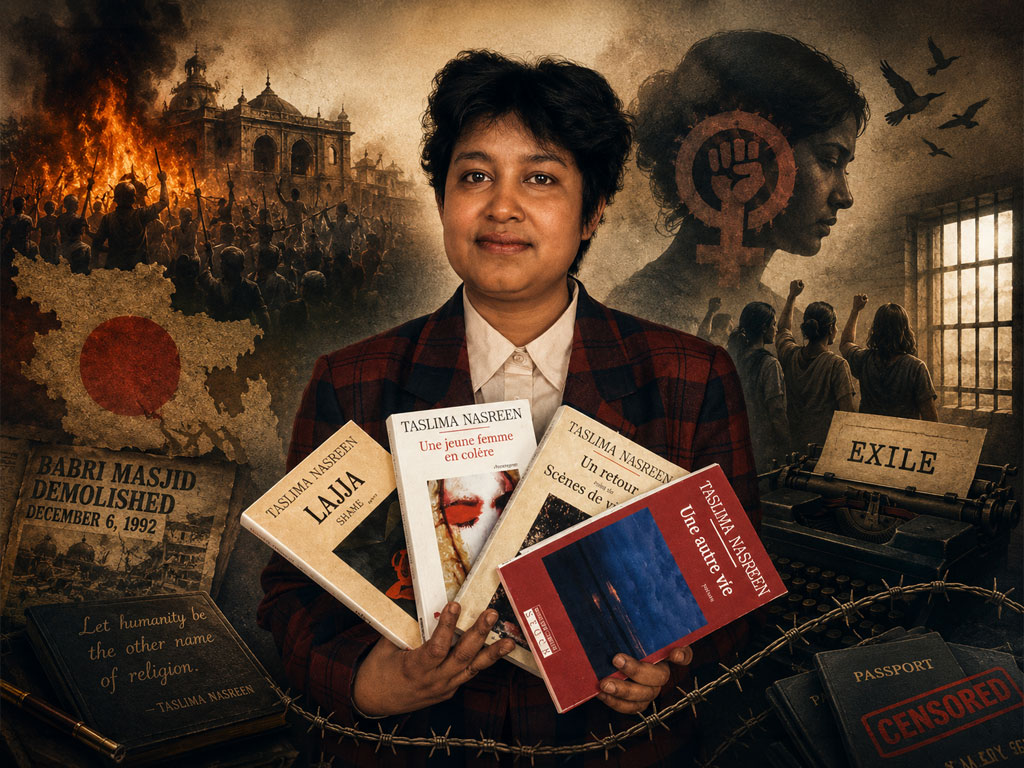
Taslima Nasrin Lajja confronts religious extremism, minority persecution, patriarchy and the collapse of secular humanism in South Asia.
Taslima Nasrin Lajja remains one of South Asia’s most provocative literary confrontations with religious fundamentalism, communal violence, patriarchy and the fragility of humanism.
Literature is not confined to aesthetic pleasure. At its most powerful, it challenges injustice, political hypocrisy and violations of human dignity. Bangladeshi writer Taslima Nasrin became one of the region’s most controversial literary voices precisely because she pursued that role despite threats to her freedom and safety.
Her 1993 novel Lajja, meaning Shame, rejects communal nationalism and religious extremism while examining what happens when an individual’s identity becomes more important to society than their humanity.
The novel combines fiction with documentary material to follow a Hindu family caught in the aftermath of communal violence in Bangladesh. Through that family, Nasrin examines nationalism, minority insecurity, patriarchy, alienation and the consequences of allowing religion to overpower citizenship.
Get Breaking News First
on WhatsApp

Taslima Nasrin Lajja and Her Feminist Struggle
Nasrin was born on August 25, 1962, in Mymensingh, then part of East Pakistan and now Bangladesh. She trained as a doctor before becoming internationally known as a writer, secular humanist and women’s-rights advocate. The European Parliament records that she practised medicine in Bangladesh before focusing on writing after being forced into exile.
Her writing repeatedly challenged patriarchal customs, religious authority and discrimination against women.
Nasrin began publishing poetry while young and later became widely known for newspaper columns and essays. By the early 1990s, her increasingly outspoken criticism of religious fundamentalism and gender inequality had made her both influential and deeply controversial.
Her medical work also exposed her to the consequences of violence against women. Those experiences helped shape a literary outlook centred on bodily autonomy, equality and resistance to patriarchal control.
In Lajja, those concerns expand beyond gender. The novel asks what becomes of citizenship when religious identity determines who belongs, who receives protection and who becomes vulnerable.
That question would soon make the book politically explosive.
Babri Masjid Violence and Seven Days of Writing
The immediate backdrop was the demolition of the Babri Masjid in Ayodhya, India, on December 6, 1992.
Communal violence followed in parts of Bangladesh, including attacks against members of the Hindu minority and their property. Nasrin later wrote that the persecution following the demolition drove her to produce Lajja. She said she completed the book in only seven days.
Her central message appears immediately in the work: “Let humanity be the other name of religion.”
That sentence captures the novel’s moral argument.
Nasrin saw collective punishment of Bangladeshi Hindus for an event in another country as a national disgrace. Rather than treating communal violence as an isolated riot, she presented it as evidence of a deeper failure of secular citizenship.
She also used newspaper reports and documented incidents throughout the narrative. The result is partly fictional and partly documentary, intentionally blurring the boundary between the suffering of one family and the historical experience surrounding it.
Religion, the State and Minority Insecurity
One of Lajja’s strongest political themes is the vulnerability created when religious nationalism penetrates state institutions.
The historical legal background needs precision. The Enemy Property framework did not originate with the 1947 Partition, as sometimes claimed. It developed under Pakistan’s emergency legislation following the 1965 India-Pakistan war. After Bangladesh’s independence, related provisions continued under what became known as the Vested Property regime. Critics have long argued that these laws disproportionately harmed Hindu property owners.
Bangladesh’s constitutional history also reflects its contested relationship with secularism.
The original 1972 Constitution adopted secularism as a fundamental principle. Constitutional changes during the military period later removed secularism and introduced Islamic language into the constitutional framework. Islam was subsequently declared the state religion in 1988. Secularism has since returned to the constitutional text while the state-religion provision remains, producing an unusual constitutional coexistence.
Demographic change forms another layer of the novel’s political context.
Hindus represented roughly 22% of the population of what was then East Pakistan in the 1951 census. By Bangladesh’s 2011 census, their share stood at about 8.5%. However, attributing that entire decline to a single law would oversimplify a complex history involving migration, communal insecurity, fertility differences, political upheaval and property dispossession.
The Datta Family and the Psychology of Alienation
Nasrin constructs the novel around the Datta family: Sudhamoy, Kiranmoyi, their son Suranjan and daughter Maya.
Their experiences transform an enormous political crisis into an intimate psychological one.
Sudhamoy is a doctor, secularist and committed Bangladeshi patriot. He believes citizenship should transcend religion. His attachment to the country becomes increasingly painful as the social order around him begins defining him primarily as Hindu.
His tragedy lies in the collapse of that idealism.
Suranjan begins from a similarly secular position. Educated and politically conscious, he confronts discrimination, unemployment and growing alienation. As violence intensifies, the ideals he once defended become increasingly difficult to sustain.
The abduction of his sister Maya, not his niece as some summaries incorrectly state, becomes the devastating turning point.
His response illustrates one of the book’s bleakest ideas: persecution can transform even someone who rejects communal hatred into a person vulnerable to the same hatred.
Kiranmoyi and Maya reveal another dimension.
They experience insecurity not only as members of a religious minority but also as women within a patriarchal family and society. Maya repeatedly recognises danger before the men around her accept its seriousness.
From a feminist reading, this is crucial. Women become targets through overlapping structures of communal violence and male authority.
Their vulnerability therefore cannot be understood solely through religion.
Ban, Exile and International Recognition
Lajja was published in Bangladesh in February 1993. Nasrin later wrote that more than 60,000 copies sold before the government banned the book five months later, officially citing concerns over communal peace.
Fundamentalist opposition escalated.
A religious extremist organisation issued a fatwa and offered a reward for her death. Nasrin ultimately went into hiding and left Bangladesh in 1994. The European Parliament records that she escaped to Sweden after months of intense threats and demonstrations.
Nasrin later described Bangladesh’s independence as having been achieved at the cost of three million lives, not thirty million as sometimes mistakenly reproduced in secondary summaries. Her argument was that allowing religious extremism to dominate the country would betray the sacrifices associated with liberation.
Her work subsequently received major international recognition.
She won the Ananda Puraskar in 1992 and again in 2000. The European Parliament awarded her the Sakharov Prize for Freedom of Thought in 1994. UNESCO selected her for the Madanjeet Singh Prize for the Promotion of Tolerance and Non-Violence in 2004. She later received the Simone de Beauvoir Prize in 2008.
Lajja’s Continuing Relevance in Sri Lanka
Lajja eventually appeared in more than 20 languages, including Sinhala.
Its Sinhala publication history has helped bring Nasrin’s questions about nationalism, religion and minority rights into a Sri Lankan context.
A Sarasavi Publishers Sinhala edition has circulated locally, while a translation by Dimuthu Samudra Liyanage has been published by Subhavi Publishers. The latter remains listed by Sri Lankan booksellers.
For Sri Lankan readers, the parallels are difficult to ignore.
Sri Lanka has experienced its own devastating struggles involving ethnicity, nationalism, religion and competing understandings of belonging. That history gives Lajja a relevance extending far beyond Bangladesh.
The novel is ultimately not simply about Hindus and Muslims.
It is about what happens when a society stops seeing individuals as human beings first.
Nasrin transforms the Datta family’s suffering into a warning about the intellectual and moral collapse that can occur when nationalism becomes exclusionary and religion becomes an instrument of political division.
Her humanist argument remains the book’s most enduring challenge.
A society may have constitutions, elections, laws and national symbols. But when citizenship depends upon religious identity, those institutions alone cannot guarantee justice.
Lajja therefore survives not merely as a controversial novel from 1993, but as a political and literary warning for South Asia.
As long as communal nationalism, religious extremism and gender oppression remain capable of overriding human dignity, Taslima Nasrin’s central question will remain relevant: can humanity itself become the principle that comes before religion, ethnicity and power?