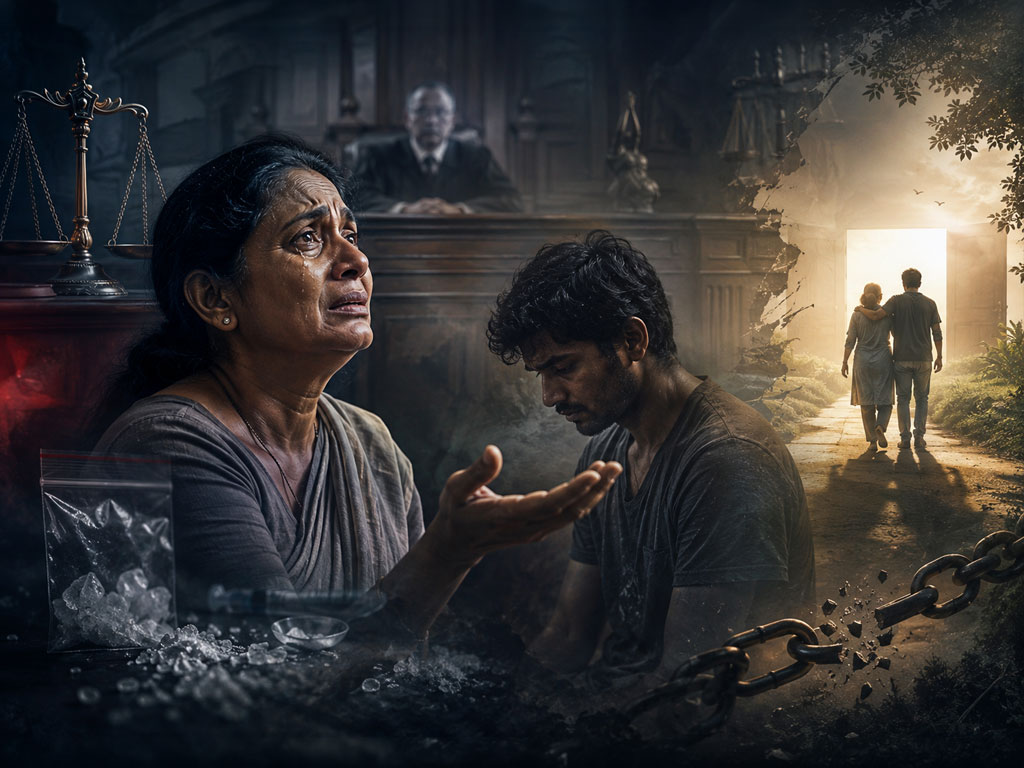
Drug rehabilitation Sri Lanka story showing a mother seeking treatment instead of imprisonment for her drug-addicted son.
A mother’s plea for drug rehabilitation Sri Lanka authorities could provide instead of another prison sentence reveals the hidden human cost behind the country’s growing narcotics crisis.
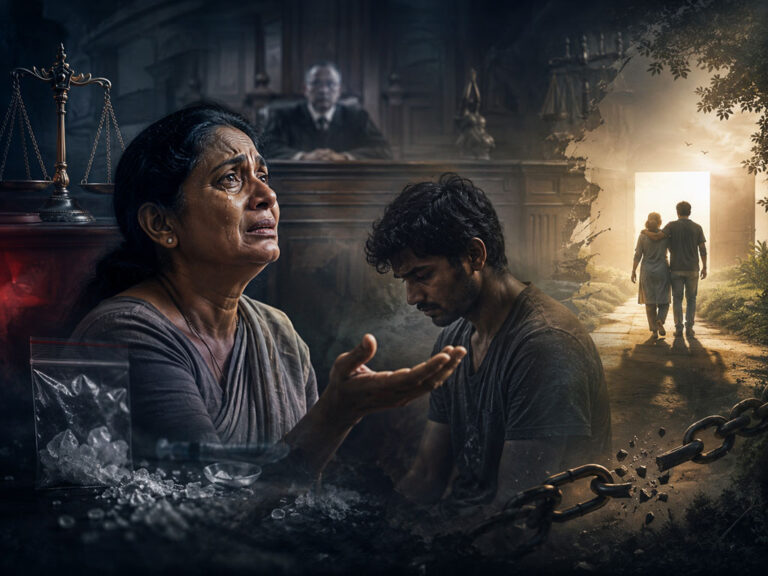
Drug addiction is destroying not only young lives but entire families. This emotional story draws from the experience of a mother who asked police and the court to help rehabilitate her 26-year-old son after his repeated addiction to Ice.
Her request carried a simple message: give her child a chance at treatment and life, rather than allowing addiction and punishment to consume him.
“Send my son to rehabilitation, not prison”
“Saving one child is not saving just one life — it is saving an entire family and a future society.”
PeliyaGoda Police arrested the 26-year-old youth following his continuing addiction to Ice. His mother then asked both police and the court to help place him in rehabilitation.
The account below draws on facts revealed during a conversation with the mother at the court premises.

All names and places are fictional, while some scenes have been edited for creative purposes.
A Family Living Under the Weight of Addiction
Scene 1
Home
(Night)
A loud knock at the door is heard.
Kasun:
“Mom! Open the door!”
(Kasun’s mother – Malani opens the door fearfully.)
Malani:
“Son… where did you go at this hour? Why are you like this?”
Kasun:
“I need money. Right now!”
Malani:
“Son, there’s no money today. I’ve done everything I could for you. We have no more…”
Kasun angrily slams the table.
Nearby, Sewwandi (Kasun’s sister) hugs her brother fearfully.
Sewwandi:
“Mom… why is big brother doing this again?”
Malani has no answer.
The father silently stares at the wall.
(Kasun’s younger brother)
Chamod:
“Mom… are we going to lose big brother?”
Hearing those words, tears roll down Malani’s eyes.
Scene 02
The Mother’s Decision
The next morning.
Malani and Sunil sit silently at home.
(Kasun’s father)
Sunil:
“I don’t understand Malani… how long are we going to endure this?”
Malani:
“Do you remember how Kasun used to hold our hand and go to school when he was little?”
Sunil falls silent.
Malani:
“Today he has become a pain to us. But… he is our son. We cannot abandon him.”
Sunil:
“Then what do we do?”
Malani wipes her tears and stands up.
Malani:
“If we can’t save him on our own… let’s ask the law for help.”
Sunil:
“The court?”
Malani:
“Yes. I will ask myself… to rehabilitate my son.”
A Mother Asks the Court for Treatment, Not Punishment
The Voice of a Mother’s Conscience Raised from the Court Dock…
(Court)
The courtroom is full.
PeliyaGoda Police is handling the case related to the incident.
Kasun sits in the accused seat.
Malani stands to give testimony.
Magistrate:
“What is it that you are requesting from this court?”
Malani is silent for a moment.
Her eyes turn towards Kasun.
Malani:
“Your Honour… I cannot ask for my son to be punished.”
The courtroom falls silent.
Malani:
“What I want… is to get my son back.”
Kasun lowers his head.
Malani:
“Drugs have taken away the happiness in my home. My children live in fear. My husband suffers. And I cry every day.”
She speaks through tears.
Malani:
“But Your Honour… I came here today not to abandon my son.”
“I came to save him.”
“I don’t want punishment… I want treatment. Rehabilitation. A chance for him to live again like a human being.”
The mother’s words capture the central argument behind drug rehabilitation Sri Lanka continues to confront: whether repeated punishment alone can break addiction when families are asking for treatment.
The Son’s Voice
Kasun can no longer remain silent.
Kasun:
“Mom…”
Malani looks at him.
Kasun:
“I thought you brought me to court against me.”
Malani smiles through tears.
Malani:
“No son… I came to court for you.”
Kasun:
“I’ve lost myself, Mom…”
Malani:
“That’s why son, we are asking for help to find you again.”
Kasun lowers his head, crying.
Kasun:
“Help me, Mom…”
Malani reaches out her hand.
Malani:
“Mom is here, son.”
Rehabilitation Offers the Family Another Chance
Scene 05 – Court Verdict
The Magistrate announces the verdict.
Magistrate:
“This is not just one person’s problem. Drug addiction does not only affect him. His family, his children, and ultimately society also suffer.”
“What this young man needs is not to escape responsibility, but an opportunity to rebuild his life.”
“Accordingly, under the relevant legal provisions, I order that he be referred to a rehabilitation process.”
Kasun looks at his mother.
Malani folds her hands in gratitude.
Scene 06 – Final
Months later.
Kasun returns home after completing the rehabilitation process.
At the door, his younger sister and brother are waiting.
Chamod:
“Big brother!”
He runs and hugs Kasun.
Sewwandi also comes closer, smiling.
Malani watches silently.
Kasun goes to his mother and touches her feet.
Kasun:
“Mom… thank you for not abandoning me that day in court.”
Malani strokes his head.
Malani:
“When a child makes mistakes, a mother’s love doesn’t end, son. Sometimes… love is not just crying and watching.”
“It’s making the right decision when needed.”
The camera focuses on all the family members.
Kasun:
“Drugs took me away from myself. But my family gave me back to myself.”
Final Message
“A child addicted to drugs needs not just punishment, but treatment.
Silently allowing his mistake is not love.
True love is providing the right help at the right time.”
All names and places here are fictional, and some scenes have been edited for creative purposes.
Sri Lanka’s Ice and Heroin Problem Goes Beyond One Family
Drug dependence can develop through several pressures, including peer influence, family problems, economic and social hardship, mental stress, easy access to narcotics and the influence of drug traffickers.
Young people becoming addicted is therefore not only a family problem. The effects can spread into communities and wider society.
Sri Lankan authorities continue to report raids involving heroin, crystal methamphetamine, cannabis, cocaine and other narcotics.
Police records cited in the original report state that authorities seized more than 3kg of Ice and heroin in Kotahena in June 2026.
The government and police are also implementing the “Ratama Ekata” national operation. Its stated measures include reducing drug supply and demand, arresting traffickers, rehabilitating people with drug dependence and increasing public awareness.
Drug Cases Before the Courts
Authorities produce people accused of possession, transportation, sale and trafficking before Magistrate’s Courts and High Courts, depending on the case.
Courts can also authorise detention and questioning when investigations require it.
After cases conclude, authorities destroy narcotics held as court exhibits under judicial supervision.
In March 2026, authorities destroyed a large quantity of heroin, ketamine, cocaine and drug pills linked to concluded cases. Exhibits relating to nearly 1,500 cases from the Government Analyst’s Department were also included, according to the material provided.
Drug Rehabilitation Sri Lanka Needs Alongside Enforcement
Law enforcement and court action alone cannot resolve the drug problem.
Families, schools, religious and social institutions, healthcare providers and rehabilitation services all have roles to play.
The National Dangerous Drugs Control Board also conducts treatment and rehabilitation programmes for people affected by drug dependence. It has published statistical information relating to arrests and treatment for 2025 and 2026, according to the original report.
Any report concerning a specific court case requires separate verification of the case number, court and charges.
An arrest does not establish guilt. Anyone accused of an offence remains entitled to the presumption of innocence unless and until a court determines otherwise.
The distinction is important because addiction, possession and trafficking can involve very different circumstances and legal consequences.
The Cycle of Arrest, Bail and Returning to Drugs
The wider challenge becomes even clearer in information attributed to the Operations Division of PeliyaGoda Police.
Police Constable Tharindu Madushan said officers arrest between 20 and 25 suspects each day in connection with drug addiction and produce them before court.
He also said authorities refer more than 300 people every month to court on allegations involving drug possession and trafficking.
According to the officer, some suspects pay fines or obtain bail but later return to drug use, creating a continuing cycle of arrest, release and relapse.
He further stated that rehabilitation itself does not always end the problem.
Some people who enter rehabilitation through a court order or with parental consent return to the same environment after completing treatment. According to the officer, some then resume drug use.
That raises a difficult question for Sri Lanka.
Rehabilitation can provide treatment and an opportunity to rebuild a life, but recovery may become harder when the individual returns to the same social pressures, relationships and access to drugs that contributed to the addiction.
Police enforcement therefore remains necessary, particularly against trafficking and distribution. However, the original account argues that government responsibility extends beyond arrests.
The challenge is also to strengthen prevention, rehabilitation and the conditions that allow recovering users to remain free from drugs once they return home.
The mother at the centre of this story did not ask the court to erase her son’s responsibility.
She asked for a chance to recover him.
That distinction may capture the larger challenge facing drug rehabilitation Sri Lanka needs today. Punishment can address an offence, but addiction can demand treatment, sustained support and a family and society prepared to help prevent the next relapse.
Saving one young person from addiction may therefore mean more than rescuing an individual.
It may also mean saving a frightened family from continuing to live inside the same cycle.
SOURCE:- THE LEADER