By Marlon Dale Ferreira
Sri Lanka’s decision to invite international aviation experts to identify weaknesses before its forthcoming ICAO safety oversight audit represents precisely the kind of proactive governance the country’s aviation sector has needed for years.
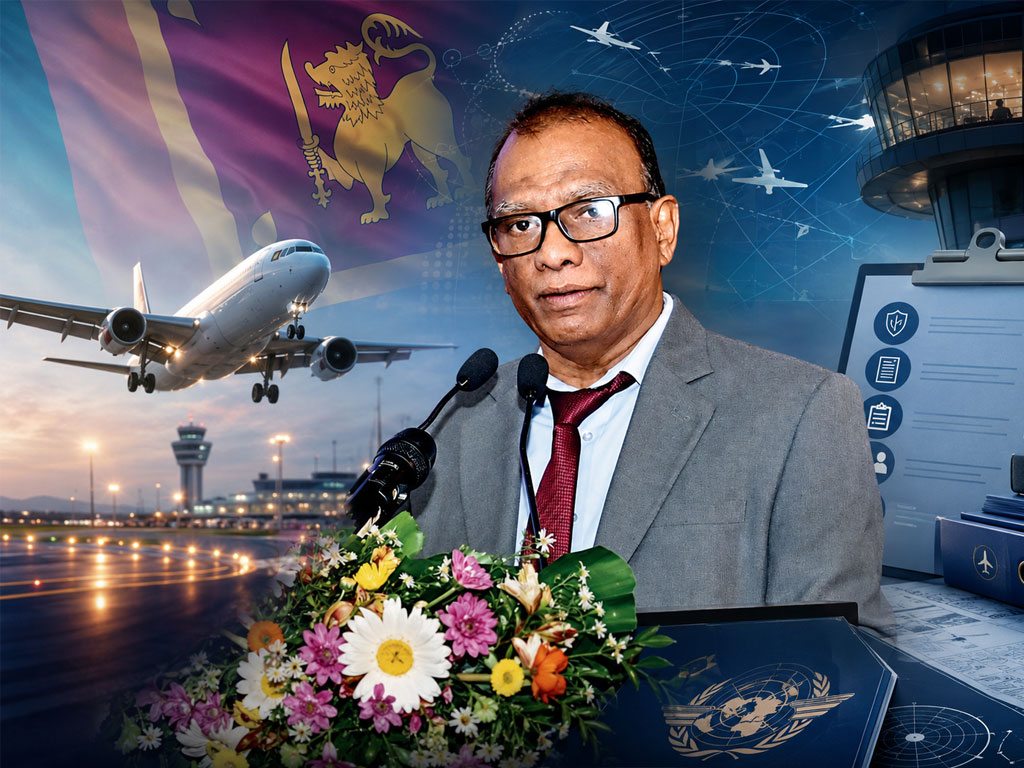
Minister of Ports and Civil Aviation Anura Karunathilake and his Ministry deserve recognition for taking the initiative to bring an International Civil Aviation Organization Combined Action Team to Sri Lanka rather than waiting for weaknesses in the country’s aviation safety oversight system to be exposed during a formal international audit.
The ICAO Combined Action Team Technical Assistance Mission, conducted at the Civil Aviation Authority of Sri Lanka from August 5 to 12, brought eight ICAO technical experts together with CAASL officials to examine regulatory frameworks, procedures, surveillance capabilities, technical competencies and documentation systems.
Most importantly, the Government itself requested the assistance.
That distinction matters.
This was not an ICAO audit, nor should it be portrayed as one. It produced no formal audit rating, no Effective Implementation score and no determination that Sri Lanka had either passed or failed an ICAO assessment.
Instead, it did something arguably more valuable at this stage: it provided Sri Lanka with an opportunity to discover weaknesses before the real examination takes place.

Finding Gaps Was the Objective, Not a Failure
An official from the Ministry of Aviation speaking to The Morning Telegraph said, quote – “Some commentary surrounding the mission has attempted to portray the identification of deficiencies or areas requiring improvement as evidence that CAASL somehow “failed” an ICAO assessment.
That interpretation fundamentally misunderstands why the team was invited.
The purpose was to identify gaps.
If ICAO specialists completed an intensive technical review and returned with areas requiring attention, that should not be regarded as an embarrassment. It means the exercise worked.
A Government serious about aviation safety does not attempt to conceal weaknesses. It finds them, measures them and fixes them before those weaknesses become formal international findings.
In practical terms, while this mission cannot technically be called an ICAO pre-audit, it served an important preparatory and diagnostic function ahead of Sri Lanka’s forthcoming USOAP-CMA safety oversight audit.
That is precisely why the initiative taken by Minister Karunathilake and his team deserves acknowledgement.” – unquote
Sri Lanka’s previous comprehensive ICAO safety oversight audit took place in June 2018. Since then, international civil aviation has changed considerably.
New standards have emerged. Technologies have evolved. Regulatory expectations have developed. Surveillance systems have become more sophisticated, while ICAO requirements and global safety oversight practices have continued to move forward.
Any weaknesses accumulated during those intervening years cannot simply be wished away.
The responsibility of the present administration is to identify what exists today and ensure that those deficiencies are corrected before Sri Lanka faces its next international assessment.
That appears to be exactly what is now being attempted.
Inviting Scrutiny Takes Confidence
There is also an important governance principle involved.
It is easy for an administration to claim that everything is functioning well.
It is far more meaningful to invite qualified international professionals into the system and ask them to identify what is not.
Minister Karunathilake’s decision to support such an exercise therefore demonstrates confidence rather than weakness.
The CAT mission was also significant because it was the first time Sri Lanka had received this particular form of assistance from the ICAO Asia and Pacific Office.
Rather than approaching the forthcoming audit reactively, the Ministry has effectively created an opportunity for CAASL to work through its shortcomings while there is still time to address them.
The mission concluded on August 12 with a debriefing at which the ICAO technical team presented the outcomes of its discussions and reviews, identified areas requiring further improvement and recommended follow-up action.
The real test now begins.
Every significant gap identified through this process should be converted into an action item, given a responsible officer or institution, assigned a deadline and followed through until closure.
That process should involve not only CAASL but the Ministry, SriLankan Airlines, Airport and Aviation Services (Sri Lanka) (Private) Limited and every institution whose responsibilities intersect with Sri Lanka’s aviation safety oversight framework.
Leadership Change Sends Another Signal
The Government’s willingness to make changes at the top of CAASL also adds another dimension to the restructuring taking place within the sector.
Sunil Jayaratne, who became Chairman of CAASL in November 2024, has now been replaced, with retired Colonel Ranjith Rajasinghe appointed as the Authority’s new Chairman.
Changing leadership at such a sensitive stage, as the country prepares itself for increased international scrutiny, is not an insignificant decision.
Leadership positions in aviation cannot simply be ceremonial appointments.
Sri Lanka’s civil aviation system operates within an intensely regulated international environment. ICAO compliance, State safety oversight, legislation, surveillance, personnel licensing, aircraft operations, airworthiness, aerodromes, air navigation and accident investigation all form part of a much larger system in which weaknesses in one area can affect the country’s overall standing.
A new Chairman therefore inherits a serious responsibility.
Rajasinghe must now help ensure that the momentum created through the CAT mission is translated into measurable improvements rather than allowing its recommendations to become another collection of reports sitting inside government offices.
The Minister Should Be Judged on What Happens Next
Credit should therefore be given where it is due.
Minister Anura Karunathilake and the present administration did not have to request this level of external technical scrutiny before the forthcoming ICAO audit.
They chose to do so.
They invited specialists to look beneath the surface, identify vulnerabilities and tell Sri Lanka what needs correcting.
Discovering several gaps through such an exercise is therefore not evidence that the exercise failed.
It is evidence of why the exercise was necessary.
Some of those weaknesses may have developed over years as international standards changed and institutional shortcomings accumulated. What matters now is whether the present Government has the determination to correct them.
The early signs demonstrate a willingness to confront the problem rather than postpone it.
Bringing in ICAO expertise, identifying weaknesses before they become formal audit findings, strengthening CAASL’s preparedness and introducing new leadership at the Authority constitute a significant series of interventions.
That proactive stance deserves applause.
But the greatest endorsement of the Minister’s strategy will come later.
If the recommendations identified during the CAT mission are systematically addressed, the regulatory gaps closed, technical capacity strengthened and Sri Lanka enters its forthcoming ICAO USOAP-CMA audit considerably better prepared than it would otherwise have been, this mission may ultimately prove to have been one of the most important aviation safety decisions taken by the present Government.
The Minister and his team have done the right thing by asking the difficult questions before ICAO arrives to ask them formally.
Now they must ensure that every answer is ready.