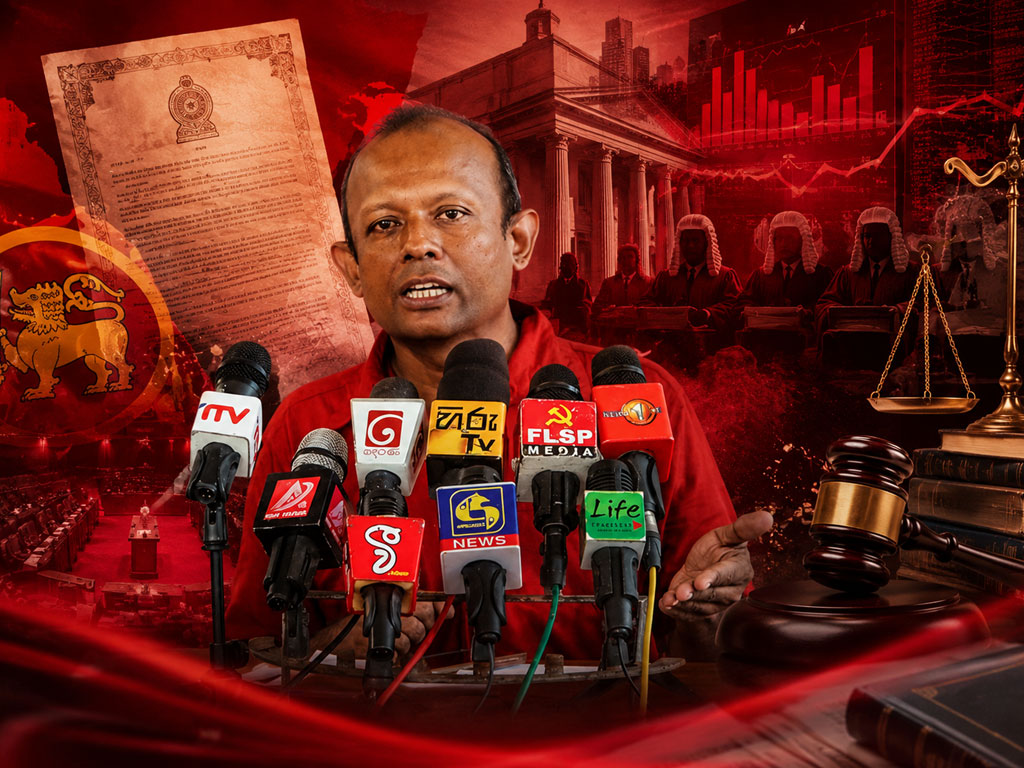
22nd Amendment Sri Lanka debate intensifies as the FSP questions whether extending judges’ retirement age is linked to coming economic reforms.
The 22nd Amendment Sri Lanka proposal to extend the retirement age of Supreme Court and Court of Appeal judges has triggered fresh political and legal debate over its wider purpose.
The Government argues that the proposed constitutional change could help reduce case delays, retain the expertise of senior judges and strengthen the country’s anti-corruption process.
However, opposition activists claim the proposal may go beyond judicial reform. They allege it could help the Government manage legal challenges and public opposition arising from future socio-economic reforms.
The Frontline Socialist Party has emerged as one of the strongest critics of the proposal.

22nd Amendment Sri Lanka Debate Focuses on Court Backlog
Speaking at a seminar held at Wijerama Mawatha in Colombo, Frontline Socialist Party Education Secretary Pubudu Jayagoda questioned whether extending the retirement age of superior court judges would meaningfully reduce delays.
He argued that most pending cases remain concentrated in lower courts rather than the Supreme Court or Court of Appeal.
“Fraud, corruption, and the majority of cases are heard in Magistrate’s Courts, District Courts, and High Courts,” Jayagoda said.
“Approximately 99% of the backlog in the judicial system exists in these primary courts. If the aim is to prevent case delays, capacity should be developed in those courts, not in the Supreme Court or the Court of Appeal,” he added.
Jayagoda also questioned why the Government had chosen a constitutional amendment to address the issue.
According to him, several measures aimed at reducing judicial delays could instead be achieved through changes to ordinary legislation.
He cited the Judicial Service Commission Act as one example of a legal framework that could potentially be amended without changing the Constitution.
FSP Links Proposal to Wider Economic Reforms
Jayagoda’s broader allegation is that the proposed amendment could be connected to a series of economic and administrative reforms expected in the future.
He claimed those reforms could trigger public protests, trade union action and fundamental rights cases.
According to him, the Government’s policy agenda includes changes to labour laws and possible private sector participation in the management of the Employees’ Provident Fund.
He also referred to proposals involving agricultural companies and the restructuring of the Paddy Marketing Board.
Other changes cited by Jayagoda include new fisheries laws that could allow commercial companies to lease marine areas.
He also pointed to proposed accreditation commissions within the higher education sector.
Critics have additionally raised concerns about school restructuring, changes involving hospital laboratory services and the restructuring of state-owned enterprises.
The drafting of new security legislation, referred to as the PSTA, has also entered the debate.
According to critics, such reforms could lead individuals and trade unions to seek relief through fundamental rights petitions and other court action.
They therefore allege that the 22nd Amendment Sri Lanka proposal could form part of a broader effort to prepare for possible legal challenges.
These claims remain political allegations and have not been established as fact.
Government Says Judicial Efficiency Supports Economic Stability
Government policymakers, however, present a different argument.
They maintain that a more efficient judicial system remains essential for strengthening economic stability, transparency and confidence in public institutions.
The Government also argues that Sri Lanka benefits from retaining experienced senior judges when dealing with complex constitutional and commercial matters.
According to this position, continuity at the highest levels of the judiciary could help courts manage difficult cases more effectively.
Government supporters also point to the importance that international financial institutions and investors place on the rule of law.
An efficient judicial process is often viewed as an important part of creating a predictable environment for economic activity and investment.
From that perspective, extending the service of experienced judges could contribute positively to the country’s economic recovery and institutional reform programme.
Political and Legal Debate Set to Continue
The controversy is therefore likely to intensify as the proposed amendment moves further into the political process.
Supporters see the proposal as a mechanism to retain judicial experience and strengthen the efficiency of superior courts.
Critics, meanwhile, suspect that its timing could be connected to the Government’s wider economic programme and the possibility of future legal challenges.
The central question is whether the amendment represents a genuine attempt to improve judicial efficiency or a strategic measure designed to reduce obstacles arising from controversial reforms.
That issue is unlikely to be settled immediately.
Instead, the debate over the proposed retirement age changes, judicial independence and the Government’s economic agenda is expected to continue through Parliament and wider public discussion.
Ultimately, the political and legal scrutiny surrounding the 22nd Amendment will determine whether the proposal is viewed as institutional reform or as a measure carrying consequences far beyond the judiciary.