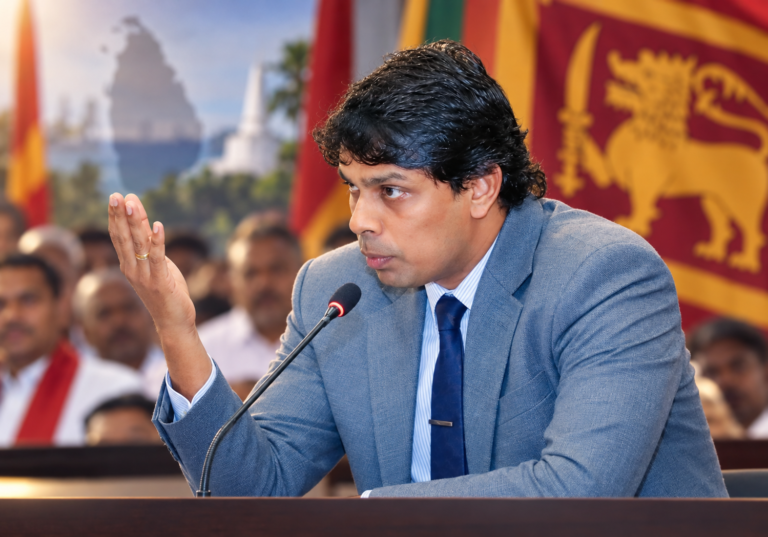
Lakvijaya coal loss estimates are disputed by Energy Minister Anura Karunathilaka, who says National System Operator figures are more accurate.
Energy Minister Anura Karunathilaka has disputed the Rs. 10 billion Lakvijaya coal loss estimate cited by the Opposition and the Public Utilities Commission of Sri Lanka.
The Minister acknowledged that losses had occurred because of substandard coal used at the Lakvijaya Power Plant. However, he maintained that the actual figure was lower.
Speaking to The Daily Morning, Karunathilaka said only the National System Operator, or NSO, could accurately calculate the financial impact.
The NSO, he said, could determine how much electricity generation dropped because of the problematic coal and identify how authorities replaced that lost power.

Lakvijaya Coal Loss Must Be Calculated by NSO
“They are the ones who know where the reduced megawatts caused by the use of the problematic coal were obtained from,” Karunathilaka said.
“They know whether it was diesel, naphtha or hydropower.”
The Minister said the NSO had calculated the loss caused by the coal problem up to July.
He argued that this remained the most accurate assessment because only the NSO could establish exactly how the electricity shortfall had been covered.
“A loss has occurred due to the use of substandard coal. But the figure is not the figure mentioned by the Opposition or by the PUCSL,” he said.
“They have extrapolated data given by the NSO and made calculations up to September. That is not scientific.”
Karunathilaka also said the Government had already taken steps to recover money from the relevant coal supplier.
According to him, authorities had encashed the supplier’s performance guarantee, valued at approximately US$ 14.5 million.
“We have already encashed the performance guarantee of the relevant company. It is about 14.5 million US Dollars,” he said.
“Therefore, we have already recovered more than Rs 7 billion from the company. Steps are also being taken to recover the penalties applicable to each shipment.”
Opposition Cites Rs. 10 Billion Loss
The Minister’s comments followed allegations made in Parliament by Opposition MP S.M. Marikkar.
Marikkar claimed that importing substandard coal had caused losses exceeding Rs. 10 billion.
He cited third-party testing conducted by Bureau Veritas International Trade Australia Ltd.
According to Marikkar, none of the 19 coal consignments tested met the required calorific value of 5,900 kcal/kg.
He also referred to PUCSL figures which claimed that lower electricity generation caused additional expenditure of Rs. 8.536 billion.
That amount was reportedly spent on diesel and furnace oil between January and June to compensate for reduced generation.
The PUCSL had also raised concerns over coal supplied to the Lakvijaya Power Plant in a report issued in March 2026.
PUCSL Report Flags Generation and Emission Concerns
In its observations, the PUCSL said recently imported coal had reduced generation capacity at the plant.
The regulator also identified higher coal consumption, increased emissions and several operational concerns.
According to the report seen by The Daily Morning, Lakvijaya had not operated at full capacity while burning coal from nine shipments supplied by the current supplier.
Under the previous supplier, each generating unit had recorded an average gross generation capacity of 300 MW.
The dispute now centres on how the overall financial loss should be calculated.
While the Opposition and PUCSL have pointed to replacement-generation costs and coal quality data, Karunathilaka maintains that the NSO’s calculations provide the most accurate picture.
The Government also says it has already recovered more than Rs. 7 billion through the supplier’s performance guarantee and is pursuing further penalties.