By Roy Denish.
Gnanasara Thero pardon voided by Supreme Court as prison authorities search for the BBS leader to serve the remainder of his sentence.
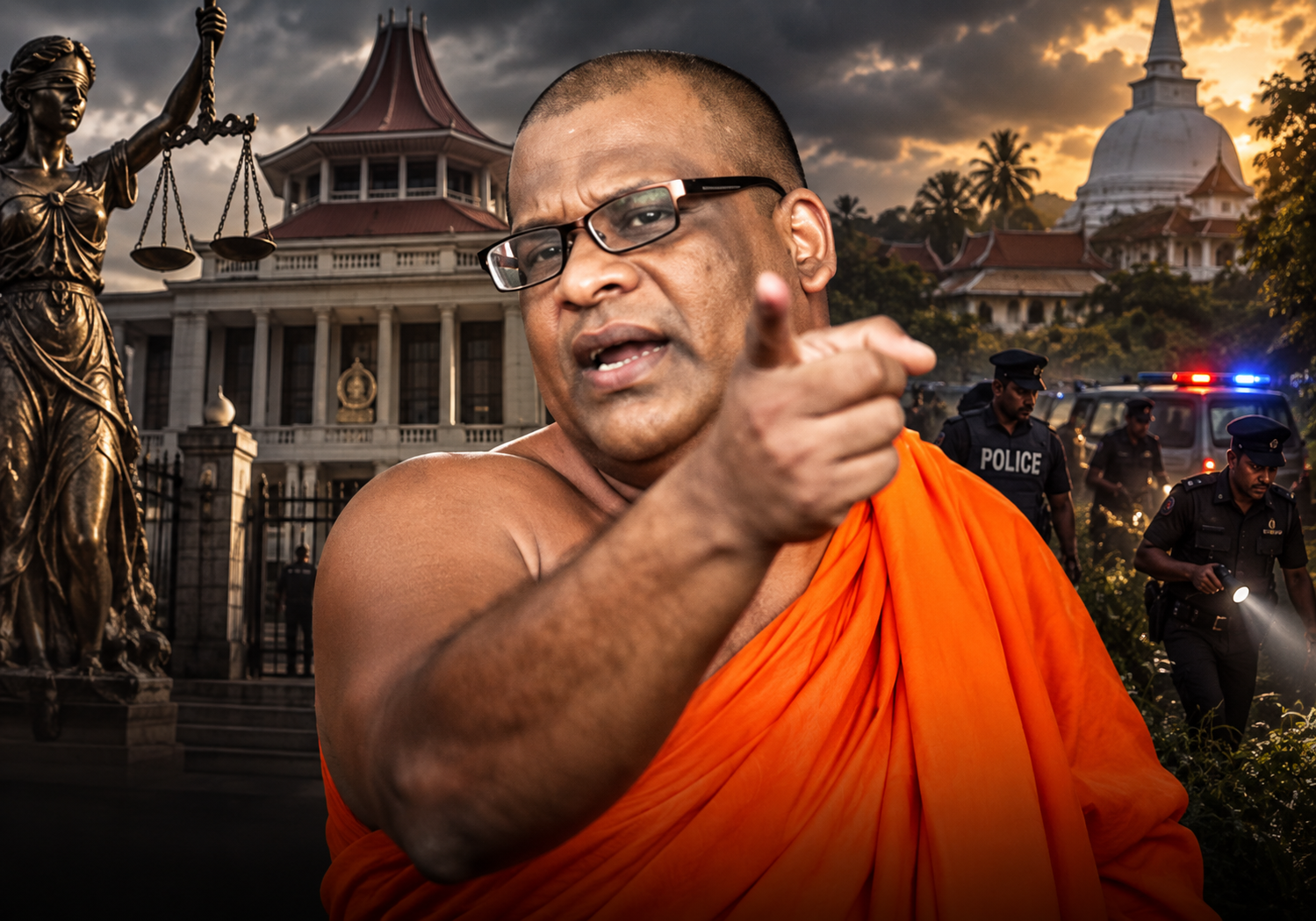
COLOMBO: The Gnanasara Thero pardon has been struck down by the Supreme Court, triggering a search for the Bodu Bala Sena (BBS) General Secretary after prison officials failed to locate him at his temple in Nawala, Rajagiriya.
The three-member Supreme Court bench ruled that the May 2019 presidential pardon granted by then-President Maithripala Sirisena was arbitrary and invalid in law. The court found that the former President had failed to properly exercise the constitutional power entrusted to his office.
Gnanasara Thero was sentenced in August 2018 to six years of rigorous imprisonment for contempt of court. The conviction followed his aggressive conduct inside court, including threats directed at Sandhya Eknaligoda, wife of disappeared journalist Prageeth Eknaligoda.
He served roughly nine months before Sirisena granted him presidential clemency in May 2019. Following the latest ruling, he now faces returning to prison to serve the remainder of that sentence. When prison officials visited his Rajagiriya temple, resident monks reportedly said they did not know his whereabouts.

Gnanasara Thero Pardon Reshapes Executive Accountability
The ruling carries implications far beyond one prisoner. Article 34 of Sri Lanka’s Constitution gives the President broad powers to grant pardons. Presidential clemency has often been viewed as an area of wide executive discretion.
However, the Supreme Court has now reinforced that such power remains subject to constitutional standards. A pardon cannot operate as an unchecked political favour when authorities disregard proper procedure, public trust or the rule of law.
The decision therefore strengthens judicial oversight of executive clemency. It also sends a warning that presidential mercy cannot automatically shield political allies or override the authority of the courts.
The pressure surrounding Gnanasara also comes shortly after the early September 2026 arrest of Batticaloa monk Ampitiye Sumanaratne Thero. Police arrested him over an alleged obstruction involving Geological Survey and Mines Bureau officers. Taken together, the two cases signal a more assertive application of the law to politically prominent clergy.
A Long History of Communal Controversy
Gnanasara rose to national prominence through the BBS from around 2012. The organisation campaigned aggressively on issues including halal certification, Islamic attire and minority religious sites.
Critics and human rights groups have long accused his rhetoric of fuelling anti-Muslim hostility. His name also became closely associated with the climate of communal tension surrounding the 2014 Aluthgama riots. Despite repeated police complaints, hate-speech investigations and his eventual contempt conviction, he retained significant political visibility.
For President Anura Kumara Dissanayake’s National People’s Power administration, the Supreme Court decision presents both an institutional opportunity and a political test.
The ruling fits the government’s stated emphasis on institutional reform, equal application of the law and dismantling political patronage. However, any enforcement action against influential Buddhist clergy could provoke resistance from hardline nationalist groups and sections of the monastic establishment.
As authorities search for Gnanasara Thero, the larger issue now extends beyond one controversial monk. Sri Lanka must show whether its strengthened legal standard can withstand political pressure and whether religious status or political connections can still place individuals beyond the reach of the penal system.