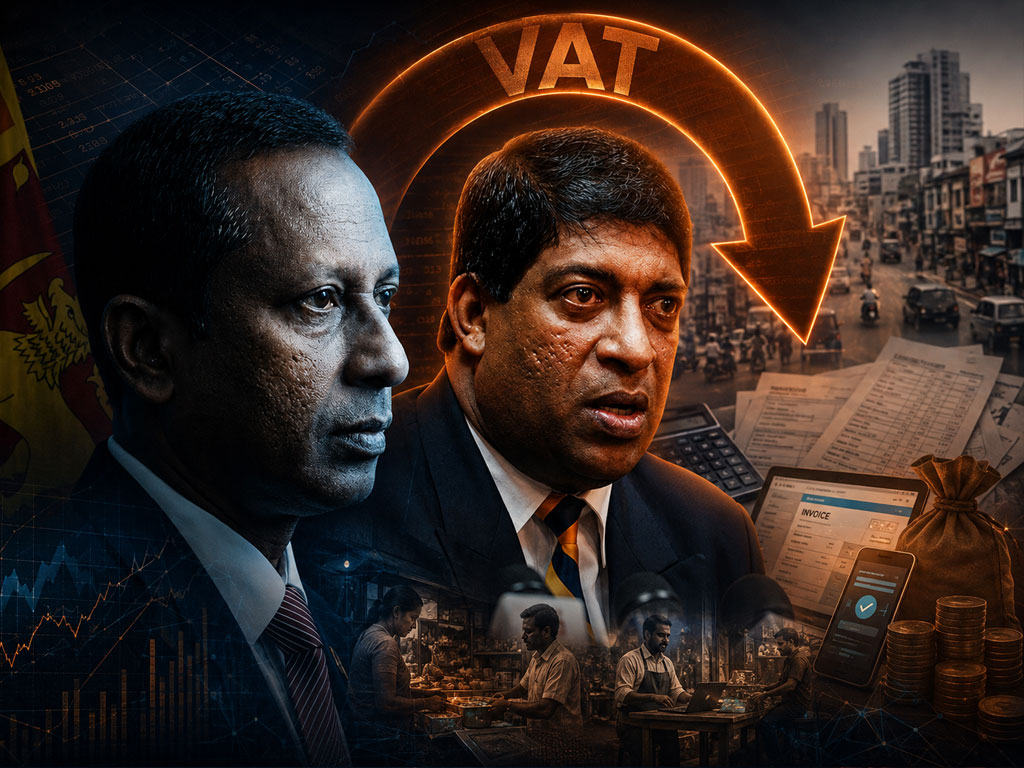
Sri Lanka VAT threshold remains at Rs. 60 million as the Government balances MSME relief, IMF revenue targets and new digital tax measures.
The Sri Lanka VAT threshold will remain at an annual turnover of Rs. 60 million, with the Government deciding against an earlier proposal to reduce it to Rs. 36 million.
The decision has renewed debate over how Sri Lanka can meet state revenue targets while expanding its domestic tax base under the economic recovery programme.
Deputy Minister Nishantha Jayawcera told the Committee on Public Finance, or COPF, that the Government had not decided to lower the VAT registration threshold at this stage.
He was responding to a question from former Finance Minister Ravi Karunanayake on whether the proposal, withdrawn in June, would be brought back.
The Deputy Minister confirmed in Parliament that no such decision had been taken.

Sri Lanka VAT Threshold Gives Relief to MSMEs
Keeping the threshold at Rs. 60 million provides administrative and financial relief to thousands of Micro, Small and Medium Enterprises.
Industry representatives argue that the decision protects smaller businesses from additional VAT compliance costs.
It could also reduce pressure on businesses already dealing with higher commodity prices during Sri Lanka’s economic recovery.
However, maintaining the present threshold creates another challenge for the Government.
Revenue collection will continue to depend heavily on the approximately 36,656 taxpayers already registered under the VAT system.
Estimates suggest that lowering the threshold to Rs. 36 million would have brought nearly 10,000 additional MSMEs into the VAT net.
That creates a difficult policy question as Sri Lanka works towards revenue targets associated with its International Monetary Fund programme.
Policymakers must determine whether the existing taxpayer base can carry the required revenue burden without a broader expansion of the VAT system.
Government Turns to Digital Taxes and VAT Reforms
While keeping the Sri Lanka VAT threshold unchanged, the Government has introduced other measures aimed at improving tax collection and reducing revenue leakages.
One major change involves cross-border digital services.
An 18% VAT has been imposed on non-resident digital service providers supplying services to consumers in Sri Lanka.
The Government has also changed the tax structure affecting financial services.
The 2.5% Social Security Contribution Levy on financial services has been removed.
At the same time, the VAT rate applicable to financial services has been revised to 20.5%.
Another major reform involves the Simplified Value Added Tax system.
The Government has taken steps to abolish the SVAT mechanism and replace it with a refund system based on risk assessment.
The objective is to improve efficiency while addressing weaknesses that could contribute to revenue losses.
Electronic VAT Invoicing Begins October 01
The next major step will be the introduction of mandatory Electronic VAT Invoicing from October 01.
The system is intended to strengthen the Inland Revenue Department’s ability to monitor transactions and reduce tax leakages.
The Government also expects electronic invoicing to improve transparency by creating a clearer digital record of taxable transactions.
The policy direction therefore combines protection for smaller businesses with tighter enforcement and greater digital monitoring.
However, the underlying fiscal challenge remains unresolved.
Sri Lanka must continue meeting revenue targets while avoiding excessive pressure on the businesses and taxpayers already inside the system.
The long-term question is whether fiscal stability can be maintained without expanding the domestic VAT net.
How the Government distributes the burden of economic recovery across different sections of society will therefore remain a key issue in the months ahead.
SOURCE:- LANKA NEWS