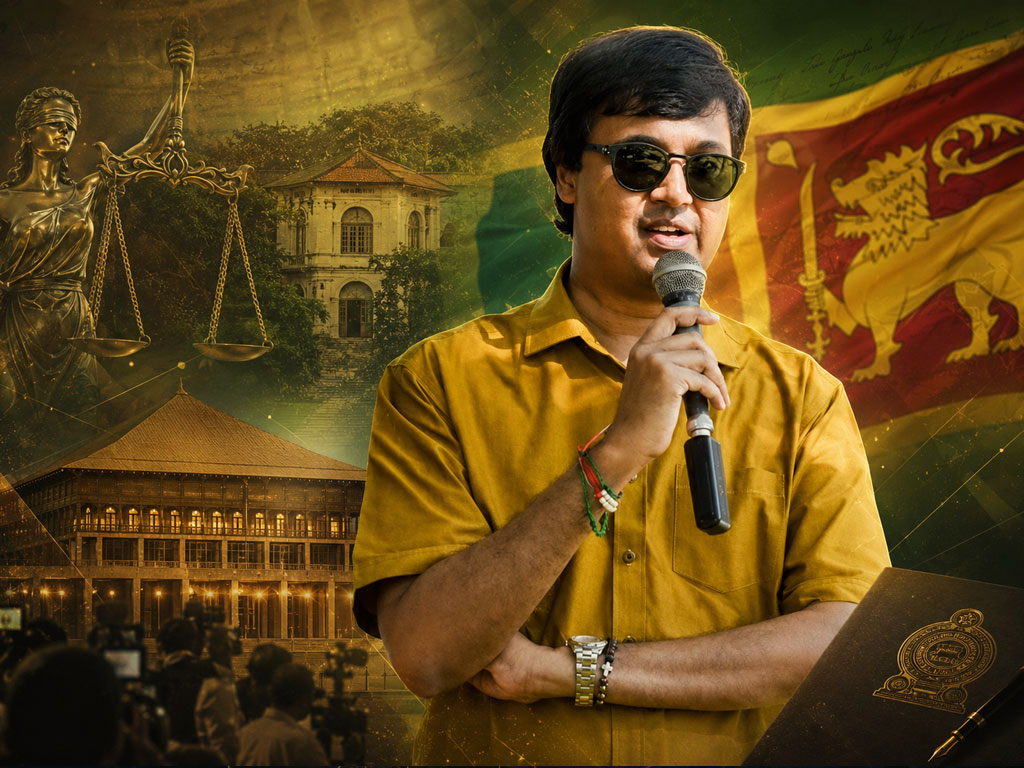
Amarasuriya political legacy returns to focus as Harini and Rajiv emerge at the centre of Sri Lanka’s latest constitutional and political debate.
The Amarasuriya political legacy has returned to the centre of Sri Lanka’s political conversation, decades after the family first shaped national politics through the UNP, the SLFP and the country’s early parliamentary institutions.
Today, that legacy is being carried in very different ways by Prime Minister Harini Amarasuriya and Bar Association of Sri Lanka President Rajiv Amarasuriya.
Their emergence has revived interest in a political family whose influence stretches back to the State Council era, the birth of the United National Party and some of the most dramatic political battles of the 1940s, 1950s and 1960s.
One famous episode involved S.W.R.D. Bandaranaike and the Bedddegama electorate.
“Here I have shaken down a money tree. Now come and collect what you can,” Bandaranaike declared at a public rally organised to support Henry Abeywickrama, who was contesting under the Sri Lanka Freedom Party and Mahajana Eksath Peramuna banner.

The remark targeted Henry Amarasuriya, the United National Party candidate.
At a separate rally organised to support Amarasuriya, Prime Minister and UNP leader Sir John Kotelawala created his own memorable moment.
“When you go to the polling booth, cast your vote before the elephant so that Henry Abeywickrama will win,” Sir John told the crowd.
The mistake was immediate.
Henry Amarasuriya’s expression reportedly changed as the audience burst into laughter.
He later approached Sir John and asked him to correct the slip.
“I never withdraw a word I have spoken. If you wish, you may explain it yourself,” Sir John replied with a laugh.
Henry Abeywickrama eventually won.
Henry Amarasuriya lost.
Amarasuriya Political Legacy Began Before Independence
The Amarasuriyas of Unawatuna were among the South’s prominent business families.
Their ancestral home, Amaragiri Walawwa in Unawatuna, became one of the best-known mansions associated with the family.
Henry Amarasuriya and Thomas Amarasuriya were brothers, with Henry the elder.
Their political involvement began through the Lanka National Congress and their close association with the Senanayakes.
Henry Amarasuriya served as President of the National Congress between 1936 and 1938.
He had already entered the State Council in 1931 as the representative for Udugama.
From 1936 to 1947, he represented Galle.
During that period, he served on the State Council’s Education Committee alongside C.W.W. Kannangara and contributed to the development of free education in Ceylon.
Before becoming closely involved with the National Congress, Henry had served as President of the Lanka Mahajana Sabha.
D.S. Senanayake later approached him with a proposal.
“Henry, join the Mahajana Sabha to the new party I am forming, the UNP,” Senanayake reportedly told him.
Henry accepted.
When the United National Party was formally established at Albert Crescent on September 6, 1946, D.S. Senanayake nominated Henry Amarasuriya as General Secretary.
The gathering unanimously approved the appointment.
His political fortunes, however, were mixed.
In 1947, he contested Galle but lost to Wijayananda Dahanayake.
A year later, he won the Bedddegama by-election and entered Parliament.
He later served as Deputy Speaker and subsequently became Minister of Trade and Commerce.
Although he lost general elections in 1952 and 1956, he remained in national politics through an appointment to the Senate.
Thomas Amarasuriya Crosses From UNP to SLFP
Henry’s brother, Thomas Amarasuriya, also played a significant role within the UNP.
The UNP Government appointed him to the Senate in 1953.
However, his political path later changed.
In 1959, Thomas left the UNP and joined Bandaranaike’s Sri Lanka Freedom Party.
Four years later, in 1963, he became President of the Senate with the support of both the UNP and the SLFP.
That unusual cross-party backing reflected the status the family had achieved within Sri Lanka’s political establishment.
But the Amarasuriyas were known for more than politics.
They were also active in the Sinhala Buddhist movement and played a major role in Buddhist education in southern Sri Lanka.
Henry Amarasuriya founded Vidyaloka College in Galle, Vijayaba College, Unawatuna Vidyalaya in Hikkaduwa and Amarasuriya Vidyalaya.
He also donated the library building at Visakha Vidyalaya in Colombo.
Two buildings were donated to Ananda Balika Vidyalaya.
Amaragiri Walawwa itself was eventually gifted for use as a teachers’ training college.
Their economic influence was equally significant.
The family owned approximately 6,000 acres of tea, coconut and rubber estates.
That wealth would later be dramatically affected by land reform.
Land Reform Reshaped the Amarasuriya Family
In 1972, the United Front Government led by Sirimavo Bandaranaike took over thousands of acres of privately owned land under its land reform programme.
The Amarasuriya estates were among those affected.
Children of the family, deprived of the vast landholdings that had supported earlier generations, increasingly moved to Colombo to pursue education and professional careers.
That transition eventually produced a new generation of Amarasuriyas with a very different relationship to politics and public life.
Prime Minister Harini Amarasuriya comes from this lineage.
So does Rajiv Amarasuriya, President of the Bar Association of Sri Lanka.
Their public prominence has now placed the family name back into the centre of national debate.
The Amarasuriyas who influenced politics in the 1940s, 1950s and 1960s are no longer the story.
A new generation is.
Harini Amarasuriya Takes an Unlikely Route to Power
Harini Amarasuriya’s political rise carries a particular irony because of the family’s deep UNP roots.
She emerged as Prime Minister through the political movement built around the JVP.
For a family whose earlier political history was closely tied to D.S. Senanayake and the founding of the UNP, that represents a striking political reversal.
Yet it also represents the highest office so far reached by anyone from the family.
The family’s earlier generations held Cabinet, parliamentary and Senate positions.
Harini became Prime Minister.
Her rise initially prompted speculation that she might eventually clash with the JVP’s internal leadership.
Opposition politicians repeatedly suggested that ideological differences could emerge.
At one stage, Bimal Ratnayake himself was interpreted as suggesting that tensions existed.
However, Harini’s premiership did not collapse.
Nor was she politically marginalised.
Instead, she consolidated her position.
As opposition voices increasingly defended or promoted her image, she appeared to become more secure within the Government.
She then defended the administration more strongly once her position appeared safe.
The article’s argument is that this process diminished some of the independent “star quality” initially associated with her rise.
Now another Amarasuriya has entered the political spotlight.
Rajiv Amarasuriya Rises Through the 22nd Amendment Debate
Rajiv Amarasuriya’s prominence has grown through an entirely different route.
As President of the Bar Association of Sri Lanka, he has become a visible figure in the debate over the proposed 22nd Constitutional Amendment.
The Opposition, including the SJB and UNP, has amplified his profile by supporting criticism of the proposed amendment.
Rajiv has helped mobilise legal and public opinion against the proposal.
Harini, meanwhile, has remained largely silent on the issue.
That contrast has created a politically awkward question.
“Why is Harini silent on the 22nd?”
That is the question critics and political observers are now asking.
The controversy places two members of the same political family on different sides of a major constitutional discussion, at least in public perception.
One is the Prime Minister inside the Government.
The other is the President of the Bar Association, speaking in a debate in which the Opposition has increasingly elevated his voice.
Their roles are not directly comparable.
But politically, the symbolism is difficult to ignore.
From Senanayakes and Bandaranaikes to Amarasuriyas
Sri Lankan politics was once defined by the Senanayakes and Bandaranaikes.
The Amarasuriyas operated within that world, sometimes alongside them and sometimes against them.
Henry worked closely with D.S. Senanayake and helped build the UNP.
Thomas later crossed to Bandaranaike’s SLFP.
The family moved between political camps while retaining influence across different periods.
Now, decades later, the surname has returned in an unexpected form.
Harini Amarasuriya sits at the head of Government as Prime Minister through a political movement historically far removed from her family’s UNP origins.
Rajiv Amarasuriya, meanwhile, has emerged through the legal profession and the constitutional debate surrounding the 22nd Amendment.
The political circumstances are entirely different from those of Henry and Thomas.
Yet the family name is once again appearing at the intersection of power, opposition, law and public opinion.
That makes the present moment more than a simple coincidence of surnames.
It reflects the return of a political lineage that had once been deeply woven into Sri Lanka’s early post-independence story.
The Senanayake era has passed.
The Bandaranaike era has also largely faded.
Now, as Harini governs and Rajiv challenges a major constitutional proposal from the legal sphere, Sri Lanka is watching another political family return to national prominence.
The politics of the Amarasuriyas may only just be beginning again.