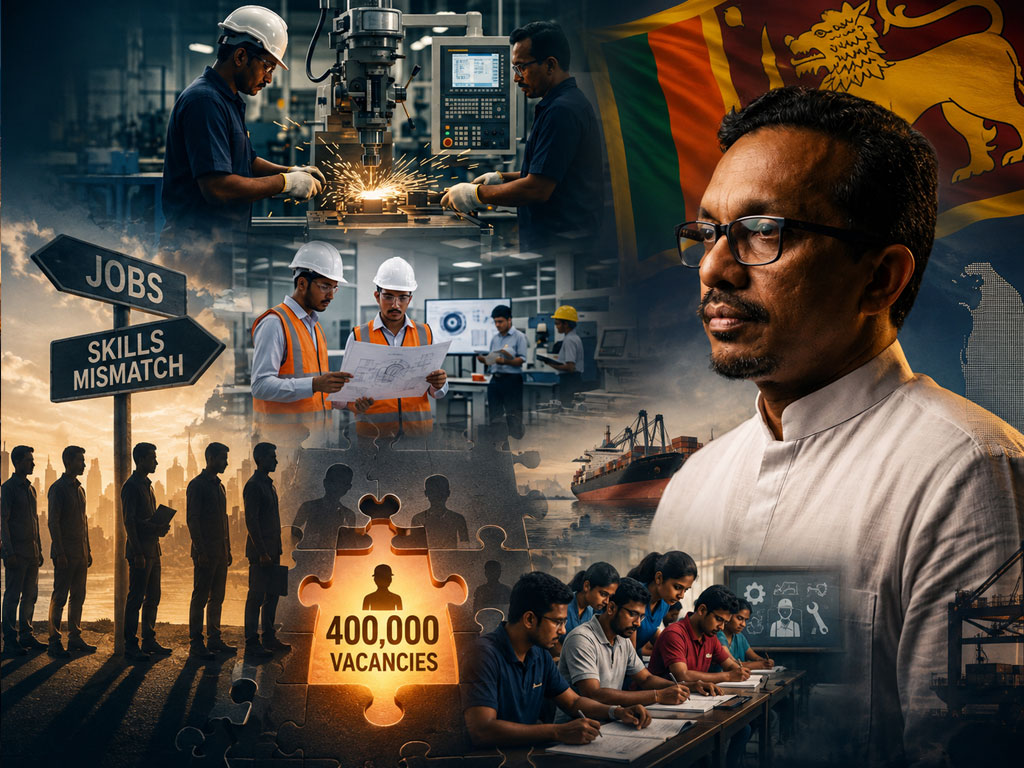
Sri Lanka skills mismatch leaves around 400,000 industrial vacancies open as employers struggle to find workers with the right qualifications.
Sri Lanka skills mismatch concerns are deepening as around 400,000 industrial vacancies remain open while employers struggle to find workers with the qualifications needed.
Minister of Industries and Entrepreneurship Development Sunil Handunetti said the contradiction highlights a serious weakness in the labour market.
Hundreds of thousands of jobs are reportedly available across the industrial sector. However, a large share of the unemployed population does not have the technical or professional skills required to fill them.
The problem has become especially serious for exporters.
Many exporters need technical specialists, skilled professionals and specialised service providers to maintain operations and expand production.
Handunetti said companies were finding it increasingly difficult to source essential expertise locally.
That raises concerns about whether Sri Lanka’s export sector can meet growing production needs without a more targeted approach to workforce development.

Sri Lanka Skills Mismatch Hits Exporters
The Minister stressed that Sri Lanka should not immediately rely on foreign workers to solve the shortage.
Instead, he said authorities should first determine whether local workers can be trained to meet the needs of domestic industries.
Doing that, however, will require a major change in how vocational education is planned.
Handunetti said discussions were underway with institutions including the Vocational Training Authority, the Ministry of Vocational Training and universities.
The aim is to identify the exact skills demanded by employers.
He indicated that the focus should move away from generic training programmes that may have little connection with actual vacancies.
Instead, training should be built around real industrial requirements.
That would allow graduates to leave training programmes with skills that employers are actively seeking.
Employment Could Support Rehabilitation
The issue also extends beyond conventional vocational training.
Handunetti pointed to people previously affected by drug-related problems as another potential source of workers.
He argued that rehabilitation should not simply end with individuals returning to their communities.
Instead, productive employment could support their reintegration while also helping the wider economy.
At the same time, Sri Lanka continues to deal with the loss of skilled workers who have moved overseas for employment.
Their departure has contributed to shortages in several professional and technical fields.
However, the Minister’s comments suggest that simply persuading skilled expatriates to return would not resolve the deeper problem.
The central issue remains the mismatch between available jobs and the capabilities of those seeking employment.
400,000 Vacancies Reveal Structural Weakness
Handunetti made the comments at the National Assembly of Exporters on the 26th.
His remarks highlight a deeper weakness in Sri Lanka’s labour market.
The country does not appear to face a simple shortage of jobs.
Nor does it face only a shortage of workers.
Instead, Sri Lanka faces a shortage of workers equipped with the skills needed for the jobs that already exist.
Closing that divide will require much closer coordination between industry, vocational training institutions and universities.
Employers must clearly identify the competencies they need.
Training institutions, meanwhile, must respond with programmes designed around those demands.
Without that targeted intervention, the Sri Lanka skills mismatch could continue even while unemployment remains a concern.
The reported 400,000 industrial vacancies may stay open while thousands of job seekers continue searching for work.
That makes the issue not just an employment problem, but a major challenge for productivity, exports and Sri Lanka’s wider economic recovery.