
By Roy Denish.
Dutch Burghers of Sri Lanka reflect centuries of migration, mixed ancestry, culture and resilience that continue to shape the island today.
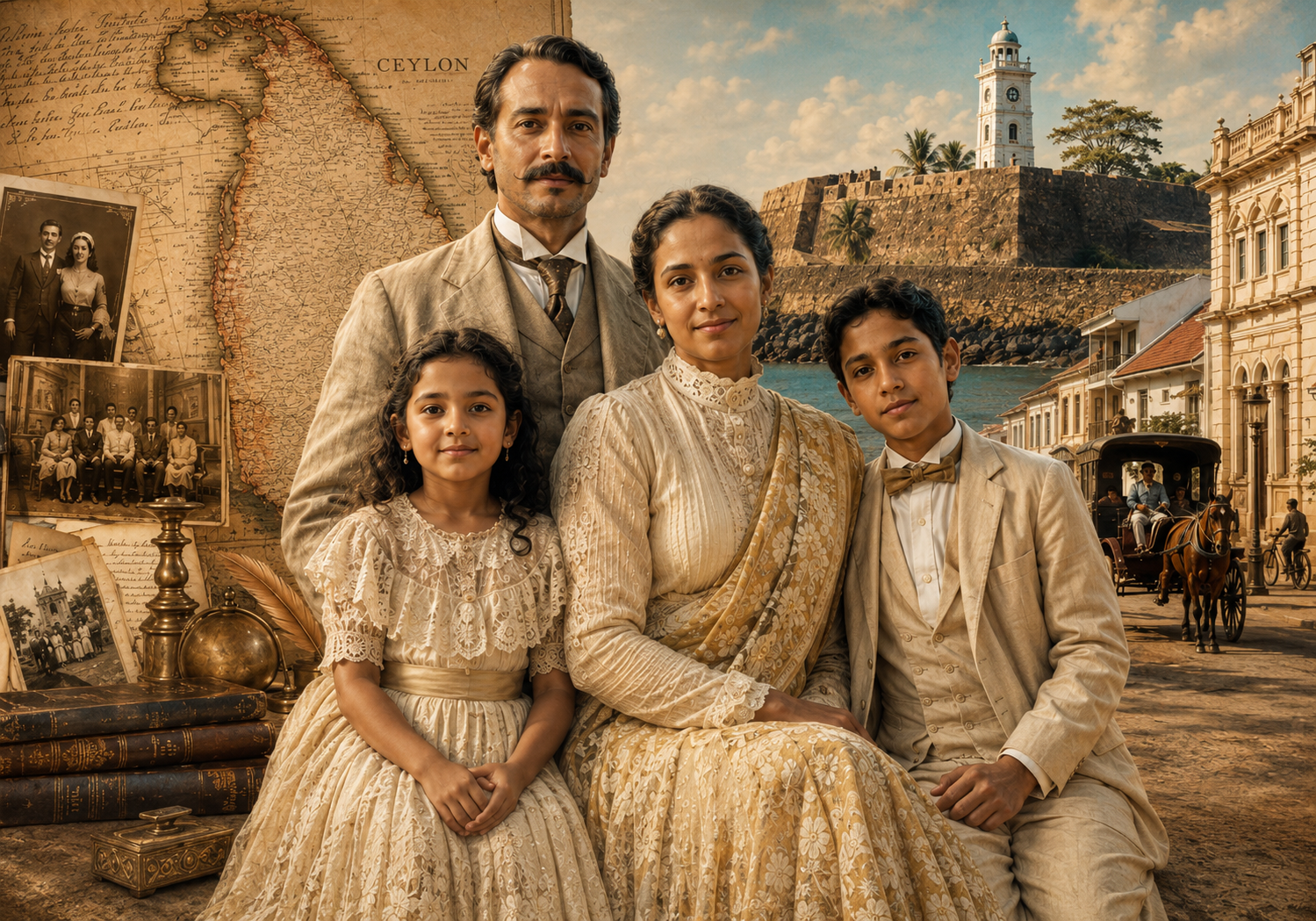
The history of the Dutch Burghers of Sri Lanka is a profound narrative of migration, cultural synthesis, and resilience that stretches back centuries to an era when European maritime powers fiercely competed for control of the island then known as Ceylon. Originally, the term “Burgher” derived from the Dutch word for citizen served a purely administrative function to distinguish select European residents from the wider local population. Over successive generations, however, the word evolved to describe a distinct community of mixed European and Sri Lankan ancestry, establishing a rich cultural footprint that remains woven into the fabric of modern Sri Lankan society.

The foundation of this community deepened significantly during the seventeenth century, when the Dutch East India Company seized vital coastal territories from the Portuguese. Dutch officials, soldiers, merchants, and administrators arrived on the island, with many putting down permanent roots. Yet the population that emerged from this colonial framework was never exclusively Dutch. Settlers arrived from diverse European backgrounds and frequently married local inhabitants, including members of Indigenous communities and women from established Portuguese Burgher families. Consequently, a Dutch Burgher family tree often embraces a remarkably diverse lineage, encompassing Dutch, Portuguese, Sinhalese, Tamil, German, Swiss, French, and Italian ancestry.
By the eighteenth century, this Eurasian population had coalesced into a recognizable social group concentrated largely in coastal urban centres such as Colombo, Galle, Negombo, and Batticaloa. Their daily lives reflected a unique convergence of worlds, vividly demonstrated through their linguistic evolution. Before and during the Dutch era, Portuguese-based creoles and Ceylon Creole Dutch flourished alongside indigenous languages, while the subsequent British period cemented English as a primary medium of education and administration. Similarly, religion played a foundational role. While early Dutch colonial society was predominantly associated with Dutch Reformed Christianity, later generations integrated into a wide array of Christian denominations.
One of the most fascinating archives of this heritage is preserved within the community’s surnames. Family names function as historical documents, reflecting the island’s administrative shifts and cross-cultural interactions. Patronymic names such as Claessen and Jansz trace back to Dutch personal names like Klaas and Jan, while geographical designations such as Van de Berg, Van Buren, and Van Dort point directly to European landscapes or specific towns in the Netherlands. Descriptive monikers such as De Jong and De Bruin further illustrate European naming customs adapted to colonial life. At the same time, the broader Sri Lankan landscape absorbed Portuguese administrative naming traditions, resulting in widespread names such as Fernando and De Silva, alongside rarer designations such as Dalpatado. Such names often bridge European record-keeping methods with older indigenous ancestral structures, demonstrating that Sri Lankan surnames cannot always be understood through simple translation alone.
This syncretic identity naturally extended into everyday life, most notably through cuisine, where European cooking techniques merged with local spices and indigenous ingredients to create a distinct culinary tradition. Literature also became a powerful medium for preserving these memories. Writers such as Carl Muller and Michael Ondaatje explored the complexities of Burgher identity, family relationships, and social change, elevating private family histories into the broader national consciousness.
The twentieth century brought profound transformations. Following Sri Lanka’s independence in 1948, the political and linguistic landscape shifted rapidly. The passage of the Sinhala Only Act in 1956 created acute professional and social challenges for communities whose education and livelihoods had long been tied to English. This catalytic period prompted a major wave of migration, establishing a vibrant Sri Lankan Burgher diaspora across Australia, the United Kingdom, Canada, New Zealand, and the United States.
Despite this geographical dispersion, the community did not dissolve. Families carried photographs, recipes, oral histories, and meticulous genealogical records across oceans, while institutions such as the Dutch Burgher Union continued to foster global connections. Today, the Dutch Burghers stand as a testament to the fact that identity is rarely defined by a single ancestry. Through their language, literature, cuisine, and enduring family names, they remain an irreplaceable thread in the remarkable mosaic of Sri Lanka’s shared history.

I want to know where the COWLEY family name derived from.