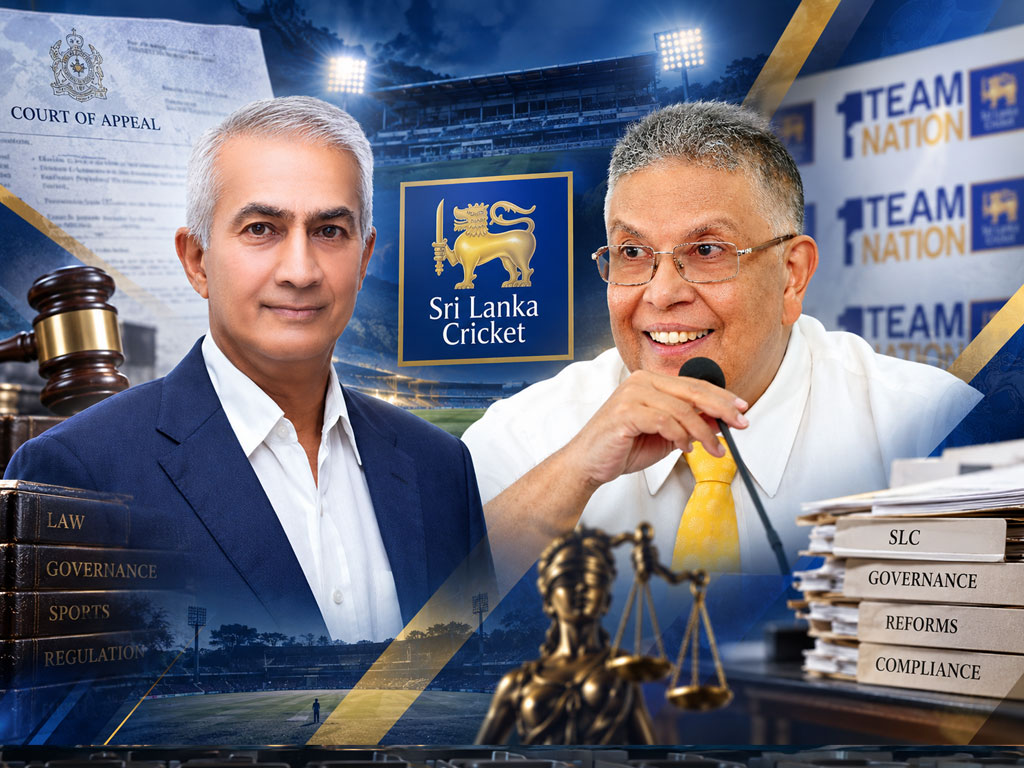
SLC court case takes an unusual turn as Sidath Wettimuny and Dinal Phillips, original petitioners, now help administer Sri Lanka Cricket.
COLOMBO: The SLC court case CA/Writ/460/2020 has taken an extraordinary turn, with two original petitioners now serving on the Government-appointed committee administering Sri Lanka Cricket.
Former Sri Lanka Test cricketer Sidath Wettimuny and President’s Counsel Dinal Phillips were among those who went before the Court of Appeal seeking sweeping governance reforms at Sri Lanka Cricket.
Their petition named the Minister of Sports, Secretary to the Ministry of Sports and Sri Lanka Cricket among the respondents.
Today, both Wettimuny and Phillips sit on the Sri Lanka Cricket Transformation Committee appointed by Sports Minister Sunil Kumara Gamage.

The committee currently administers SLC and has been tasked with undertaking structural reforms within the organisation.
That creates an unusual governance overlap.
Two men who sought judicial intervention over SLC’s structure are now participating in the administration and transformation of the very cricket body they took to court.
There is no suggestion that their appointments automatically make Wettimuny and Phillips formal respondents in CA/Writ/460/2020.
Any such change in legal status would require examination of the latest Court of Appeal record.
However, in practical governance terms, the situation is remarkable.
The petitioners are now helping administer the institution whose governance framework they asked the Court to fundamentally change.
Wettimuny and Phillips Were Among Original Petitioners
Sri Lanka Cricket’s own published annual report records the SLC court case as CA Writ 460/2020.
It identifies the parties as:
“Mr. Sidath Wettamuny, Mr. Kusil Gunasekara, Mr. Dinal Phillips PC and others Vs. Minister of Sports, Secretary to the Ministry of Sports & SLC.”
The petition was filed as public-interest litigation seeking Court of Appeal intervention over the governance of Sri Lanka Cricket.
Among the petitioners associated with the case were several prominent figures from cricket, law, business and public life.
They included Sidath Wettimuny, Muttiah Muralitharan, Kushil Prasanna Gunasekera and Dinal Phillips PC.
The central argument concerned the structure of Sri Lanka Cricket.
The petitioners contended that SLC’s constitution and electoral framework required fundamental reform.
According to SLC’s own description of the litigation, they sought changes to the organisation’s constitution, composition, election process and membership structure.
They also sought intervention by the Sports Minister through statutes and regulations governing SLC’s affairs.
The petitioners further argued that the existing SLC constitution allowed political and external parties to adversely influence cricket administration.
At the time, they approached the judiciary from outside the administrative structure of Sri Lanka Cricket.
Nearly six years later, two of those petitioners now occupy influential positions within that structure.
Two Petitioners Now Sit on Transformation Committee
On April 29, 2026, Sports Minister Sunil Kumara Gamage appointed the Cricket Transformation Committee following the resignation of the previous SLC administration.
The nine-member committee is chaired by Eran Wickramaratne.
Its members are Sidath Wettimuny, Roshan Mahanama, Kumar Sangakkara, Prakash Schaffter, Avanthi Colombage, Thushira Raddella, Dinal Phillips PC and Upul Kumarapperuma PC.
Therefore, two petitioners connected to CA/Writ/460/2020 now serve on the Transformation Committee:
Sidath Wettimuny
and
Dinal Phillips PC.
Neither Muttiah Muralitharan nor Kushil Gunasekera is a member of the current committee.
The significance extends beyond their presence on an advisory body.
The Gazette establishing the Transformation Committee empowered it to carry out and manage the functions of Sri Lanka Cricket until an Annual General Meeting elects new office-bearers.
SLC itself now publicly lists the Transformation Committee within its organisational structure.
Phillips is listed as Honorary Treasurer.
Wettimuny is listed as a committee member and has also been identified by SLC as Chairman of its Cricket Committee.
The result is an extraordinary institutional overlap.
Wettimuny and Phillips remain publicly associated with litigation in which SLC is a respondent.
At the same time, both occupy positions inside the structure presently administering Sri Lanka Cricket.
That does not, on its own, establish any wrongdoing.
It does, however, create an unusual situation requiring clarity about how the litigation and their administrative roles interact.
Governance Reform Links Both Their Roles
There is an even deeper connection between the litigation and their current appointments.
The transformation programme now being pursued substantially overlaps with the relief the petitioners sought when they originally approached the Court of Appeal.
The present committee was established to transform Sri Lankan cricket, with governance reform among its principal objectives.
When outlining the committee’s direction in April, Chairman Eran Wickramaratne said its immediate priority would be a total overhaul of SLC’s governance framework and the implementation of a new constitution.
That objective closely resembles the central issue raised in CA/Writ/460/2020.
In other words, Wettimuny and Phillips initially went to court seeking intervention over SLC’s constitution and governance.
They are now members of the body attempting to implement transformation and governance reform from inside Sri Lanka Cricket.
That makes the SLC court case especially significant in the context of the current administration.
The question is no longer only what the petitioners asked the Court to order.
It also concerns how their present responsibilities relate to the litigation they initiated.
Court Case Has Been Recorded as Pending
The legal status of CA/Writ/460/2020 is therefore crucial.
Sri Lanka Cricket’s 2023 Annual Report recorded the case among its pending litigation.
It stated that the matter had been fixed for argument on April 5, 2024.
More recent reporting in May 2026 continued to describe CA/Writ/460/2020 as pending before the Court of Appeal.
No publicly available final judgment terminating the case has been identified.
If the proceedings remain pending, the situation becomes particularly unusual.
Wettimuny and Phillips would then remain associated with an ongoing legal challenge concerning SLC governance while also serving on the committee exercising administrative functions within SLC.
Again, that does not automatically create a legally prohibited conflict of interest.
Nor does committee membership automatically transform either man from petitioner to respondent.
Their formal legal position depends on the Court of Appeal record.
However, the overlap raises important questions about legal standing, institutional independence, conflict management and how the case is now being conducted.
Those questions become more significant because the Transformation Committee is not operating outside Sri Lanka Cricket.
It is currently carrying out and managing SLC’s functions.
Who Now Instructs Lawyers Representing SLC?
One practical question may be particularly important.
If Sri Lanka Cricket remains a respondent in the SLC court case, who currently has authority to instruct the lawyers appearing for SLC?
And what role, if any, do Wettimuny and Phillips have in administrative decisions concerning litigation in which they are petitioners?
If either man participates in decisions relating to SLC’s legal position in CA/Writ/460/2020, the potential conflict becomes considerably more significant.
Conversely, if both have formally recused themselves from every discussion and decision concerning the case, disclosure of those arrangements would clarify how the apparent overlap is being managed.
The position of the Sports Ministry also deserves attention.
The Transformation Committee exists because of ministerial action.
Yet the Minister of Sports and the Secretary to the Ministry of Sports are among the respondents identified in the litigation brought by the petitioners.
The Government therefore now has two original petitioners from that case serving on the committee it appointed to transform Sri Lanka Cricket.
That adds another layer to an already unusual legal and administrative arrangement.
The issue is not whether their appointments automatically alter their legal identities in the court proceedings.
There is no basis to make that assumption without examining the current court record.
The issue is how litigation between petitioners and respondents is being managed when some of those petitioners now participate in administering one of the respondent institutions.
Has the SLC Court Case Come Full Circle?
Whether Sri Lankan sporting history has previously produced an identical situation would require a detailed examination of earlier litigation.
It would therefore be premature to describe the arrangement definitively as unprecedented.
Nevertheless, CA/Writ/460/2020 has travelled an extraordinary circle.
In 2020, Wettimuny, Phillips and their fellow petitioners approached the Court of Appeal from outside Sri Lanka Cricket.
They sought judicial intervention to compel fundamental changes to the organisation’s governance structure.
In 2026, Wettimuny and Phillips are inside the administrative structure of Sri Lanka Cricket.
They are now helping pursue transformation of the same organisation whose constitutional and governance arrangements they challenged in court.
The legal distinction remains important.
Neither has been shown to have formally changed from petitioner to respondent in the Court of Appeal record.
Institutionally, however, the dividing line has become much less straightforward.
Two men who approached the Court as petitioners challenging the governance arrangements surrounding Sri Lanka Cricket now sit on the body administering and transforming SLC.
Meanwhile, Sri Lanka Cricket remains the respondent named in their case.
That leaves a fundamental question requiring clarification from the Sports Ministry, Sri Lanka Cricket and the two committee members.
What is now happening to CA/Writ/460/2020?
And, if the case remains active, how is the apparent overlap between the petitioners’ continuing litigation and their present administrative responsibilities being managed?