By Roy Denish.
Sri Lankan peacekeepers are back in Haiti as questions grow over vetting, past abuse allegations and UN human rights safeguards.
The debate over Sri Lankan peacekeepers in Haiti has returned as the United Nations Security Council prepares to decide whether to renew the Gang Suppression Force (GSF), whose mandate expires on Sept. 30. The United States and Panama are the Council’s lead negotiators on the mandate.
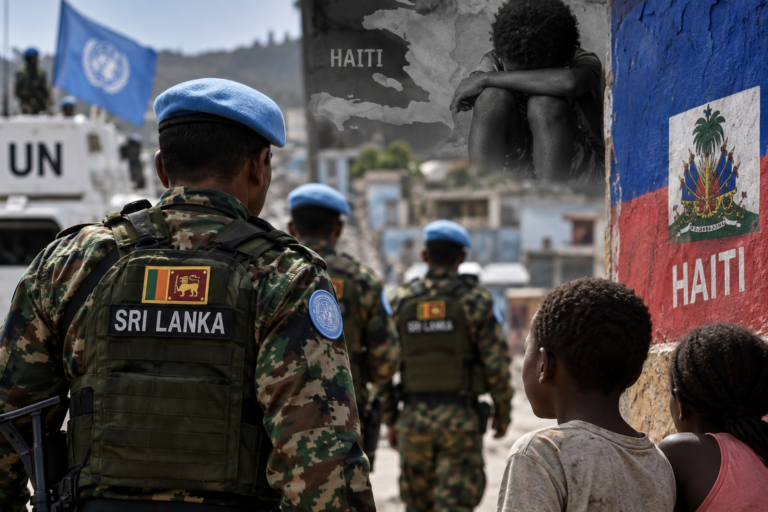
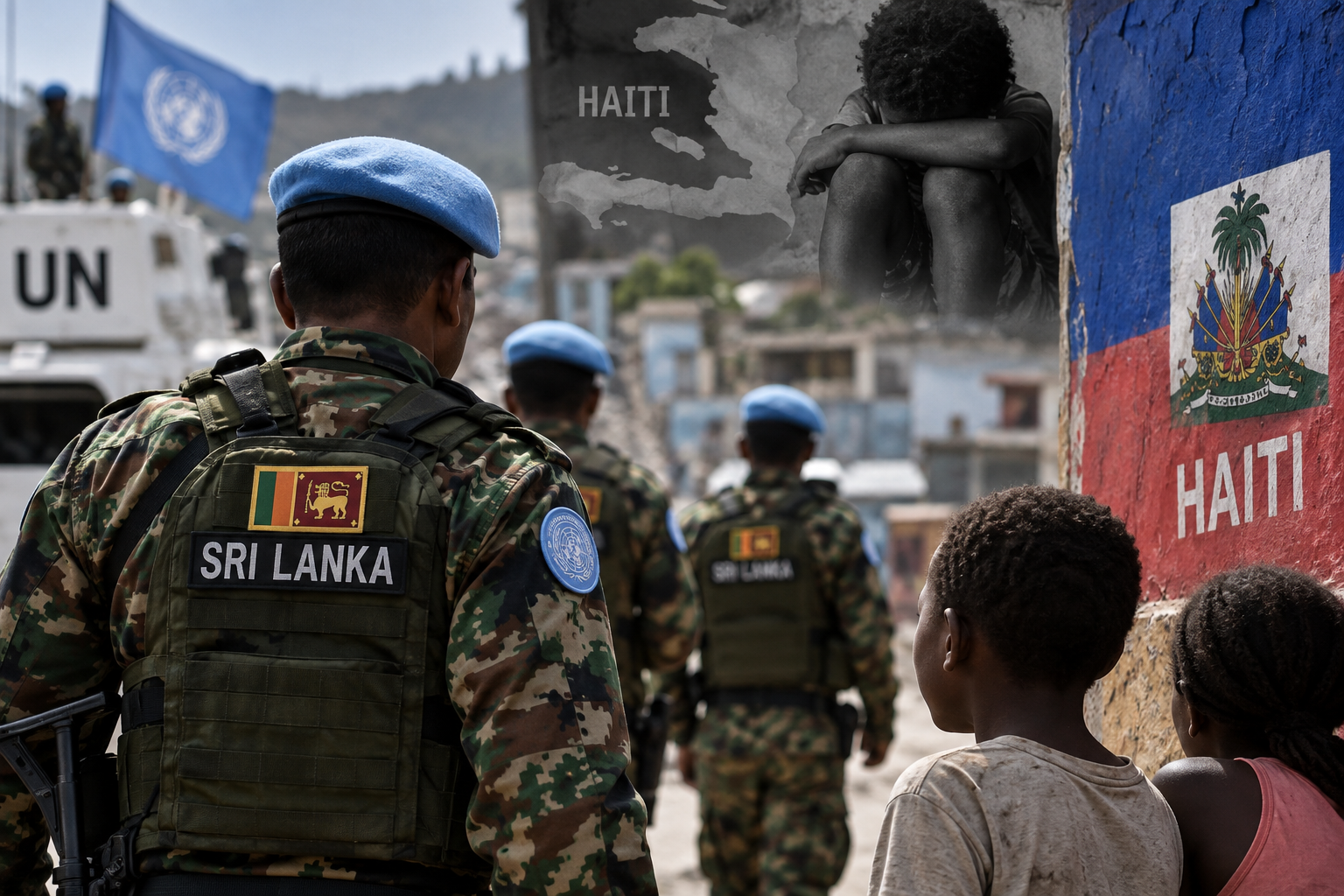
Sri Lanka is making one of the largest contributions to the militarized operation, with 900 Army personnel and 189 paramilitary police from the Special Task Force, according to its Ministry of Defense. At a 2025 force-generation conference, personnel pledges exceeded 7,500 against an authorized ceiling of 5,550. Pledges do not necessarily equal deployable capacity. However, Sri Lankan personnel were selected despite the country’s troubling history in Haiti.

Sri Lankan Peacekeepers and Haiti’s 2007 Abuse Scandal
In 2007, a confidential UN investigation found credible allegations covering 2005 to 2007 and implicating at least 134 members of successive Sri Lankan contingents in the sexual exploitation and abuse of Haitian children. Some victims were as young as eight. The UN repatriated more than 108 Sri Lankans in 2007. There is no evidence that anyone was ever prosecuted.
Joint UN and Sri Lankan investigators identified what they described as an organized pattern. Children were sexually exploited and abused for food or a few dollars at virtually every location where the troops served. Investigators found that contact details were passed from one rotation to the next. One boy was abused by more than 100 soldiers. Commanders, the report concluded, “failed to take appropriate action”.
Sri Lanka’s account of the disciplinary action that followed narrowed over time from 23 troop members disciplined, to nine, and then to three. Nobody was jailed for raping children. The UN Committee Against Torture repeatedly sought details about prosecutions but received no answer. No evidence of criminal prosecutions exists. Meanwhile, the International Truth and Justice Project (ITJP) found that every contingent commander from those deployments was subsequently promoted.
The first Sri Lankan troops serving with the GSF reached Port-au-Prince in July 2026. In August, another contingent landed at Gonaïves as the force expanded into the Artibonite region beyond the capital.
A UN-Backed Force Without Blue Helmets
The GSF is not a blue-helmet mission. Personnel serve under national flags and a non-UN command structure. Security Council Resolution 2793 created the UN Support Office in Haiti (UNSOH), which provides the force with logistics, medical care and transport.
That support activates the UN’s Human Rights Due Diligence Policy. UNSOH must assess and reduce the risk that its assistance could contribute to grave violations. It must withdraw support where adequate safeguards are absent. Credible screening of personnel forms part of the UN’s responsibilities.
Under the UN’s general screening policy, contributing states certify their nationals, while each candidate attests that he has committed no violations. For Sri Lanka, that approach was formally recognized as inadequate after a 2015 Office of the High Commissioner for Human Rights investigation found patterns of conduct during Sri Lanka’s civil war indicating “system crimes”.
From 2016, the Human Rights Commission of Sri Lanka (HRCSL) assumed a special screening role agreed with the UN and coordinated with OHCHR. OHCHR held confidential material that was unavailable to the commission. The mechanism was promoted as a model for other countries.
Sri Lanka’s Vetting System Broke Down
The process was soon circumvented. In 2017, 49 personnel without HRCSL clearance were nevertheless deployed to the UN peacekeeping mission in South Lebanon, UNIFIL. The system was tightened after deployments were halted for a year.
Then, in June 2024, the domestic Human Rights Commission withdrew from its vetting and screening role. Its lessons-learned report recorded “unwarranted pressure to expedite screening” of peacekeepers and “pressure to reconsider its decisions to not clear particular applicants”. The commission concluded that OHCHR’s involvement “remains important”.
Two years later, no successor exists to the domestic vetting and screening system for Sri Lankan peacekeepers. A UN-outlined proposal suggests an interministerial committee advised by Sri Lanka Police and the Human Rights Commission. Critics argue that this would again allow the state to screen its personnel.
It remains unclear who would staff the body, whether an adverse finding would be binding, and whether commanders as well as direct perpetrators would face scrutiny. Questions remain over how the mechanism could receive confidential OHCHR evidence supplied by victims of the very institutions under review.
Questions Over Interim Screening for Haiti
Interim screening of the Sri Lankan GSF contingent in Haiti has relied on information supplied by Sri Lankan authorities, diplomatic checks and self-declaration, according to the original PassBlue article. The US Embassy in Haiti rejected at least one candidate under Leahy Law vetting requirements. Rather than reassuring critics, that decision raises questions about why such a candidate was submitted.
The government representative at an October 2025 UN roundtable on building a new Sri Lankan peacekeeping mechanism was the deputy minister of defense. According to the Army’s 2006 annual report, he served as second-in-command of the third Haiti contingent during the period covered by the UN investigation.
That does not establish personal involvement. However, the authors argue that it creates an appearance of conflict of interest if he helps design or certify a system examining command failures within those contingents.
The contrast with Bangladesh is instructive. In February 2025, OHCHR recommended that Bangladesh establish “an effective and sufficiently independent human rights screening mechanism” before nominating personnel for the Haitian operation. No equivalent hold preceded Sri Lanka’s deployment to Haiti, or the 112 soldiers it sent to UNIFIL three days earlier.
Screening Standards Face Renewed Scrutiny
Applying the principle selectively risks turning human rights screening into a question of political convenience rather than protection against foreseeable harm.
The UN recorded four substantiated cases of sexual exploitation and abuse by the Kenyan-led predecessor mission in Haiti in 2025. Sri Lankan peacekeepers are now operating at the same forward bases in the Artibonite region.
UNICEF estimates that up to half of Haiti’s armed-group members are children. The concern raised by Yasmin Sooka and Frances Harrison is clear: a contingent whose predecessors sexually exploited and abused Haitian children is now being sent to fight an enemy substantially composed of children.
Originally published by PassBlue. Written by Yasmin Sooka and Frances Harrison.