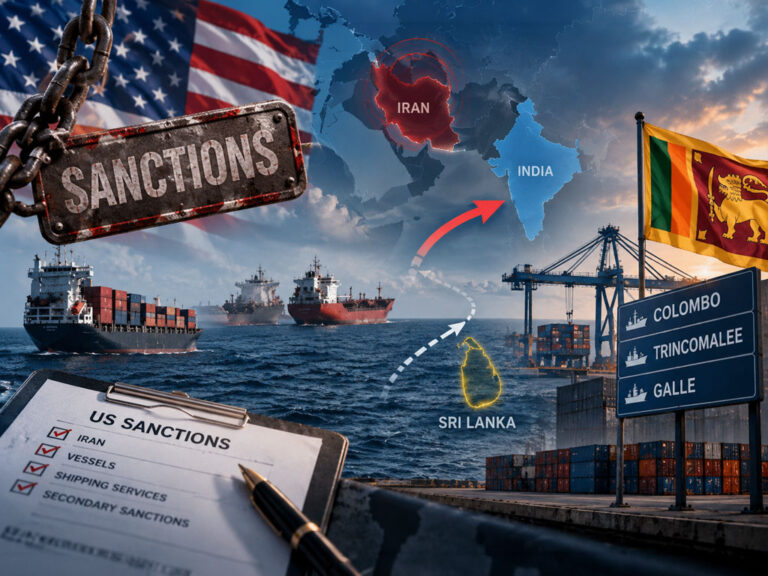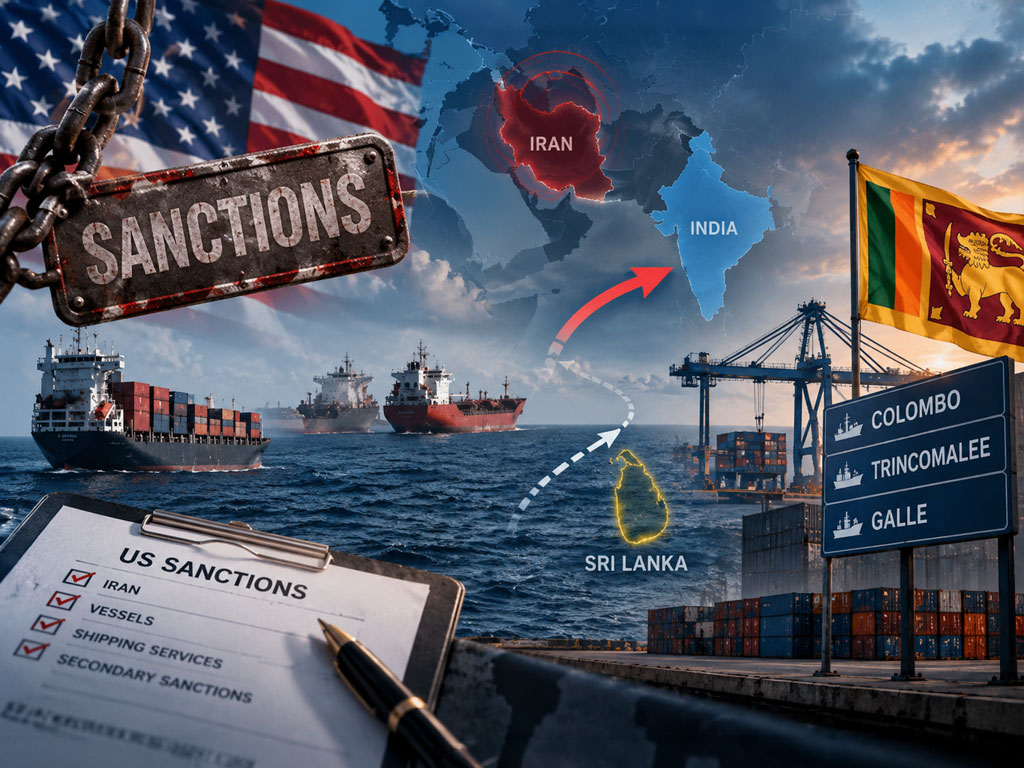
US sanctions are putting pressure on Sri Lanka shipping services, with some vessels reportedly diverting to India as authorities protect local firms.
COLOMBO — Sri Lankan authorities are moving to protect local maritime companies from potential exposure to United States sanctions after concerns emerged over providing services to sanctioned vessels calling at the country’s ports.
- Authorities are circulating information on US-sanctioned vessels to Sri Lankan port service providers to reduce the risk of local companies becoming exposed to sanctions.
- Shipping agents say some vessels are diverting to India after encountering difficulties obtaining services at Sri Lankan ports.
The issue has become increasingly important for Sri Lanka’s maritime sector amid heightened tensions in the Middle East and a tightening of US sanctions relating to Iran and associated shipping networks.
Deputy Minister of Ports and Civil Aviation Janitha Kodituwakku said authorities were taking precautionary measures following information received from the US Embassy in Colombo about vessels subject to American sanctions.
Information is being channelled through the Ministry of Foreign Affairs to the Director General of Merchant Shipping, who is subsequently circulating the relevant details among companies providing maritime services.
The objective is to ensure that Sri Lankan businesses understand the potential sanctions risks before dealing with designated vessels.

Shipping agents raise concerns
Shipping agents have warned that the issue could affect Sri Lanka’s competitiveness as a regional maritime hub if vessels become uncertain about whether essential services will be available when they call at the country’s ports.
Their concerns relate particularly to Colombo, Trincomalee and Galle, where visiting vessels may require bunkering, food, crew changes and other services.
Under US sanctions rules relating to Iran, certain transactions or services involving designated entities, individuals or vessels can expose third parties to sanctions risks, depending on the circumstances.
US sanctions guidance specifically identifies maritime activities as an area requiring heightened compliance. Bunkering services involving certain Iranian vessels, for example, can potentially be sanctionable under US law.
Shipping agents in Sri Lanka say the problem has become more pronounced over approximately the past two weeks.
Some vessels that had been expected to obtain services in Sri Lanka have reportedly diverted towards India when the required services were unavailable.
The extent of those diversions, including the number of vessels affected, has not been officially quantified.
Sri Lanka faces different legal obligations
A central difficulty for Sri Lankan authorities is the distinction between sanctions imposed by the United Nations and unilateral sanctions imposed by individual countries.
Kodituwakku said that under Sri Lanka’s existing legal framework, the country currently withholds services from vessels subjected to United Nations sanctions.
US sanctions create a separate compliance concern because companies with exposure to the American financial system or dealings governed by US sanctions rules could face consequences even where a vessel is not prohibited from receiving services under Sri Lankan law.
That places private companies in a difficult position. A transaction may not necessarily be prohibited domestically, yet a company could still need to consider its exposure to US sanctions before providing services.
The Government’s current intervention is therefore focused on providing information to the industry rather than introducing a blanket prohibition on servicing every vessel appearing on a US sanctions list.
Secondary sanctions risk for local companies
The United States has intensified sanctions targeting Iran-linked shipping, oil trading and maritime networks during 2026.
Recent measures have included the designation of vessels, ship-management companies and other entities linked to Iranian petroleum movements and what US authorities describe as sanctions-evasion networks.
Some designations explicitly identify individuals or entities as being subject to secondary sanctions.
For Sri Lankan companies, the concern is particularly significant because international shipping depends heavily on access to banking, insurance, payments, bunkering and other cross-border services.
A sanctions-related compliance problem could therefore extend well beyond an individual port call.
The Ministry of Foreign Affairs has consequently informed the Director General of Merchant Shipping of the relevant developments, allowing information on designated vessels to be passed to port and maritime service providers.
That process is intended to give individual companies an opportunity to conduct the necessary compliance checks before agreeing to provide services.
Diversions could affect Sri Lanka’s maritime ambitions
Any sustained diversion of vessels from Sri Lanka to neighbouring ports could carry commercial consequences.
Colombo occupies a strategically important position on major east-west shipping routes, while the Government is seeking to strengthen the country’s role as a regional maritime and logistics centre.
Ships requiring crew changes, provisions, bunkering or other services generate business not only for ports but also for shipping agents, suppliers and a broad network of maritime companies.
The immediate challenge is therefore to preserve those commercial opportunities without exposing Sri Lankan companies to sanctions-related financial or legal risks.
Authorities will now have to maintain that balance as US sanctions lists continue to change and shipping companies reassess where they can safely obtain services in the region.