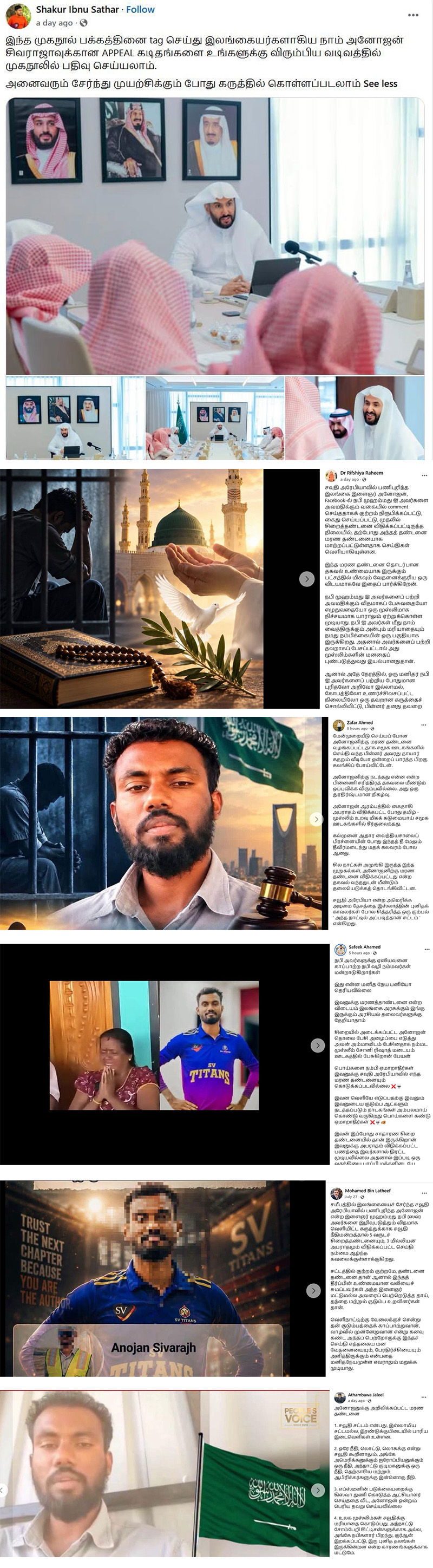
The Anojan Sivarasa Saudi case has triggered cross-community appeals for clemency after his family was told his sentence had been increased to death.
COLOMBO — Muslim and Tamil political leaders in Sri Lanka have joined growing calls for urgent diplomatic intervention to save the life of Sivarasa Anojan, a young Sri Lankan Tamil migrant worker whose family was informed that a Saudi appellate court had increased his five-year prison sentence to the death penalty over a Facebook post deemed offensive to Islam and the Prophet Muhammad.
- Former Foreign Minister Ali Sabry has appealed for clemency, describing the reported death penalty as disproportionate and unacceptable.
- ACMC leader Rishad Bathiudeen has visited Anojan’s family and pledged to mobilise Muslim parliamentarians in an appeal to the Saudi King.
- Tamil MPs Gajendrakumar Ponnambalam and Shanakiyan Rasamanickam have called for urgent intervention at the highest diplomatic level.
The reported death sentence has not yet been formally confirmed through a written Saudi court judgment. Sri Lanka’s Foreign Ministry has said the Embassy in Riyadh was verbally informed by Anojan’s lawyer that his sentence had been increased to capital punishment, but officials are still awaiting the written ruling setting out the decision and its legal basis.
The case has drawn particular attention because Anojan had originally been sentenced by the Al-Ahsa Criminal Court on July 15 to five years in prison and fined three million Saudi riyals. His appeal sought a reduction of that punishment.
Instead, his family was subsequently informed that the sentence had been increased to death.

Appeal sought reduction of original punishment
Anojan’s appeal challenged the severity of the original sentence rather than denying the seriousness of the offence.
The appeal was filed by Saudi attorney Adlan Abdullah Al Sube, who argued that imposing both the five-year prison term and the three-million-riyal fine required careful consideration of whether the combined punishment was proportionate to the offence.
His submission did not seek to diminish the sanctity of religion or deny the seriousness of the Facebook post.
Instead, the lawyer argued that punishment under the principle of Ta’zir in Islamic jurisprudence should serve purposes that include deterrence and rehabilitation and should not ultimately depart from those objectives.
During the original proceedings, Anojan said the Facebook post had been made in anger during an exchange of words and that he deleted it within about 10 minutes.
His lawyer argued that the rapid removal demonstrated that Anojan had not continued publishing or reposting the material and had not intentionally left it online for an extended period to facilitate its further circulation.
The appeal also stated that the post was an isolated incident and that Anojan had no history of similar conduct.
Al Sube consequently asked the court to reduce the five-year prison sentence, taking into consideration his client’s lack of previous offences, and to substantially reduce the fine in light of his financial circumstances.
The appeal was unsuccessful.
Sivarasa Anojan Saudi Case: Faizer Maps a Path to Clemency
Sivarasa Anojan Saudi case enters a critical stage as Faizer Mustapha outlines an appeal and diplomatic path seeking to save his life.
The Morning Telegraph • September 19, 2026 • 5 min readFamily appeals for compassion
Anojan’s parents, Thambirasa Sivarasa and Yogalechchumi Sivarasa of Natpittimunai in Kalmunai, Ampara District, have publicly appealed to the Sri Lankan and Saudi authorities to act urgently to save their son’s life.
Yogalechchumi said her son informed her by telephone that a death sentence had been imposed following the appeal.
Questions have also emerged over how the appeal process was handled and what information was provided to the family.
The Sri Lankan Government retained Saudi legal representation for the appeal, with approximately Rs. 1.8 million from money saved by Anojan’s family used towards the legal process.
The family received an Arabic copy of the appeal and a rough English translation through the Foreign Ministry, but not a Tamil translation they could readily understand.
Sri Lanka’s Foreign Ministry said on September 18 that it was closely following Anojan’s case through the Embassy in Riyadh and in coordination with the Saudi Embassy in Colombo.
Officials said diplomatic engagement with Saudi authorities was continuing and that steps were being taken to safeguard his interests and provide all possible assistance.
The Ministry has not formally announced that the death sentence has been confirmed, as the official written judgment from the Saudi judicial authorities remains awaited.
Ali Sabry calls for clemency
The case has prompted a significant response from Muslim political figures in Sri Lanka.
Former Foreign Minister and President’s Counsel M.U.M. Ali Sabry has appealed to Saudi authorities to grant Anojan clemency while acknowledging Saudi Arabia’s sovereignty and legal system.
Sabry argued that respect for another country’s legal system does not prevent concerns from being raised over the proportionality of a punishment.
He described the reported death penalty for the social media offence as disproportionate, inhuman and unacceptable.
Sabry also highlighted reports that Anojan deleted the offending post within minutes and later apologised, arguing that repentance, rehabilitation and compassion should remain possible.
His intervention is particularly significant in the broader public discussion because he has framed the appeal for clemency from within the Muslim community while emphasising respect for Islam and Saudi law.
Rishad visits Anojan’s family
All Ceylon Makkal Congress leader and former Minister Rishad Bathiudeen has also intervened, visiting Anojan’s family in Natpittimunai after reports of the death sentence emerged.
Bathiudeen told family members that news of the reported sentence had caused distress within Sri Lanka’s Muslim community and assured them of his support.
He said he intended to bring Muslim parliamentarians together to make an urgent appeal to President Anura Kumara Dissanayake and the King of Saudi Arabia.
Bathiudeen also plans to seek the intervention of the All Ceylon Jamiyyathul Ulama in efforts to obtain clemency.
The ACMC leader has argued that even the original five-year prison sentence was excessive for the social media offence and that taking a person’s life over such an act would be unacceptable.
Muslim activists have similarly used social media to call for clemency while urging Sri Lankans not to allow Anojan’s case to create hostility between the country’s Tamil and Muslim communities.
Some have called for a humanitarian or royal pardon that would ultimately allow him to return to his family.
Tamil MPs seek high-level intervention
Tamil political leaders have also increased pressure on the Government.
Tamil National People’s Front leader and MP Gajendrakumar Ponnambalam has contacted Foreign Minister Vijitha Herath and called for urgent legal and diplomatic measures to protect Anojan.
Ilankai Tamil Arasu Kachchi MP Shanakiyan Rasamanickam has demanded intervention at the highest diplomatic level and said he intends to raise the case in Parliament.
Rasamanickam has also questioned the Foreign Ministry’s handling of the appeal process, including the legal representation arranged for Anojan and the information provided to his family.
He has called for the Government to obtain the complete written judgment, secure experienced and independent Saudi legal representation, examine every remaining legal remedy and pursue clemency through direct diplomatic engagement.
The Foreign Ministry, for its part, says it remains engaged with Saudi authorities and is taking steps to protect Anojan’s interests.
Written judgment now crucial
The immediate priority is obtaining the formal written ruling from the Saudi court.
Until that document is received, important questions remain over the precise legal basis for the reported increase in punishment and what judicial or clemency procedures remain available.
The distinction is critical because Sri Lankan authorities have so far received verbal information about the death sentence from Anojan’s lawyer rather than the final written judgment from the Saudi judicial authorities.
What has become clear, however, is that the case is generating an unusually broad response across Sri Lanka’s ethnic and religious political divide.
Muslim leaders, Tamil parliamentarians, activists and Anojan’s family are now converging on the same immediate objective: securing every available legal, diplomatic and humanitarian avenue to prevent the reported death sentence from being carried out.