Sri Lanka cancer drug controversy deepens as doctors demand answers over 190,000 G-CSF injections reportedly worth Rs. 250 million.
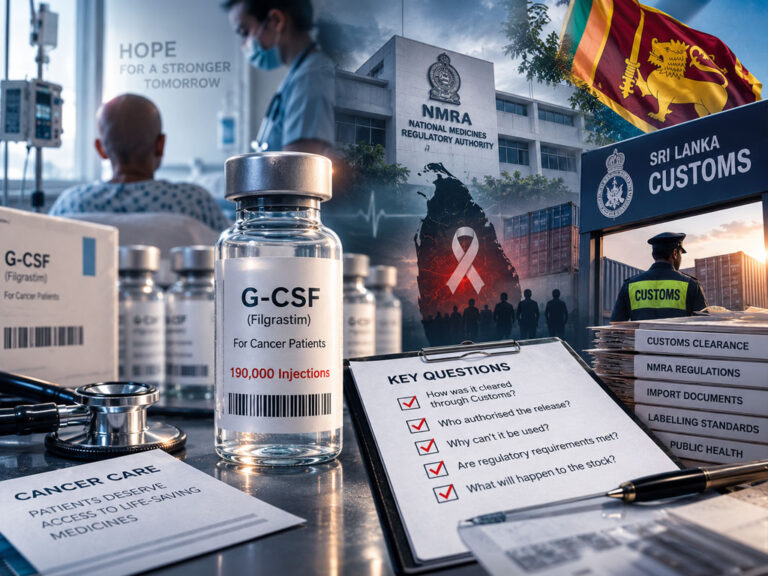
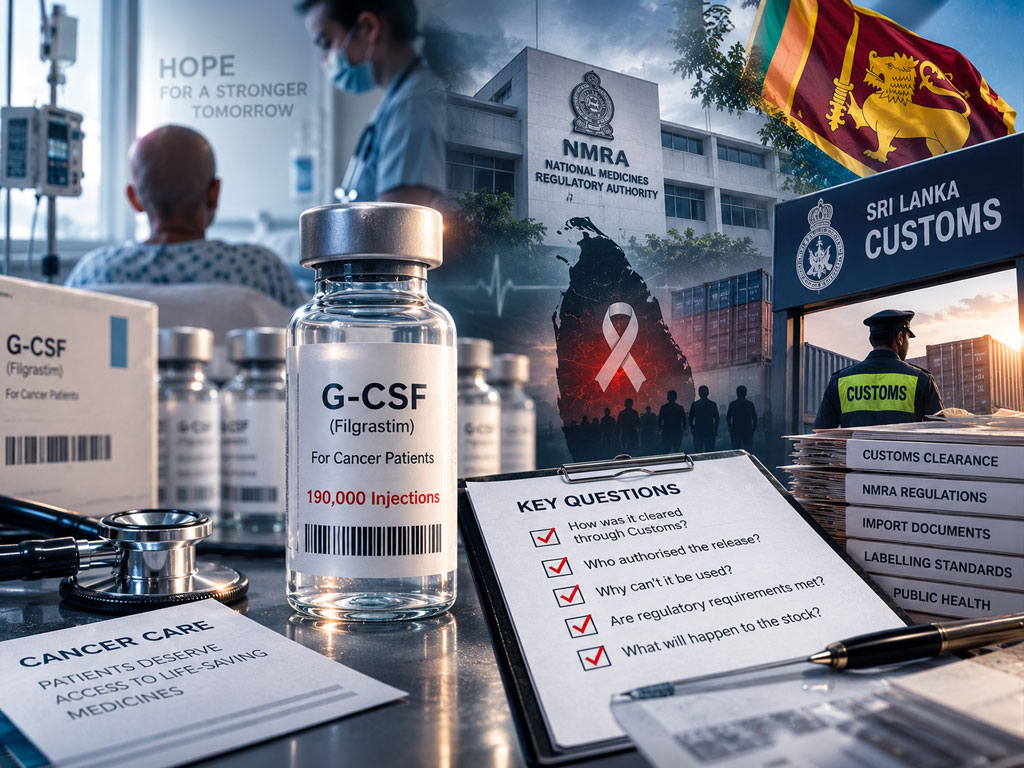
COLOMBO — A doctors’ group has demanded answers over how a consignment of around 190,000 G-CSF injections, reportedly worth Rs. 250 million, was cleared through Sri Lanka Customs despite concerns over labelling and regulatory requirements that have prevented the drugs from being used.
Specialist Dr. Chamal Sanjeewa, Chairman of the Medical and Civil Rights Professional Association of Doctors, has called on the National Medicines Regulatory Authority (NMRA) to disclose who authorised the release of the consignment and explain how it entered the country if the required regulatory conditions had not been met.
G-CSF, or granulocyte colony-stimulating factor, is used in cancer care to stimulate white blood cell production and help patients whose immune systems have been weakened by treatment. The drugs are used by cancer patients, including children.
Questions surrounding the consignment have intensified because the injections have reportedly not been administered due to concerns over their labelling and compliance with required standards.
Sanjeewa questioned how such a large shipment could have been cleared if requirements relating to registration, quality certification, certificates of analysis, import control approval and labelling had not been satisfied.

Doctors seek explanation over Customs clearance
The controversy centres on an important distinction: the consignment was reportedly cleared through Customs, but that did not amount to regulatory approval for the drugs to be administered to patients.
The NMRA has said it was unaware of the circumstances under which the stock was released by Customs, according to reporting on the dispute. Its Chairman, Specialist Dr. Ananda Wijewickrama, has said the injections cannot be permitted for use because required information is missing from the packaging.
Sanjeewa has called for both the NMRA and the State Pharmaceuticals Corporation (SPC), which imported the drugs, to explain the circumstances surrounding the consignment.
The dispute comes as cancer patients continue to face reported shortages of several essential medicines, increasing pressure on families who may have to obtain drugs through private pharmacies when supplies are unavailable at government hospitals.
Sanjeewa has previously alleged that some cancer medicines are being sold at sharply inflated prices outside the state hospital system and that unregistered medicines may also be circulating in the market.
Those allegations have prompted calls for closer scrutiny of the pharmaceutical supply chain and stronger enforcement against any illegal trade in medicines.
Earlier dispute over the same type of medicine
The latest allegations follow weeks of controversy surrounding a stock of Filgrastim, a G-CSF medicine, valued at more than Rs. 250 million.
Earlier this month, Sanjeewa warned that the stock could ultimately be destroyed if regulatory issues prevented its distribution to hospitals. At the time, he called for authorities to examine whether the medicine could be released following expert assessment or whether labelling deficiencies could be corrected under supervision.
He also called for an investigation into the procurement process and whether officials had followed the required procedures.
That earlier position adds an important dimension to the latest controversy. Questions over how the medicine entered Sri Lanka and whether it can legally and safely be used are separate regulatory issues, even though they concern the same broader supply problem.
Discrepancies have also emerged over the quantity involved.
Recent reports citing Sanjeewa refer to approximately 190,000 injections. Earlier reporting on the supply problem cited Health Minister Dr. Nalinda Jayatissa as telling Parliament that 160,000 vials delivered on July 28 had been rejected because pre-filled syringes lacked labels required by the NMRA.
It has not been publicly established whether the figures refer to precisely the same consignment or how the numerical difference should be reconciled.
Shortages put pressure on cancer patients
The dispute is unfolding against a broader shortage of cancer medicines that doctors’ groups have been highlighting for months.
Sanjeewa has previously claimed that around 40 types of cancer medicine have been in short supply and warned that patients who cannot obtain prescribed drugs from state hospitals may be forced to purchase them privately at substantially higher prices.
In August, he alleged that a medicine normally costing around Rs. 900 was being sold for more than Rs. 25,000 amid shortages.
Claims of unregistered cancer medicines circulating in the market have also previously been raised with the Criminal Investigation Department.
Such allegations require investigation and should not be treated as proof of an organised “drug mafia” without evidence establishing who was involved and how any alleged illegal network operated.
The original claims surrounding the Rs. 250 million consignment similarly do not, on their own, establish corruption or criminal conduct by the NMRA, SPC, Health Ministry, Customs officials or any individual.
What they do establish is a need for clear answers about the procurement, importation, Customs clearance, regulatory status and eventual fate of a large stock of medicine intended for vulnerable cancer patients.
Wider concerns over health-sector staffing
Sanjeewa has also linked medicine shortages to wider pressures facing Sri Lanka’s public health system, including the departure of doctors and delays in filling vacancies.
He has cited a requirement for approximately 5,000 specialist doctors and 30,000 medical officers, while arguing that taxation, remuneration concerns and delays in Treasury approval of positions have contributed to doctors leaving the country or avoiding public-sector employment.
Those broader claims are distinct from the regulatory questions surrounding the G-CSF shipment and require separate assessment.
For the immediate controversy, the central questions remain straightforward: who authorised the Customs clearance, what regulatory requirements had been completed at the time, why the injections cannot currently be administered, and what will happen to a stock reportedly worth around Rs. 250 million?
Clear answers from the relevant authorities will be essential, both to establish accountability and to determine whether the medicines can safely and lawfully reach the cancer patients for whom they were procured.