Easter Sunday attacks verdict due at the Colombo High Court Trial-at-Bar after the lengthy case against 24 defendants
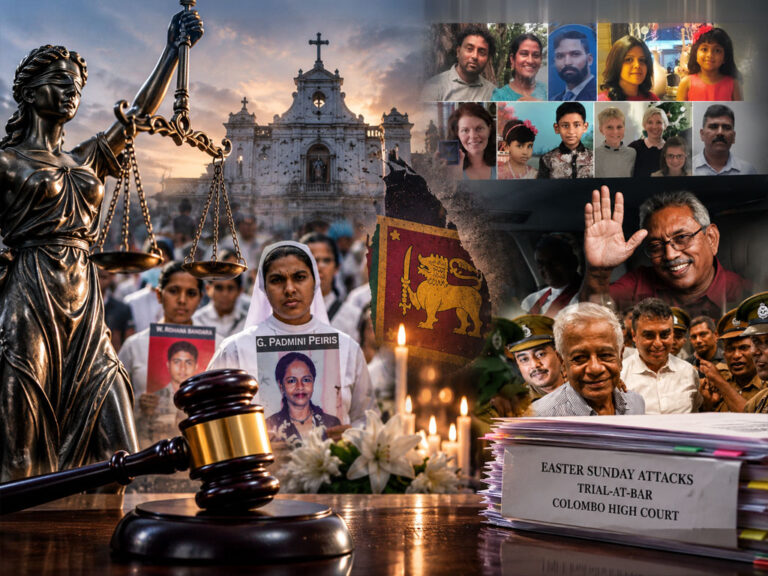
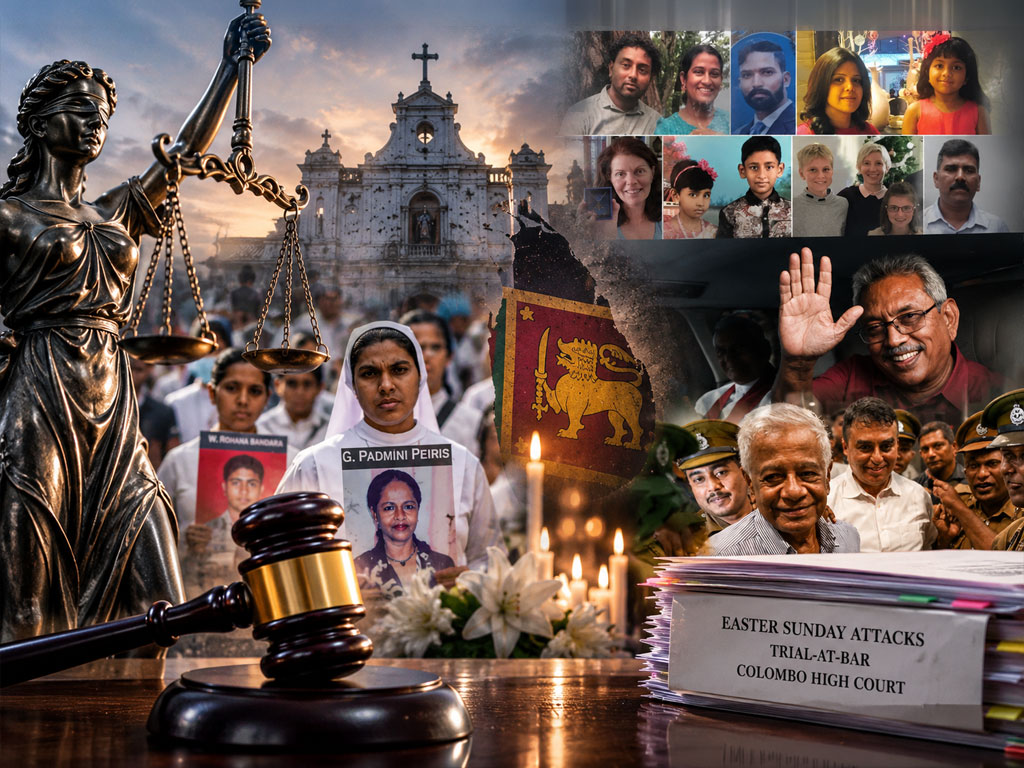
COLOMBO — A Colombo High Court Trial-at-Bar is scheduled to deliver its verdict today, September 22, in the landmark case against 24 defendants, including Mohamed Ibrahim Mohamed Naufar, alias Naufar Moulavi, over alleged involvement in Sri Lanka’s 2019 Easter Sunday terrorist attacks.
The defendants face 23,270 charges arising from allegations that include conspiring to carry out the attacks and aiding and abetting those responsible for the coordinated suicide bombings that struck churches and hotels on April 21, 2019.
The verdict comes after proceedings that lasted nearly five years. The three-judge bench comprising High Court Judges Navaratne Marasinghe, Ramanathan Kannan and Sujeewa Nissanka concluded the hearing of evidence on August 24 before fixing September 22 for judgment.
The Attorney General initially indicted 25 accused. One of them, Yasin Bawa Abdul Rauf, died during the proceedings, leaving 24 defendants before court.
Recent reports on the trial state that 2,309 witnesses testified for the prosecution. During the proceedings, the court also ruled that 10 confessions made to police under the Prevention of Terrorism Act could be admitted as evidence after determining that they had been given voluntarily.
Government Analyst reports, DNA evidence and judicial medical material were also presented. A total of 2,076 productions, including explosives, chemicals allegedly used to manufacture explosives, swords and firearms, were marked during the case.
As Sri Lanka awaits the judgment, these are five key elements of the Easter Sunday attacks and the investigations and court proceedings that followed.

1. What happened on April 21, 2019?
Nine suicide bombers were identified by Sri Lankan police in connection with explosions at eight locations on Easter Sunday 2019.
The attacks began during Easter morning services and breakfast hours at major Colombo hotels.
- 8.45 a.m. – St. Sebastian’s Church, Katuwapitiya
- 8.45 a.m. – St. Anthony’s Shrine, Kochchikade
- 8.47 a.m. – The Kingsbury Hotel
- 8.54 a.m. – Shangri-La Colombo
- 9.10 a.m. – Zion Church, Batticaloa
- 9.12 a.m. – Cinnamon Grand Colombo
- 1.45 p.m. – Tropical Inn, Dehiwala
- 2.15 p.m. – A residence at Mahawila Gardens, Dematagoda
Later official and judicial records have used differing casualty totals. More than 260 people were killed, including dozens of foreign nationals, while hundreds more were injured.
The bombings targeted Christian worshippers attending Easter services and guests at several of Colombo’s leading hotels, making the attacks one of the deadliest acts of terrorism in Sri Lanka’s post-war history.
2. Who were the suicide bombers?
Sri Lankan police subsequently identified nine suicide bombers involved in the explosions.
Alawdeen Ahmed Muad was identified as the attacker at St. Anthony’s Shrine in Kochchikade, while Mohamed Hasthun was identified as the bomber responsible for the attack on St. Sebastian’s Church in Katuwapitiya.
Mohamed Azam Mohamed Mubarak was identified as the Kingsbury bomber.
Two attackers detonated explosives at the Shangri-La Hotel: Zahran Hashim and Mohamed Ibrahim Ilham Ahmed. Zahran was identified by investigators as the leader of the local extremist network responsible for carrying out the coordinated attacks.
Ilham’s elder brother, Mohamed Ibrahim Inshaf Ahmed, carried out the bombing at the Cinnamon Grand Hotel.
Mohamed Nassar Mohamed Asad was identified as the Zion Church attacker in Batticaloa.
Abdul Lathif Jameel Mohamed initially attempted to attack the Taj Samudra Hotel but later detonated his explosives at the Tropical Inn in Dehiwala.
The ninth suicide bomber was Fathima Ilham, the wife of Ilham Ahmed. She detonated explosives at the family residence in Dematagoda as police closed in on the property, killing herself and others, including police officers.
3. Intelligence warnings and the political fallout
Questions over intelligence failures became one of the most contentious aspects of the Easter Sunday attacks.
The bombings occurred months after the 2018 constitutional crisis, during which then President Maithripala Sirisena removed Ranil Wickremesinghe as Prime Minister and appointed former President Mahinda Rajapaksa to the post.
The Supreme Court subsequently ruled against Sirisena’s dissolution of Parliament, and Wickremesinghe returned as Prime Minister after the 52-day political crisis.
Relations between the President and Prime Minister remained deeply strained. The United National Party alleged that Wickremesinghe and then State Minister of Defence Ruwan Wijewardene were excluded from National Security Council meetings during part of this period.
Evidence presented in subsequent inquiries established that advance intelligence warning of a possible attack had reached Sri Lankan security and intelligence authorities before April 21.
Information was received by then State Intelligence Service Director Nilantha Jayawardena in early April and subsequently circulated through the intelligence and police hierarchy.
Then Inspector General of Police Pujith Jayasundara received a warning and forwarded it to several senior officers.
Addressing the nation on April 23, 2019, Sirisena said the intelligence received by the State Intelligence Service had not been communicated to him by responsible senior officials.
“If I had been informed of the receipt of this information, it would have been possible to take immediate action regarding it,” Sirisena said.
Jayasundara later told investigative bodies that he had not been invited to National Security Council meetings following the 2018 constitutional crisis. Eight days after the bombings, he was sent on compulsory leave.
The attacks quickly became a major political issue ahead of the 2019 presidential election.
Gotabaya Rajapaksa, who had served as Defence Secretary during his brother Mahinda Rajapaksa’s presidency, campaigned for president later that year with national security as a central theme and pledged justice for the Easter Sunday victims.
He won the November 2019 presidential election with 52.25% of the vote. Rajapaksa resigned from the presidency in July 2022 after leaving Sri Lanka amid mass anti-government protests during the country’s economic crisis.
These political developments form part of the wider history surrounding the attacks. They do not establish criminal responsibility for the bombings by any political figure.
4. Other major court rulings linked to the attacks
Separate legal proceedings arising from the failure to act on advance intelligence have already produced major judgments.
Former IGP Pujith Jayasundara and former Defence Secretary Hemasiri Fernando were initially acquitted by a three-judge High Court Trial-at-Bar in February 2022 without being called to present defence evidence.
The Attorney General appealed.
Following Supreme Court intervention and the resumption of the proceedings, both men were convicted in separate cases on July 31, 2026.
Jayasundara was sentenced to death by a majority decision after being found guilty over his failure to act on advance intelligence. Fernando was also sentenced to death in his case.
Both have the right to pursue appeals against their convictions.
A separate constitutional case had already resulted in a landmark Supreme Court judgment in January 2023.
Twelve fundamental rights petitions were filed over the failure to prevent the attacks. A seven-member Supreme Court bench found that fundamental rights had been violated and ordered several former senior officials to pay compensation personally.
The amounts ordered were:
- Former President Maithripala Sirisena – Rs. 100 million
- Former IGP Pujith Jayasundara – Rs. 75 million
- Former SIS Director Nilantha Jayawardena – Rs. 75 million
- Former Defence Secretary Hemasiri Fernando – Rs. 50 million
- Former Chief of National Intelligence Sisira Mendis – Rs. 10 million
The State was separately ordered to pay Rs. 1 million.
5. Investigations continue beyond today’s verdict
Today’s verdict will resolve the current Trial-at-Bar proceedings against the 24 defendants, subject to any subsequent appeals. It will not, however, bring every investigation connected with the Easter Sunday attacks to an end.
Former State Intelligence Service Director Major General (Retd.) Suresh Sallay was arrested by the Criminal Investigation Department on February 25, 2026, as part of a renewed investigation into the attacks.
Police said at the time that his arrest followed evidence uncovered during the investigation. He was initially held under a 72-hour detention order and was subsequently detained for questioning under the Prevention of Terrorism Act.
Sallay has denied allegations linking him to the attacks. His arrest and detention do not constitute a finding of guilt.
In March, the CID informed the Colombo Fort Magistrate’s Court that Sallay had been named as a suspect based on evidence investigators said had emerged during their inquiries.
Investigators have continued examining whether others were involved in, facilitated or had prior knowledge of the attacks.
Former President Gotabaya Rajapaksa has meanwhile filed a writ petition before the Court of Appeal seeking an order preventing his arrest under the Prevention of Terrorism Act in connection with the Easter Sunday investigation. Filing that application does not establish criminal involvement on his part.
Seven years after the bombings, the legal process therefore extends beyond the verdict expected today.
For the victims and their families, the Trial-at-Bar judgment represents one of the most consequential stages yet in a case that has moved through years of criminal proceedings, constitutional litigation, inquiries and renewed investigations.