The Government says the sponsorship was intended to promote Sri Lanka internationally. Critics are asking whether the allocation met the standards of transparency, equal treatment and accountability promised by the administration.
The Government’s decision to approve Rs. 104.6 million in tourism-promotion sponsorship for an international broadcasting summit hosted by a private media company has sparked questions about the use of state-controlled funds, the fairness of sponsorship decisions and the standards of accountability expected of an administration elected on an anti-corruption platform.
At the centre of the controversy is an allocation of Rs. 104,603,876 through the Sri Lanka Tourism Promotion Bureau (SLTPB) to MTV Channels (Private) Limited, part of the Maharaja Media Network associated with Sirasa.
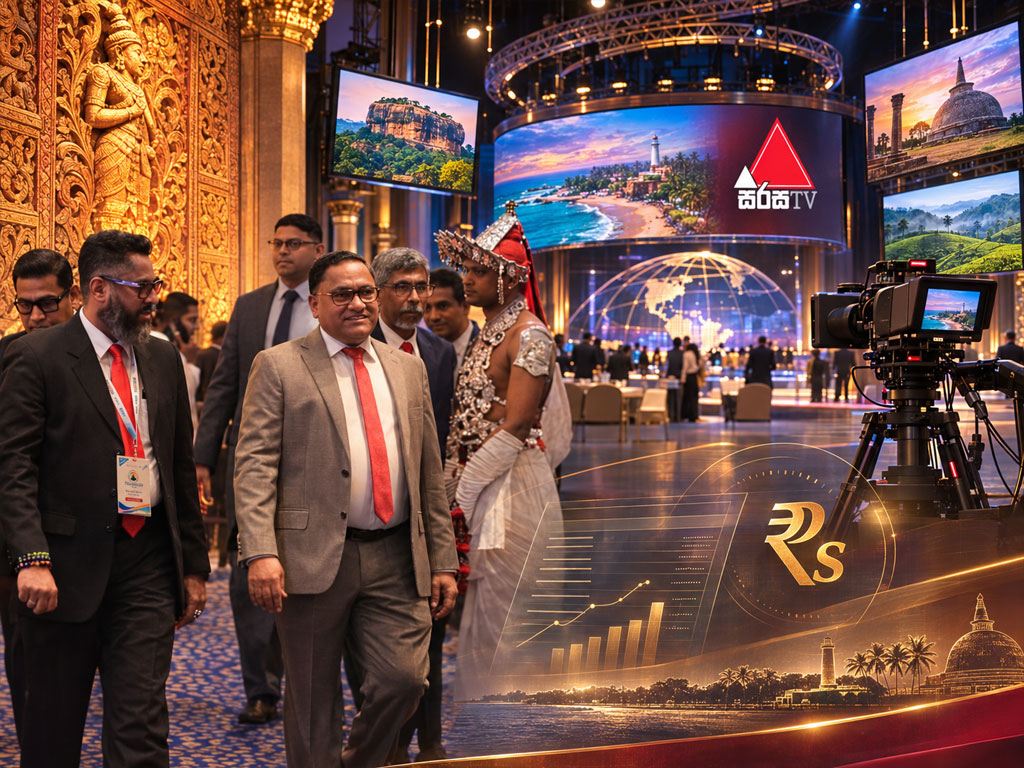
The sponsorship supported the 63rd General Assembly of the Asia-Pacific Broadcasting Union (ABU) and associated programmes held in Colombo from October 30 to November 3, 2026.
Hosting such an international gathering represents a significant achievement for Sri Lanka. It offers opportunities for international exposure, professional engagement and tourism promotion.
Nevertheless, the value of an event and the justification for spending public-sector funds on it are separate questions.
The central issue is whether the expenditure was approved through a transparent, consistently applied process and whether its anticipated benefits can be demonstrated.

The ABU General Assembly: An International Achievement for Sri Lanka
Established in 1964 and headquartered in Kuala Lumpur, Malaysia, the Asia-Pacific Broadcasting Union is a major international organisation representing broadcasting institutions across the region and beyond.
Its 63rd General Assembly and associated meetings took place at Cinnamon Life, City of Dreams, Colombo, from October 30 to November 3.
MTV Channels (Private) Limited, representing the Maharaja Media Network, served as the host broadcaster in collaboration with the ABU.
The gathering brought together more than 350 broadcasters, media executives, industry specialists, policymakers and other participants.
The ABU represents organisations across 66 countries, although that membership figure should not be confused with the number of countries represented by delegates attending the Colombo event.
Held under the theme “Media for Peace and Humanity: Truth, Trust and Transformation”, the programme addressed developments in artificial intelligence, digital broadcasting, cybersecurity, sports broadcasting, media credibility and other issues affecting the industry.
The General Assembly was formally inaugurated on November 1 under the patronage of President Anura Kumara Dissanayake.
An important outcome was the election of Chevaan Daniel, Group Director of the Capital Maharaja Group and Maharaja Media Network, as ABU Vice-President.
His election marked the first occasion on which a Sri Lankan had secured that position.
These achievements deserve recognition. However, they do not eliminate the need to examine how state sponsorship was approved and what measurable benefits Sri Lanka received.
The Rs. 1.04 Billion Sirasa Deal: Taxpayers’ Money and Vijitha’s PM Dream
Minister Nalinda Jayatissa says the sponsorship came from tourism-sector levies, while questions remain over the approved expenditure, the budget transfer and how Sri Lanka will measure the event’s promotional benefits.
Read Full Article ↗How Was the Rs. 104.6 Million Sponsorship Approved?
The financial arrangements are central to the controversy.
According to published accounts of the relevant Cabinet documentation, Foreign Affairs, Foreign Employment and Tourism Minister Vijitha Herath submitted a memorandum dated September 17, 2026, seeking approval for the sponsorship.
The Cabinet paper has been identified as No. 26/1947/807/035, with associated Ministry of Finance documentation referring to MF/PE/CM/2026/232.
Cabinet approval was reportedly obtained on September 28.
The amount approved through the Sri Lanka Tourism Promotion Bureau was Rs. 104,603,876.
The proposed payment arrangement divided the sponsorship into two instalments:
1. First instalment: 60%
Rs. 62,762,325.60.
2. Second instalment: 40%
Rs. 41,841,550.40.
According to the arrangement described in the source material, the second instalment was conditional on the submission of documentation confirming the successful conclusion of the programme.
The sponsorship covered activities associated with the General Assembly, related meetings, a music festival and excursions organised for visiting delegates.
A complete financial assessment would require the approved expenditure schedule, the amounts actually disbursed, supporting invoices and documentation establishing whether the conditions attached to each payment were satisfied.
Such disclosures would also help clarify precisely how much of the sponsorship supported conference facilities, production arrangements, hospitality and tourism-related activities.
The Government’s Position: Not a Direct Treasury Allocation
Cabinet Spokesperson and Minister Dr. Nalinda Jayatissa defended the sponsorship during the Cabinet decisions media briefing on November 3.
He explained that the money came through the Sri Lanka Tourism Promotion Bureau rather than a direct allocation from the Treasury’s general tax revenue.
According to the Minister, the Bureau finances tourism-promotion activities through revenue streams that include tourism-related charges and industry contributions.
The distinction is relevant to understanding the source of the funding.
However, it does not settle the question of public accountability.
The SLTPB is a statutory institution entrusted with promoting Sri Lanka as a tourism destination. Its funds remain subject to the legal framework, financial controls and audit obligations applicable to the institution.
Consequently, money derived from earmarked levies cannot automatically be treated as money outside public-sector financial scrutiny.
The question is not simply whether the sponsorship came directly from the Treasury. It is whether the expenditure was authorised appropriately, fell within the Bureau’s mandate and represented a reasonable use of its resources.
Was the Sponsorship Worth Rs. 104.6 Million?
The Government has argued that hosting the ABU General Assembly provided substantial international visibility for Sri Lanka.
An event attended by broadcasting professionals and media executives can potentially deliver tourism benefits through accommodation, transport, hospitality, excursions and exposure to international audiences.
Conference tourism also has value beyond immediate visitor expenditure. A successful event may improve a destination’s ability to attract future meetings, exhibitions and professional gatherings.
These potential benefits form a legitimate basis for considering public-sector sponsorship.
However, the existence of potential benefits does not establish that the amount spent was justified.
The source material refers to an anticipated publicity value exceeding Rs. 250 million.
If that figure formed part of the official investment justification, the methodology used to calculate it should be available for examination.
Several questions arise:
- Was the estimate based on the advertising value of international television coverage?
- Did it include social media exposure and digital publications?
- Were projected audience figures independently verified?
- Was the estimate prepared before the event or calculated afterwards?
- How much publicity directly promoted Sri Lanka as a tourism destination?
- What measurable economic benefits resulted from the sponsorship?
Advertising-equivalent publicity values are not necessarily the same as revenue or economic returns.
An independently assessed post-event report would provide a firmer basis for determining whether the sponsorship achieved its stated purpose.
Why Was a Private Broadcaster the Host?
Another criticism concerns the decision to support an event hosted by MTV Channels, a private broadcasting company, while Sri Lanka also operates state-owned electronic media institutions.
The Government has explained that the host broadcaster was selected through the ABU’s own arrangements rather than appointed by the Sri Lankan administration.
That distinction is important.
The host-selection process and the Government’s subsequent sponsorship decision are separate matters.
Nevertheless, the fact that an international organisation selected a private broadcaster does not, by itself, explain the criteria used by a state institution when deciding to provide substantial financial support.
The relevant questions concern whether the sponsorship was assessed against the SLTPB’s established objectives, whether comparable applications would receive equivalent consideration and whether any actual or potential conflicts of interest were properly managed.
It would be inappropriate to conclude that a conflict of interest existed merely because the recipient was a private media company.
Such a finding would require evidence of a relevant relationship or interest capable of improperly influencing the decision.
The Government can address these concerns by disclosing the applicable approval criteria and the reasons for determining that this sponsorship was in the public interest.
Would Other Media Organisations Receive Similar Support?
The broader policy issue extends beyond the Maharaja Media Network.
If another private broadcaster were selected to host a comparable international event in Sri Lanka, would the SLTPB evaluate its request using the same criteria?
A fair sponsorship framework should explain:
- Which organisations are eligible to apply.
- What activities qualify for public-sector tourism sponsorship.
- How proposed benefits are assessed.
- Whether applications are evaluated competitively.
- What financial limits and approval thresholds apply.
- How potential conflicts of interest are identified and managed.
- What reporting obligations apply after an event.
Not every sponsorship requires an identical procedure. An international event with a designated host may differ substantially from a conventional procurement exercise.
Nevertheless, departures from ordinary competitive processes should be justified through a clear legal and administrative framework.
Consistency is particularly important when public-sector sponsorship benefits privately owned organisations operating in commercially competitive industries.
Complaint Lodged With Anti-Corruption Authorities
Public scrutiny intensified after the Association of Social Media Activists for Democracy reportedly submitted a complaint to the Commission to Investigate Allegations of Bribery or Corruption (CIABOC) on November 3.
The complaint sought examination of the state sponsorship connected to the ABU General Assembly.
The filing of a complaint is not evidence that corruption occurred.
Nor does it establish that any government official, broadcaster or other party acted unlawfully.
Whether the circumstances warrant investigation, and whether any legal violation occurred, are matters for the competent authorities to determine on the available evidence.
The existence of the complaint nevertheless reinforces the importance of making relevant financial and administrative records available through appropriate channels.
The Disagreement in Parliament
The allocation also became the subject of debate in Parliament on November 4.
Samagi Jana Balawegaya MP Mujibur Rahuman questioned the Government over the sponsorship and its use of funds held by the Sri Lanka Tourism Promotion Bureau.
He referred to legal proceedings involving former Minister Basil Rajapaksa and the alleged misuse of tourism-related funds, arguing that resources administered by the Bureau should be regarded as public funds.
Responding, Minister Nalinda Jayatissa maintained that the ABU sponsorship served a tourism-promotion purpose.
He distinguished the expenditure from allegations concerning the use of public resources for election-related activities.
These competing arguments highlight a central distinction in public financial administration.
The fact that expenditure serves a potentially legitimate public purpose does not automatically establish that every aspect of its approval was proper.
Equally, the fact that a private organisation benefits from a publicly funded sponsorship does not, by itself, demonstrate misuse of state resources.
The legality and propriety of the arrangement depend on its purpose, authority, approval procedure, financial controls and supporting evidence.
Seven Questions That Require Clear Answers
For the public to assess the sponsorship fairly, several matters deserve clarification.
1. What specific statutory powers, financial regulations and administrative procedures were relied upon to approve the Rs. 104,603,876 sponsorship?
2. How was the approved amount distributed among conference facilities, production costs, hospitality, cultural programmes and delegate excursions?
3. Was any competitive evaluation conducted, or was the sponsorship treated as a special arrangement arising from the ABU’s selection of its host broadcaster?
4. If the ABU independently selected MTV Channels, what additional criteria did the SLTPB apply before approving public-sector financial support?
5. How was the reported Rs. 250 million publicity value calculated, and can the estimate be independently verified?
6. Will the Government publish a post-event report identifying actual expenditure, payments made and measurable tourism-promotion outcomes?
7. What consistent criteria will govern comparable sponsorship applications from other private and state-owned institutions in the future?
Answers to these questions would help distinguish legitimate policy criticism from speculation about political favouritism.
International Recognition Must Go Hand in Hand With Public Accountability
Sri Lanka’s successful hosting of the ABU General Assembly is an achievement for the country’s broadcasting industry and its international profile.
Chevaan Daniel’s election as ABU Vice-President adds to that recognition.
The potential tourism value of hosting an international media gathering should not be dismissed merely because a private broadcaster served as the host.
At the same time, public-sector financial support must remain open to scrutiny, particularly when the beneficiary operates in a competitive commercial environment.
The present administration has repeatedly emphasised transparency, equal treatment and accountability as fundamental principles of governance.
Those commitments create an obligation to explain not only why public-sector money was spent, but also how the decision was reached and what the country received in return.
A clear statement of the approval criteria, an accessible expenditure breakdown and an independently assessable account of the sponsorship’s results would go a considerable way towards addressing the controversy.
The most credible response is not to dismiss every criticism as political opposition, nor to assume wrongdoing before the evidence is examined.
It is to make the relevant facts available.
For a Government seeking to establish a higher standard of public administration, transparency over Rs. 104.6 million in tourism-promotion expenditure is a practical test of the principles it has promised to uphold.