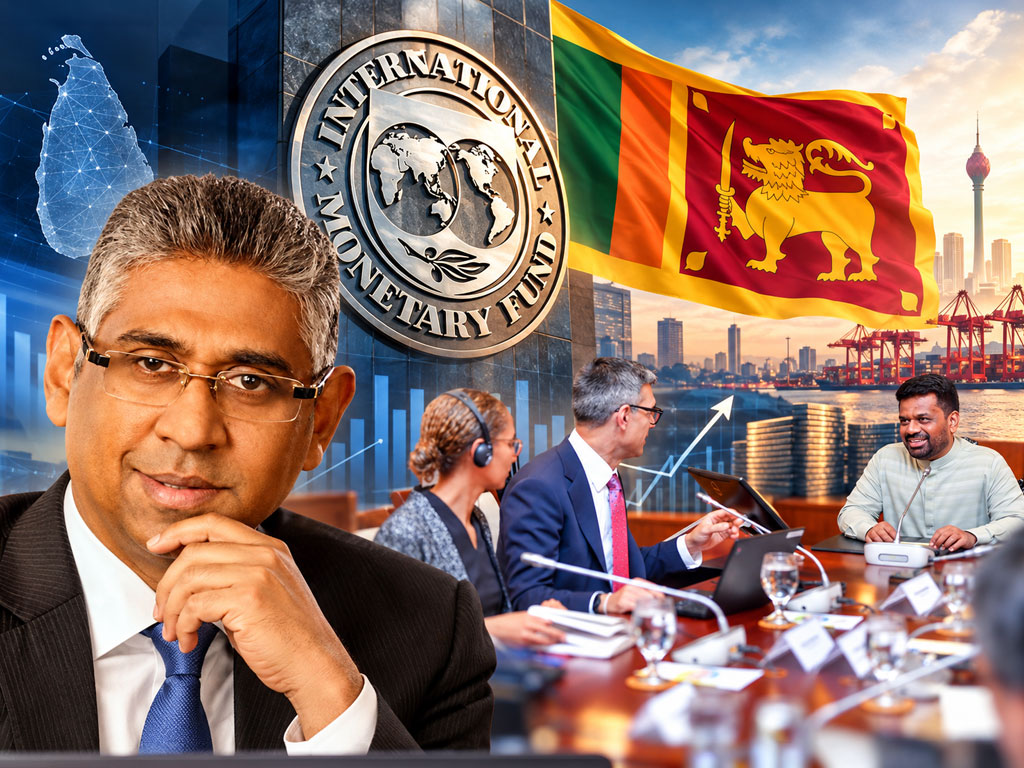
Sri Lanka 18th IMF programme debate intensifies as Faiszer Mustapha argues for domestic reforms after the current EFF ends in March 2027.
By Faiszer Mustapha, President’s Counsel and Member of Parliament
Four years after Sri Lanka defaulted on its external debt, the country’s economic stabilisation is, by many conventional measures, a genuine achievement. Reserves have been rebuilt, a primary surplus delivered, debt restructuring is largely complete, and sovereign credit ratings have moved in the right direction.
Against that backdrop, Ceylon Chamber of Commerce Chairman Krishan Balendra argued at the Sri Lanka Retail Forum 2026 that, once the current Extended Fund Facility (EFF) expires in March 2027, Sri Lanka should consider a successor IMF-supported programme or similar framework.
His argument deserves consideration. Few business leaders have observed the mechanics of this crisis and recovery as closely as Balendra. His instinct that reform momentum should not disappear when the programme ends is understandable.
Where I disagree is on the remedy.
What happens after March 2027 requires a stronger answer than automatically returning to Washington. After four years under this programme, Sri Lanka should examine what these reforms have built, who has borne their cost, and whether another IMF agreement can correct the structural weaknesses that have repeatedly brought the country back to the Fund.
My view is that it cannot, and Sri Lanka should resist the temptation to sign another successive agreement.

Who Paid for Stabilisation?
Before debating fiscal mechanisms, we should ask who actually paid for this stabilisation.
Public-sector wages remained frozen for a prolonged period while inflation eroded purchasing power, placing severe pressure on households. More than four-fifths of state expenditure, according to government data cited in this debate, continues to go towards wages, welfare and debt interest, leaving limited space for infrastructure, health and education expenditure capable of building long-term resilience.
A recent international comparison cited in the analysis ranked Sri Lanka’s minimum wage 120th among 130 countries after adjustment for purchasing power. At the same time, food insecurity has remained serious enough to require World Food Programme interventions.
None of this means the painful adjustments that followed the 2022 crisis could simply have been avoided. Many were unavoidable.
It does mean, however, that ordinary Sri Lankans have borne a severe cost. That deserves as much attention in this debate as movements in sovereign credit ratings.
The Tax Burden and Who Gets Incentives
Taxation was central to the stabilisation programme.
Sri Lanka’s tax revenue rose sharply from roughly 8% of GDP in 2021 to around 14% by 2024. VAT, which had been cut to 8% under the 2019 tax reductions, was eventually raised to 18%, while the standard corporate income tax rate increased to 30%.
At the same time, tax exemptions available to large businesses were reduced.
That correction was necessary. Generous and poorly targeted exemptions had deprived the state of revenue without doing enough to broaden the productive economy. No serious economic strategy should seek a return to that system.
The question is what replaced it.
A recently reported proposal by tax advisers would confine remaining investment incentives to “strategic investments”, essentially large, capital-intensive projects exceeding a specified monetary threshold.
Such an approach may reduce abuse, but it also risks designing the remaining incentive structure around multinational-scale capital rather than the small manufacturer, family retailer expanding into a second city, or start-up challenging an established player.
An incumbent business can absorb higher taxation against profits accumulated through years of trading. A new entrant faces the prevailing tax structure from its first day, without comparable protection against the risks of entering a market.
Sri Lanka is also lowering tariff barriers. That can increase competition, but if domestic market entry remains expensive and heavily taxed, liberalisation can expose local businesses to competition without giving new Sri Lankan firms sufficient opportunity to challenge established players.
A market that protects incumbents while making entry difficult is not genuinely competitive.
Cost-Reflective Pricing and State Enterprises
Fiscal reform is not the only way the programme has affected households and businesses.
Successive IMF reviews have pushed electricity and petroleum pricing towards cost recovery. The economic logic is clear: state enterprises cannot indefinitely sell energy below cost and transfer the resulting losses to taxpayers.
Yet the practical consequences also matter.
Higher tariffs affect households and energy-intensive industries, including manufacturers expected to compete internationally. Meanwhile, restructuring of the Ceylon Electricity Board under new legislation has created separate entities covering areas such as generation, transmission and distribution, amid trade union concerns over job security.
Reforming loss-making state enterprises is not inherently wrong. Many have imposed substantial costs on the public finances for decades.
The question is whether reform should proceed according to an externally linked timetable or one determined by Sri Lanka’s own capacity to absorb the economic and social consequences.
Another IMF programme risks keeping that timetable externally anchored.
Stability Without Competition Is Not Enough
The corporate sector should be equally concerned about what happens when genuine market entry remains difficult.
Businesses that face little credible competition have less incentive to cut prices, improve services or invest in productivity. While households endured a painful adjustment, many large listed companies strengthened their profitability.
The issue is not whether companies should make profits. They should.
The question is whether economic stability creates enough opportunity for new competitors, investment and employment, rather than primarily consolidating the position of businesses already dominant when the crisis began.
That distinction matters to ordinary Sri Lankans.
Macroeconomic stability and a household’s experience of stability are not automatically the same thing. Falling inflation, stronger reserves and improved ratings matter, but so do wages, food security, electricity bills, employment opportunities and the ability of a small business to enter a market and survive.
After four years, that gap remains wide.
A Recurring IMF Cycle
Sri Lanka’s relationship with the IMF must also be considered historically.
The present programme follows a long sequence of Fund arrangements stretching back decades. The pattern has repeatedly involved a balance-of-payments crisis, an IMF-supported stabilisation programme and a subsequent period in which fundamental weaknesses, including a narrow export base, weak domestic revenue generation and insufficient productive investment, remain only partly resolved before another crisis emerges.
That history should make policymakers cautious about assuming that another programme automatically provides the solution.
If the instruments remain primarily higher revenue, restrained expenditure, external buffers and macroeconomic stabilisation, there is no guarantee that another agreement will solve the structural weaknesses that previous programmes did not eliminate.
After four years of difficult adjustment, what Sri Lanka should have purchased is not a ticket into another programme.
It should have purchased the option of not needing one.
Fiscal Discipline Does Not Require Permanent IMF Supervision
This is not an argument against fiscal discipline.
Nor is it an argument against predictable economic policy. Investors need predictability, public finances require discipline, and Sri Lanka cannot return to the policies that helped produce the 2022 crisis.
The question is whether discipline must always come through an IMF programme.
The Fund’s role centres on macroeconomic stability and debt sustainability. Sri Lanka needs something broader: a transparent, rules-based investment environment open to businesses of every size, stronger competition, productive investment and a system capable of protecting smaller firms as the economy liberalises.
A successor programme built on substantially the same framework should not automatically be expected to provide what the current programme was not designed to deliver.
Sri Lanka Must Build Its Own Economic Anchor
Sri Lanka now has an opportunity to create a domestically anchored framework.
Reserves have recovered, debt restructuring has advanced, inflation has fallen considerably from its crisis peak, and the rupee is no longer operating under the extreme pressures experienced near default.
That should provide the foundation for domestic institutions to carry reform forward.
Such a framework should include credible fiscal rules, an independent Central Bank and a competition authority capable of confronting monopolistic markets.
Revenue reform should also become fairer. Rather than repeatedly relying on VAT increases, which disproportionately affect lower-income households, Sri Lanka should examine under-taxed wealth and property.
Domestic capital markets should be deepened so Sri Lankan savings can finance national development. Exports must diversify beyond established sectors such as tourism and apparel, while productive foreign direct investment should take priority over debt-creating capital flows.
State-enterprise reform should continue, but according to a timetable Sri Lanka can sustain economically and socially.
Reform momentum does not necessarily require permanent external supervision. It requires domestic institutions strong enough to maintain discipline themselves.
Answering Balendra’s Case for Continuity
Balendra’s argument should be addressed on its merits.
He argues that a successor programme could preserve reform momentum and policy credibility. But if credibility exists only while an external institution supervises policy, that itself points to a weakness in domestic institutions.
He also argues that continuity could reassure investors and support further sovereign rating improvements, potentially lowering borrowing costs.
Those benefits matter. But rating agencies and investors consider more than the existence of an IMF programme. Growth, debt sustainability, political stability and social conditions also influence perceptions of risk.
Food insecurity, industrial unrest and prolonged pressure on household incomes cannot simply be separated from macroeconomic stability.
Predictability is indeed one of the most valuable forms of economic infrastructure a government can provide. But Sri Lanka can seek to institutionalise it domestically through fiscal rules, Central Bank independence, transparent state-enterprise governance and a credible medium-term revenue strategy.
Balendra is also right to identify Sri Lanka’s proximity to India and Colombo Port’s transshipment role as important opportunities.
Yet those opportunities can equally support an argument for strengthening Sri Lanka’s own economic trajectory. Customs modernisation, trade facilitation and competitiveness reforms can be pursued because they are in the national interest, rather than solely because they form part of loan conditions.
There is also a tension between advocating another programme under broadly similar conditions and wanting small and medium-sized enterprises to grow into national champions.
SMEs have already faced higher VAT, elevated borrowing costs and cost-reflective utility pricing. Any successor programme should therefore be judged not only by its effect on sovereign ratings and capital-market access, but also by what it means for small retailers, informal-sector workers and households.
The Other Side of the Argument
A serious argument against another programme must also acknowledge the risks of leaving IMF support.
Sri Lanka faces significant external debt repayments from 2028. Some economists warn that stepping away from IMF involvement at a sensitive point in the repayment cycle could unsettle investors.
Rating agencies and bondholders could interpret a rapid exit as weakening the commitment to reform, potentially increasing borrowing costs.
That risk cannot be dismissed.
Choosing not to enter another programme would therefore require a credible, detailed and clearly communicated domestic reform and financing strategy. The objective must be to make an exit from IMF dependence appear as evidence of institutional strength, not a retreat from fiscal discipline.
How Sri Lanka leaves the Fund, and how quickly, are genuine constraints.
But familiarity with IMF programmes is not, by itself, an argument for another one.
Sri Lanka’s business community and institutions are right to debate what follows the current EFF. The end of the programme in March 2027 represents a genuine policy choice.
The central question is not simply whether Sri Lanka should seek another IMF arrangement. It is whether continued IMF involvement would resolve the structural weaknesses that repeatedly brought the country back to the Fund while addressing the human and business costs of adjustment, or whether Sri Lanka can now build the domestic institutions required to carry reform forward on its own terms.
That is the test policymakers should apply before deciding whether the country needs another programme.