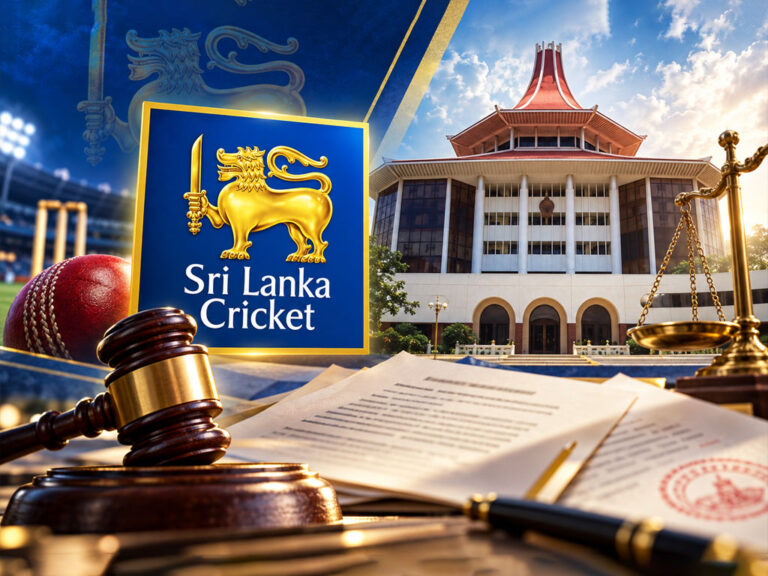
The Sri Lanka Cricket Bill faces a Supreme Court challenge over voting rights, regional representation and alleged political control.
COLOMBO — Dr. Chanaka Senanayake, former Head of Legal at Sri Lanka Cricket, has filed a petition in the Supreme Court challenging several provisions of the proposed Sri Lanka Cricket Bill, arguing that its voting structure and degree of executive control are inconsistent with the Constitution.
The Bill was published in the Gazette on September 25, 2026, and placed on Parliament’s agenda on October 6. The petition was filed within the 14-day period available for constitutional challenges to proposed legislation.
Senanayake’s petition does not seek to invalidate the entire Bill. Instead, it asks the Supreme Court to determine whether specific clauses relating to voting rights and executive influence require amendment.
Two principal areas are challenged: the proposed voting structure within Sri Lanka Cricket and the extent of State involvement in the administration of the governing body.

District Associations Could Lose Voting Rights
The first challenge concerns the representation of district cricket associations at Sri Lanka Cricket General Body meetings.
According to the petition, Section 32 and the Schedule to the Bill grant voting rights only to “A” and “B” category clubs and provincial cricket associations.
Cricket associations representing all 25 districts are classified as ordinary members under the proposed structure.
While those district associations would be permitted to attend General Body meetings as observers, the petition states that they would not have the right to speak or vote.
Senanayake argues that this would effectively remove district-level participation from the decision-making structure of Sri Lanka Cricket while concentrating voting power among a comparatively small number of clubs and provincial bodies.
Western Province Clubs Hold Dominant Share
The petition also raises concerns over the geographical distribution of voting power.
According to the media release referred to in the petition, Sri Lanka Cricket recognises 26 clubs in the “A” and “B” categories.
Of those, 21 are located within the Colombo, Gampaha and Kalutara districts of the Western Province.
That represents approximately 81 per cent of the clubs in the two voting categories.
The petition further states that 33 of the 40 club votes, or 82.5 per cent, would be controlled by clubs based in the Western Province.
When the nine provincial votes are included, it argues that approximately 69 per cent of the total voting strength would remain concentrated in the Western Province.
Senanayake contends that such a structure risks weakening the representation of cricketing interests outside the country’s most heavily represented region.
Executive Control Also Challenged
The second major area of challenge concerns what the petitioner describes as excessive executive influence over Sri Lanka Cricket.
Under Section 28 of the Bill, the President of Sri Lanka would be appointed Patron of Sri Lanka Cricket.
The petition also points to the inclusion of the Secretary to the Ministry of Sports and the Chairman of the National Sports Council as ex officio members of the nomination committee responsible for selecting seven independent directors.
Senanayake argues that these provisions raise questions over whether the governing body would retain the degree of operational independence expected of a national cricket administration.
The proposed powers of the Minister of Sports are also challenged.
According to the petition, the Bill would permit the Minister to order audits and investigations and, based on the report of a retired Supreme Court judge, remove, suspend or bar individual directors or the entire Board of Directors.
Petition Cites ICC and ACC Independence
A central argument in the petition is that the proposed executive powers could conflict with the Bill’s own stated objective of protecting the independence of Sri Lanka Cricket within the International Cricket Council and the Asian Cricket Council.
Cricket’s international governing structures place considerable importance on national boards operating without inappropriate governmental interference.
The petition therefore questions whether the powers granted to the Executive and the Sports Ministry sit comfortably with the Bill’s stated commitment to institutional independence.
That constitutional question is now before the Supreme Court.
Court Asked to Identify Necessary Amendments
Senanayake has asked the Supreme Court to determine that certain provisions governing voting rights and executive control are inconsistent with the Constitution.
He has also sought a determination on what amendments would be required to remove those inconsistencies.
Importantly, the petition does not ask the court to strike down the Sri Lanka Cricket Bill in its entirety.
Its stated objective is to reshape the proposed governance framework so that representation is distributed more fairly across the country and the administration of cricket remains free from unnecessary political control.
The challenge therefore focuses on the structure of the Bill rather than opposing the broader attempt to reform Sri Lanka Cricket.
Former SLC Legal Chief Behind Challenge
Dr. Chanaka Senanayake served as Head of Legal at Sri Lanka Cricket from 2007 to 2009.
He later served as President of the Sri Lanka Cricket Sydney Association from 2010 to 2020.
His petition places two of the most sensitive issues in Sri Lankan cricket governance before the Supreme Court: how voting power should be distributed and how far the State should be permitted to intervene in the administration of the sport.
The Supreme Court’s determination could therefore have a significant bearing on the final form of the Bill before it proceeds further through Parliament.