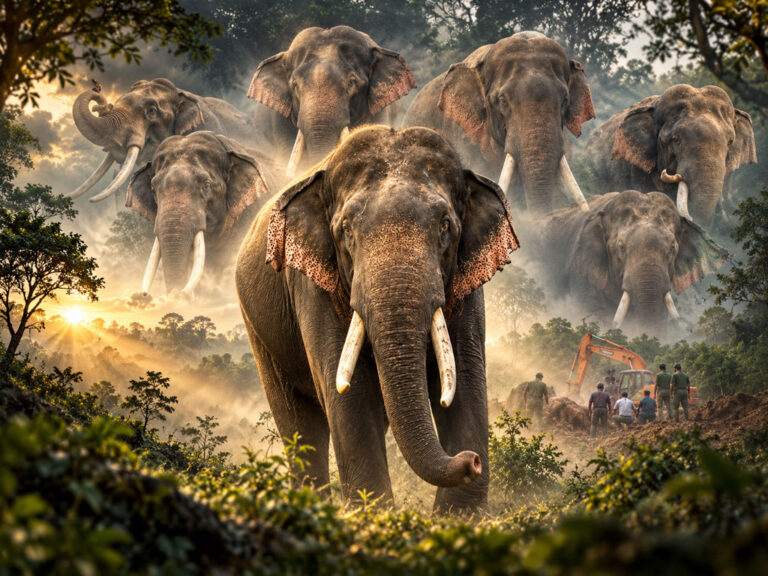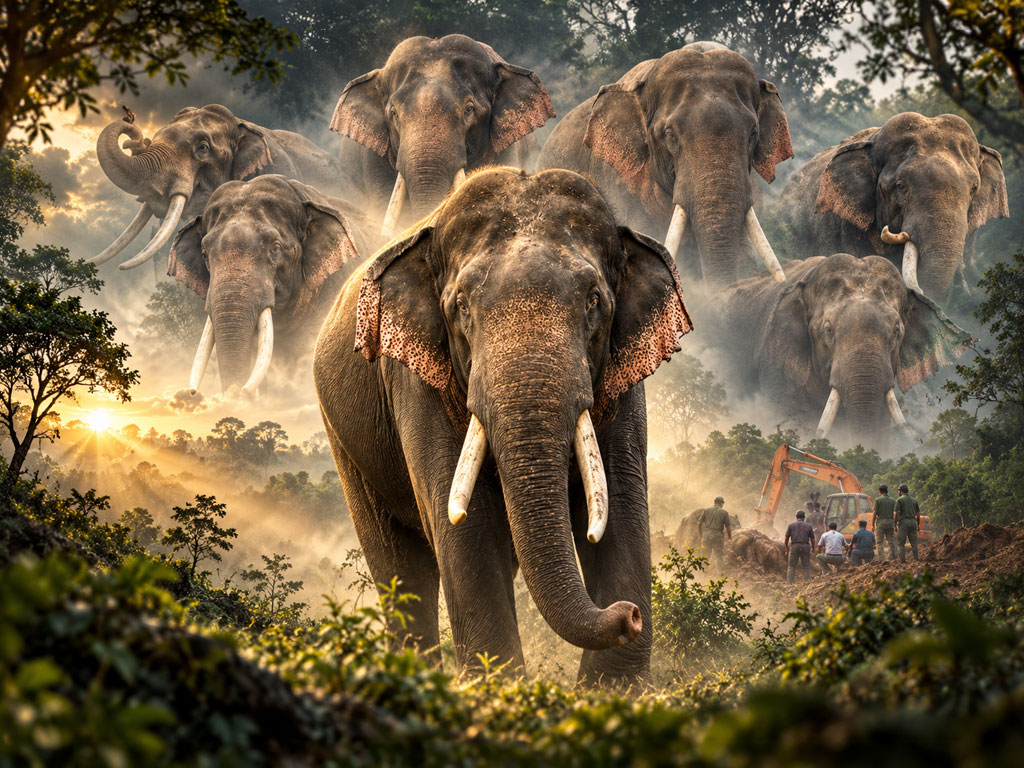
From the legendary Parakrama and Deegadanthu to Bathiya, Unicorn and Kavantissa, Sri Lanka has lost some of its most extraordinary wild elephants to shootings, electrocution, injuries and failed human interventions. Their stories reveal the growing cost of human-elephant conflict and the urgent need to protect the country’s remaining tuskers.
COLOMBO, October 17, 2026 — The death of Kavantissa, one of Sri Lanka’s largest and most admired wild tuskers, on Friday evening has brought renewed attention to a painful chapter in the country’s wildlife history: the repeated loss of extraordinary elephants whose lives were cut short by injuries, illegal electric fences and encounters with humans.
Kavantissa died at approximately 6.18 p.m. on October 16 after weeks of veterinary treatment for a suspected gunshot injury to his right foreleg. He had been found collapsed in the Siyambalangamuwa area earlier that day.
His passing follows the deaths of several other well-known tuskers, including Bathiya, Deegadanthu 1, Revatha, Barana and Parakrama.
For wildlife enthusiasts, photographers and communities living near Sri Lanka’s national parks, these were not anonymous animals. Many were recognised individually, sometimes over decades, by their distinctive tusks, appearance and behaviour.

Sri Lanka is home to approximately 7,000 to 7,500 wild elephants, although estimates vary by survey and year. Only a small proportion of the country’s male Asian elephants develop prominent tusks. The source material places that proportion at approximately 5% to 6%, a figure requiring confirmation against the latest scientific estimates.
Each mature tusker consequently represents an especially visible and valued part of Sri Lanka’s natural heritage.
Their loss also exposes the limitations of wildlife protection in landscapes where agricultural expansion, shrinking habitats, dangerous electrical installations and firearms increasingly threaten elephants.
1. Bathiya: The Gentle Giant of Nikaweratiya
Died: July 15, 2025 | Estimated age: 30–35 years
Bathiya, also widely known as Bhathiya, was a familiar tusker in the Nikaweratiya, Mahawa and surrounding forest regions.
Remembered by local residents for his relatively gentle behaviour and distinctive appearance, he became the focus of a major wildlife rescue effort after suffering serious gunshot injuries.
The original account describes an injury sustained in late 2024 and a prolonged struggle lasting more than eight months. Contemporary reports, however, document serious injuries during the first half of 2025, including a gunshot wound that left his front leg badly damaged.
His condition deteriorated further after he fell into a water-filled pit near Polpithigama.
Wildlife veterinarians, university specialists and Sri Lanka Army personnel joined efforts to keep him alive, providing medical treatment, food, water and physical support.
Despite those efforts, Bathiya died on the morning of July 15, 2025.
Veterinary reports described severe muscle deterioration and impaired blood circulation following his prolonged immobility.
His death demonstrated how a gunshot injury can become fatal long after the initial wound, particularly when an elephant loses the ability to move and feed normally.
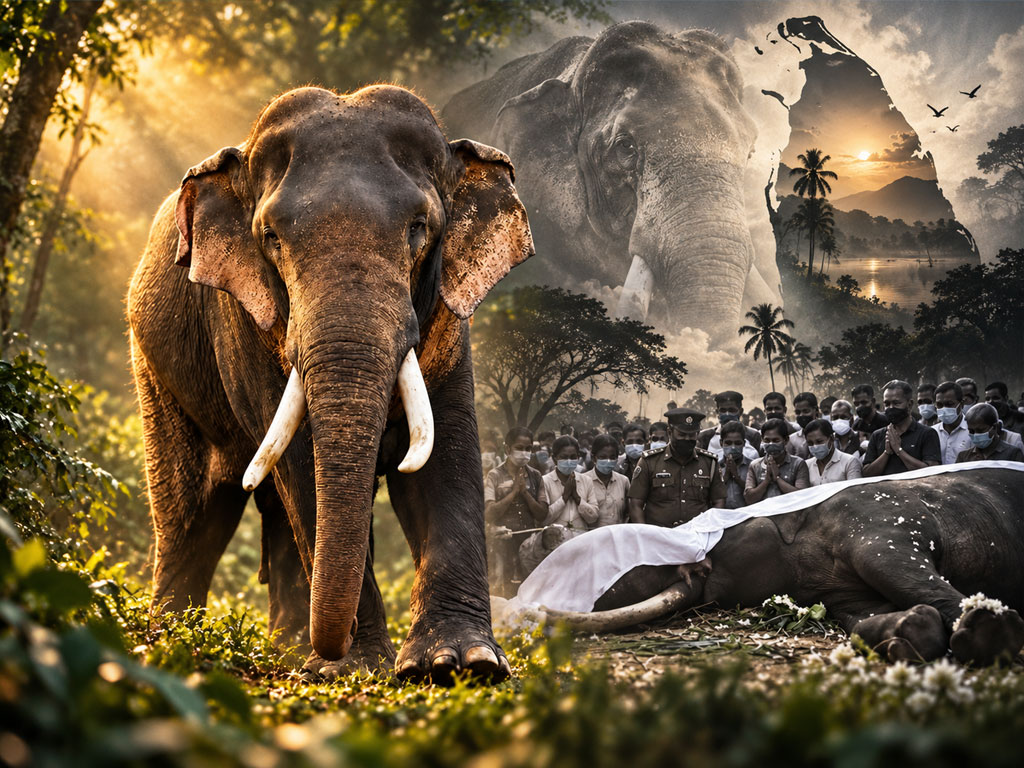
One of Sri Lanka’s most celebrated wild elephants died on Friday evening after his condition deteriorated despite weeks of veterinary care for a suspected gunshot injury.
Read More2. Deegadanthu 1: The King of Kala Wewa
Died: November 28, 2024 | Estimated age: 45–50 years
Deegadanthu 1 was among the most recognisable tuskers roaming the Kala Wewa and Kahalla-Pallekele areas.
His exceptionally long tusks made him a favourite among wildlife photographers and visitors.
The elephant died after encountering an illegally installed electrified wire near Galkiriyagama in the Anuradhapura District.
A subsequent post-mortem examination identified a fatal cardiac event resulting from a high-voltage electric shock.
The original account identifies the voltage as 23,000 volts. That precise figure has not been independently established from the veterinary or electrical investigation records.
Police subsequently arrested a suspect in connection with the incident.
Deegadanthu’s death drew widespread public criticism of dangerous electrical installations used around agricultural land.
An animal that had survived for decades in the wild was killed by a human-made hazard in an area through which elephants regularly travelled.
3. Barana: The Tusker of Namal Uyana
Reported death: July 2022 | Estimated age: 40–45 years
Barana, also referred to as Bharana, was another prominent elephant associated with the Kala Wewa and Namal Uyana regions.
He was admired for his appearance and the manner in which he carried his tusks.
The supplied account states that he died after coming into contact with an electrified wire installed to protect cultivated land.
It also alleges that his body showed signs of burning when wildlife officers arrived.
Earlier reporting has referred to Barana among notable tuskers lost to electrocution. However, the precise date, circumstances and forensic findings supplied for his death have not been independently confirmed.
His story nonetheless reflects a documented danger facing elephants that move between protected forests and agricultural settlements.
4. Revatha: The Gentle Tusker of Kala Wewa
Died: March 9, 2021 | Reported age: approximately 50–55 years
Revatha, also spelled Rewatha, was one of the best-known tuskers in the Kala Wewa and Balalu Wewa regions.
Wildlife officials described him as an animal without a recorded history of attacking humans or damaging property.
His death on March 9, 2021, caused widespread concern.
Revatha was electrocuted after coming into contact with an improperly installed electric fence associated with agricultural cultivation inside or near the forest reserve.
The incident was investigated by wildlife officials and police, with court proceedings subsequently examining the electrical equipment involved.
His death became a prominent example of the danger posed by illegal fencing installations that use electricity in ways capable of killing wildlife.
Revatha’s fate was especially troubling because an elephant need not behave aggressively or damage crops to encounter a lethal barrier.
5. Sankha: Kavantissa’s Young Companion
Reported death: 2022
Sankha was a young tusker frequently photographed alongside Kavantissa.
Their association was well known among people who followed the movements of wild elephants in the region.
According to accounts from wildlife observers, Sankha suffered a gunshot injury that left him with lasting difficulty walking.
The disability restricted his mobility and made it harder for him to escape dangerous terrain.
He subsequently fell into a pit and died.
A wildlife report published shortly before Kavantissa’s death also documented Sankha’s earlier gunshot injury and fatal fall.
The original account describes the young elephant as mischievous and a close companion of Kavantissa.
Although such descriptions reflect the affectionate language of observers rather than formal behavioural assessments, they illustrate how individual elephants become familiar to those who regularly encounter them.
Sankha’s death was another example of how injuries inflicted by humans can leave elephants vulnerable to later fatal accidents.
6. Unicorn: The One-Tusked Elephant of Minneriya
Found dead: March 2025 | Reported age: 40–45 years
Unicorn earned his name because he possessed only one prominent tusk, making him instantly recognisable among the elephants of Minneriya and Kaudulla.
His unusual appearance attracted considerable attention from wildlife enthusiasts and safari visitors.
In March 2025, the tusker was discovered dead in the Katukaliyawa area of Minneriya National Park.
Wildlife authorities suspected that he had been shot.
The original account also alleges an attempt to remove his remaining tusk, suggesting a possible ivory-related motive.
That alleged motive requires independent confirmation from the investigation. The presence of gunshot wounds does not, by itself, establish why the animal was targeted.
Nevertheless, Unicorn’s death was another serious loss among Sri Lanka’s relatively small population of visibly tusked elephants.
7. Koliya: The Young Tusker of Minneriya
Reported death: December 2024
Koliya was described in the supplied account as a young tusker roaming the Minneriya region.
Unlike the older bulls whose tusks had reached their full size, his were reportedly still developing.
According to the account, his body was discovered several weeks after death, when decomposition was already advanced.
It attributes his death to infection arising from multiple gunshot wounds.
The supplied information has not been independently corroborated through an official veterinary examination or contemporary report identifying Koliya by name.
Consequently, the precise date, medical findings and circumstances must be treated as reported details requiring further verification.
If substantiated, his death would demonstrate the particular vulnerability of young elephants that survive an initial injury but receive no treatment before complications develop.
8. The Cross-Tusked Elephant of Kumana
Reported death: January 17, 2007
Among the elephants remembered in the original account is a rare cross-tusked bull from the Kumana region.
His tusks reportedly curved across one another, creating a distinctive appearance.
The account states that the elephant was shot, suffered serious injuries to both front legs and subsequently sustained spinal damage after collapsing.
Veterinary teams reportedly attempted to support him using a sling during a rescue operation lasting three days.
Despite those efforts, the elephant died.
The precise medical chronology, date and original veterinary findings have not been independently authenticated.
The case nevertheless reflects the serious challenges involved in treating large wild elephants that suffer gunshot injuries or become unable to stand.
9. Podi Poottuwa: A Remembered Tusker of Yala
Reported death: 1980s
Podi Poottuwa is remembered in the source material as another distinctive cross-tusked elephant that roamed Yala.
The account states that he was shot and killed for his tusks during the 1980s.
It further claims that the whereabouts of his tusks remain unknown.
Those historical details require confirmation from original wildlife records and cannot presently be treated as independently established findings.
His inclusion reflects a broader concern that has persisted for decades: the vulnerability of rare, visually distinctive tuskers to deliberate killing.
10. Parakrama: The Great Tusker of Galgamuwa
Reported death: November 23, 2010 | Height: approximately nine feet
Parakrama, also remembered as the Siyambalangamuwa Maha Etha, was among Sri Lanka’s most celebrated wild tuskers.
His imposing stature and exceptionally long, symmetrical tusks made him a remarkable sight.
The original account estimates that his tusks exceeded five feet in length.
Unlike several other elephants in this feature, Parakrama’s death was associated with a government-managed relocation rather than a shooting or electric fence.
Following concerns arising from human-elephant conflict in the Galgamuwa area, authorities decided to capture and transport him elsewhere.
During the operation, part of the wooden floor of the transport vehicle reportedly gave way.
One of his hind legs became trapped, leaving him struggling to remain upright.
Despite efforts to free and stabilise the elephant, Parakrama died during the operation.
Historical wildlife reporting supports the account of the damaged transport vehicle and the elephant’s collapse.
The source attributes his death to transport-related stress and cardiac failure, although the precise quoted veterinary terminology requires confirmation from the original post-mortem report.
Parakrama’s death became a warning about the risks associated with capturing and transporting mature wild elephants.
It also demonstrated that interventions intended to address human-elephant conflict can themselves become deadly when equipment, planning or animal welfare arrangements are inadequate.
Kavantissa: Another Giant Added to the List
Died: October 16, 2026 | Time: approximately 6.18 p.m.
Kavantissa’s death adds another prominent name to the country’s record of lost tuskers.
The elephant had been receiving treatment since September 24 for an injury to his right foreleg, reportedly sustained from gunfire.
Although the wound initially showed some improvement, his health deteriorated as he developed further complications and stopped eating.
On October 16, he was found collapsed in the Siyambalangamuwa area.
Despite veterinary efforts, he died that evening.
A post-mortem examination was scheduled for October 17 to establish the precise cause of death. At the time of writing, its findings had not been confirmed.
Kavantissa’s death is particularly poignant because the threat posed by gunshot injuries had already claimed other elephants associated with him, including Sankha.
A Wider Crisis Beyond Individual Deaths
The loss of famous tuskers forms part of a much larger human-elephant conflict.
Elephants are killed by gunfire, illegal electrical installations, explosives concealed in food, poisoning and accidents. Human lives are also lost when elephants enter settlements and agricultural areas.
Reporting published in October 2026, drawing on Sri Lanka’s human-elephant conflict data, indicated that an average of approximately 402 elephants and 138 people had died annually since 2019.
The deaths are not limited to animals with tusks. Female elephants, calves and tuskless males also face the consequences of shrinking habitats, fragmented migration routes and dangerous encounters with people.
Protecting elephants therefore requires more than responding to individual tragedies.
Effective conservation depends on maintaining safe movement corridors, preventing illegal electrical connections, responding rapidly to injured wildlife and developing workable methods of protecting farming communities.
Farmers also need practical assistance to protect their crops and livelihoods without resorting to measures that place elephants and people at risk.
What Can the Public Do?
1. Report suspected illegal electric wires to the police, wildlife authorities or the electricity provider. Never approach, touch or attempt to remove an electrical installation. The original source recommends calling 1992, but that number should be verified as the appropriate reporting contact before publication.
2. If gunshots are heard near wildlife habitats or an injured elephant is discovered, inform the nearest wildlife office or police station. Do not approach the animal or interfere with veterinary rescue operations.
3. Share accurate information about elephant conservation, particularly within communities affected by human-elephant conflict. Public awareness is most effective when it encourages safe practices rather than confrontation between farmers and wildlife.
The Giants We Cannot Bring Back
Bathiya, Deegadanthu, Barana, Revatha, Sankha, Unicorn, Koliya, the Kumana tusker, Podi Poottuwa and Parakrama represent different generations of wild elephants whose stories have become part of Sri Lanka’s wildlife memory.
Some of their deaths are supported by detailed contemporary reporting and veterinary findings. Others survive primarily through historical accounts or observations that require further documentation.
What unites them is the loss of animals that occupied a distinctive place in the country’s forests and in the memories of people who encountered them.
Kavantissa now joins that history.
The task facing Sri Lanka is not simply to remember the tuskers that have died, but to protect those still moving through its forests, reservoirs, grasslands and agricultural landscapes.
Every successful intervention, every dangerous illegal electrical installation removed and every wildlife corridor protected may prevent another familiar elephant from becoming a name in a memorial.
The country cannot bring its fallen giants back. It can still decide how many more it is prepared to lose.