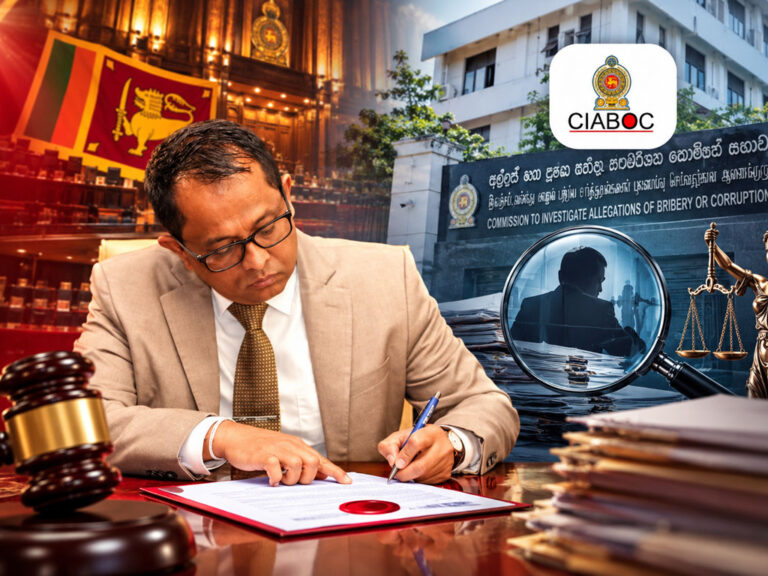
COLOMBO — Speaker of Parliament Dr. Jagath Wickramaratne has certified legislation designed to strengthen Sri Lanka’s anti-corruption framework while a complaint concerning his own conduct remains under investigation by the Commission to Investigate Allegations of Bribery or Corruption (CIABOC), placing the question of parliamentary accountability firmly in the public spotlight.
Parliament announced on October 19, 2026, that the Speaker had endorsed the Anti-Corruption (Amendment) Bill, formally bringing the Anti-Corruption (Amendment) Act, No. 25 of 2026, into law.
The legislation addresses legal, administrative and interpretative difficulties arising from the Anti-Corruption Act, No. 9 of 2023. It also seeks to strengthen investigative and prosecutorial arrangements, improve CIABOC’s administrative functions and streamline the submission of asset and liability declarations through a centralised electronic system.
The Bill was introduced on August 19 and passed with amendments on October 8, without a division.
Although the Speaker’s certification is a constitutional function under Article 79, the circumstances surrounding his continued tenure have prompted questions about the standards of conduct expected from the presiding officer of the country’s legislature.

CIABOC Investigation Places Speaker Under Scrutiny
The controversy extends beyond political disagreement.
In September, the Sunday Times reported that CIABOC had obtained documentation concerning employees attached to the Speaker’s official residence, including staff particulars, salaries and vehicle usage.
The investigation followed a complaint lodged by former Deputy Secretary-General of Parliament Chaminda Kularatne.
The existence of an investigation does not establish misconduct, and the available reporting does not demonstrate that the Speaker has been convicted of any corruption offence.
Nevertheless, the fact that allegations concerning a senior parliamentary officeholder are being examined by the same institution whose powers Parliament has sought to strengthen creates a legitimate question about public confidence.
Opposition parliamentarian Dayasiri Jayasekara had previously argued that it would be inappropriate for the Speaker to preside over the anti-corruption amendments or certify the legislation while the complaint remained under investigation.
That objection concerns the appearance of institutional independence rather than the legal validity of the Act.
Missing Records and Allegations of Interference
Separate reporting has drawn attention to concerns over records maintained at the Speaker’s official residence.
On September 30, The Morning reported that Pasan Athukorala, identified as the Manager of the Speaker’s Bungalow, had confirmed that a register recording items removed from the residence was missing.
According to that report, the disappearance had been brought to Parliament’s attention.
The reported absence of the register raises questions about recordkeeping and administrative oversight. It does not, without further evidence, establish who was responsible for its disappearance or whether any record was deliberately destroyed to obstruct an investigation.
The Opposition has also submitted a no-confidence motion containing numerous allegations relating to the Speaker’s administration, use of public resources and parliamentary conduct.
Among the allegations is interference with bribery investigations.
These remain accusations rather than established findings. Any determination of wrongdoing must depend on evidence obtained through lawful investigative procedures.
The Alleged 12-Page Letter to the President
A further controversy concerns reports that Parliament’s Secretary-General, Kushani Rohanadeera, sent a confidential 12-page communication to President Anura Kumara Dissanayake.
The Morning Telegraph previously reported allegations that the communication concerned inappropriate treatment of the Secretary-General and interference with her statutory administrative responsibilities.
The reported allegations included:
- Interference with the Secretary-General’s ability to discharge her independent administrative duties.
- Alleged pressure concerning internal parliamentary decisions and established procedures.
- Claims of inappropriate conduct towards senior parliamentary officials.
- Assertions that the President and senior Government figures had expressed concern over the situation.
However, the alleged letter has not been independently authenticated, and its full contents have not been publicly established.
Claims that the President directly instructed the Speaker to resign have also circulated, but the precise wording of any such communication has not been independently verified.
These limitations are particularly important because accusations involving interference with parliamentary officers and investigative processes carry serious implications for both institutional integrity and individual reputation.
They cannot responsibly be treated as proven merely because they have entered political discussion.
International Precedents for Resignation Amid Controversy
The dispute invites comparison with international cases in which senior officeholders resigned following controversy or corruption investigations.
Michael Martin, United Kingdom, 2009
Former House of Commons Speaker Michael Martin announced his resignation in May 2009 amid intense criticism of his handling of the parliamentary expenses scandal.
He relinquished office in June after coming under pressure from lawmakers who argued that his leadership had damaged confidence in Parliament.
His departure illustrated how a loss of institutional confidence can result in resignation without a criminal conviction of the officeholder.
Nosiviwe Mapisa-Nqakula, South Africa, 2024
South African National Assembly Speaker Nosiviwe Mapisa-Nqakula resigned from both the Speakership and Parliament in April 2024 amid a corruption investigation concerning her previous tenure as Defence Minister.
She maintained her innocence and stated that her resignation should not be interpreted as an admission of guilt.
South Africa’s Parliament confirmed that her decision reflected concern for the integrity and reputation of the institution.
António Costa, Portugal, 2023
Portuguese Prime Minister António Costa resigned in November 2023 after a corruption investigation involving members of his administration.
He denied wrongdoing, and subsequent developments raised serious doubts about aspects of the investigation that had precipitated his resignation.
His case demonstrates another important principle: resignation during a controversy should not be confused with proof of guilt, and the fairness of investigations remains essential.
These international examples involve differing legal and political circumstances. They do not establish that Sri Lanka’s Speaker is constitutionally required to resign, but they demonstrate the importance placed on institutional confidence in other parliamentary systems.
Constitutional Legality and Political Accountability
The certification of legislation by the Speaker is a constitutional responsibility.
Under Article 79 of Sri Lanka’s Constitution, the Speaker’s certificate forms part of the process through which legislation approved by Parliament becomes law.
Questions about the personal conduct of the officeholder do not, by themselves, invalidate legislation certified through the applicable constitutional procedure.
The distinction between legal validity and political accountability is therefore central to the present controversy.
The Anti-Corruption (Amendment) Act, No. 25 of 2026, remains a substantive legislative measure intended to address deficiencies in Sri Lanka’s anti-corruption framework.
Its effectiveness will depend on enforcement, institutional independence and the capacity of the authorities responsible for investigating corruption.
At the same time, public confidence in such legislation is influenced by the conduct of those responsible for parliamentary oversight.
The Speaker is expected to uphold the dignity and impartiality of Parliament, exercise authority without improper interference and respect the independence of officials responsible for its administration.
These responsibilities carry particular importance when complaints involving the officeholder are being examined.
Three Options in the Accountability Debate
The controversy has generated discussion about possible responses to the allegations.
Three broad options arise from the principle of institutional accountability:
- Remaining in office while cooperating with investigations: The Speaker could continue exercising his constitutional duties while making relevant records available and avoiding interference with investigative authorities.
- Temporarily refraining from appropriate functions: Subject to the Constitution and parliamentary procedures, arrangements could be considered to minimise perceived conflicts during the investigation. Any transfer of responsibilities would require a proper legal basis.
- Resigning from the Speakership: The Speaker could voluntarily relinquish office if he concluded that continued controversy had materially impaired confidence in his leadership.
None of these options should be presented as an automatic legal consequence of a complaint.
An allegation alone does not remove a person’s constitutional rights or establish guilt.
The appropriate response must balance procedural fairness, the independence of investigations and the duty to preserve confidence in Parliament.
The Test of Institutional Integrity
Sri Lanka’s anti-corruption reforms will ultimately be judged not merely by legislative amendments but by whether public institutions apply accountability standards consistently.
The investigation involving the Speaker requires an impartial process in which relevant documents are preserved, witnesses can provide information without improper pressure and conclusions are reached on evidence rather than political allegation.
Equally, the Speaker must be afforded the presumption of innocence and a fair opportunity to respond to the accusations.
The reported disappearance of official-residence records, the allegations concerning parliamentary administration and the unresolved CIABOC complaint underline the need for clear, verifiable explanations.
The next significant development will be whether investigators establish facts sufficient to support further action, dismiss the allegations or recommend other measures.
The Speaker’s certification of the anti-corruption amendments is constitutionally significant. The continuing inquiry into his conduct is separately significant for public confidence.
Maintaining that distinction, while ensuring neither parliamentary authority nor investigative independence is compromised, will be a critical test of Sri Lanka’s commitment to accountable governance.