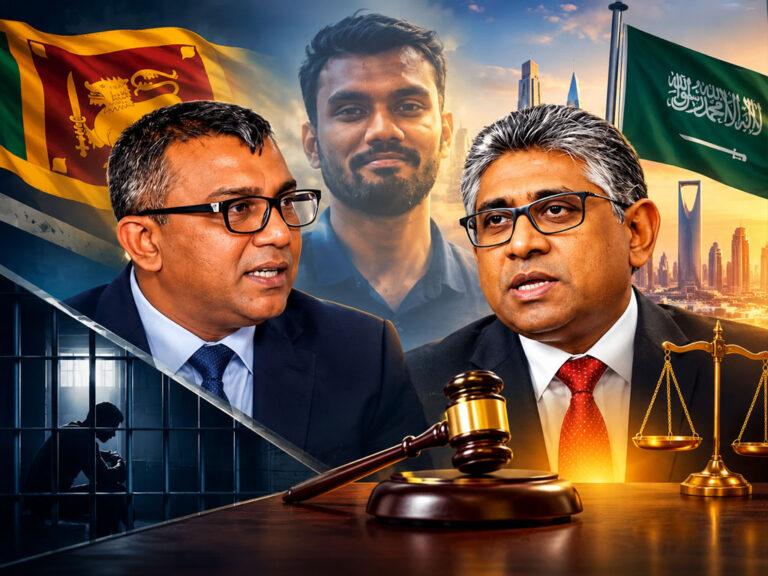
COLOMBO — When Sri Lankan national Anojan Sivarasa faced execution in Saudi Arabia over a social media comment deemed offensive to Islam, two senior Sri Lankan lawyers joined a wider legal and diplomatic mission to challenge the death sentence, setting aside religious, ethnic and political differences in an effort to save a fellow citizen.
President’s Counsel Faiszer Musthapha and President’s Counsel Upul Kumarapperuma have spoken about the personal convictions, emotional circumstances and legal challenges that prompted their involvement in the case.
Their intervention formed part of a coordinated effort involving the Sri Lankan Government, its diplomatic mission in Saudi Arabia, the Attorney General’s Department and Saudi legal practitioners.
On October 13, 2026, the Supreme Court of Saudi Arabia set aside the death sentence previously imposed on Sivarasa, following an appeal challenging the judgment.
The decision marked a substantial legal victory, although it did not amount to an acquittal or an order for his immediate release. The case was referred for further judicial consideration, and his detention and ultimate legal position remained unresolved in the latest verified reporting.
Beyond the legal outcome, the lawyers’ account of their involvement offers a powerful illustration of humanitarian solidarity across Sri Lanka’s ethnic and religious communities.
A Father’s Grief Becomes a Reason to Act
For Kumarapperuma, the decision to become involved was deeply personal.
Having experienced the death of his own son, the senior lawyer said he understood the devastating anguish that Sivarasa’s parents would endure if their child were executed.
In remarks attributed to him during a recent television discussion, Kumarapperuma explained:
“I know what it means to lose a child… I thought of the pain that father and mother are suffering. If something had happened, there is the situation that father and mother would be in. I always think that it should not happen to anyone in society. That is why I told Faiszer that we should make this journey.”
His account placed the parents’ suffering at the centre of the decision.
The mission was not simply about contesting a judicial ruling. It was also about preventing another family from experiencing a loss that the lawyer understood through personal tragedy.
Musthapha similarly emphasised that neither the prisoner’s ethnicity nor his religion had influenced their decision to help.
“We never looked at this issue from a racist perspective. Religion was never important to us. We always looked at it as Sri Lankans. Our only aim was to save a Sri Lankan brother from the death penalty.”
He acknowledged that accepting responsibility for such a sensitive intervention involved considerable public scrutiny, particularly because failure could have attracted criticism.
Nevertheless, the lawyers proceeded with the mission, viewing Sivarasa primarily as a Sri Lankan citizen in urgent need of legal assistance.
How a Facebook Dispute Led to a Death Sentence
Sivarasa, a Tamil Sri Lankan who had travelled to Saudi Arabia for employment, became embroiled in a legal case arising from a Facebook comment made during an online disagreement involving religious matters in Sri Lanka.
Saudi authorities considered the comment insulting to Islam and the Prophet Muhammad.
The case initially proceeded under Saudi Arabia’s anti-cybercrime legislation.
The Al-Ahsa Criminal Court sentenced Sivarasa to five years’ imprisonment and imposed a fine of three million Saudi riyals.
Subsequent appeals resulted in a significantly harsher outcome when an appellate court imposed the death penalty.
The escalation transformed the case into a matter of urgent diplomatic and humanitarian concern.
It also highlighted the risks faced by migrant workers navigating legal systems that differ substantially from those in their home countries.
Kumarapperuma used the case to emphasise the importance of respecting religious beliefs and understanding the laws of a country before travelling or working there.
In his television remarks, he argued that disputes involving religion and ethnicity should not be used to attack the beliefs of others through social media.
Musthapha made a similar observation, stressing that conduct which may not constitute a criminal offence in Sri Lanka can carry serious legal consequences elsewhere.
These observations were presented as lessons about cultural awareness and legal responsibility. They do not diminish the importance of due process, access to legal representation or proportionality in sentencing.
Sri Lankan and Saudi Lawyers Join Forces
The mission required cooperation between legal professionals operating within different jurisdictions.
The Sri Lankan legal delegation included:
- President’s Counsel Faiszer Musthapha.
- President’s Counsel Upul Kumarapperuma.
- Additional Solicitor General and President’s Counsel Azard Navavi.
- Attorney-at-Law Hafeel Farisz.
The delegation travelled to Saudi Arabia in early October and worked with local legal practitioners to prepare the appeal.
Sri Lanka’s Ministry of Foreign Affairs, its diplomatic representatives and senior Government officials also played important roles in facilitating the legal process.
President Anura Kumara Dissanayake and Foreign Minister Vijitha Herath supported efforts to secure relief, while Sri Lankan Ambassador to Saudi Arabia Amir Ajwad maintained diplomatic contact with the relevant authorities.
The intervention was therefore a collective effort rather than an achievement attributable to any single individual.
The legal team submitted its challenge to the Saudi Supreme Court, contesting the grounds on which the death sentence had been imposed.
The Legal Argument That Changed the Case
A central issue in the proceedings concerned the legal classification of the alleged offence under Islamic law.
The distinction between Hadd and Ta’zir offences was particularly important to the defence’s arguments.
Hadd refers to a category of offences associated with prescribed punishments under Islamic jurisprudence, while Ta’zir generally allows greater judicial discretion in determining punishment.
According to Musthapha’s account, challenging the classification of the alleged offence was a critical part of the legal strategy.
He explained that moving the case away from the more restrictive legal category could allow the court greater discretion when reconsidering the punishment.
The Sunday Times subsequently reported that the defence had also challenged ambiguities in Sivarasa’s recorded confession, including wording that his lawyers argued may have reflected the translator’s language rather than the accused person’s own religious expression.
These arguments formed part of the wider legal challenge presented to the Saudi authorities.
On October 13, the Saudi Supreme Court set aside the death sentence.
The ruling was a major breakthrough, but the legal distinction is essential: overturning a death sentence does not necessarily conclude the underlying criminal proceedings.
Sivarasa’s case remained subject to further judicial consideration, and the ultimate sentence and his prospects for release had not been conclusively established.
A Victory Beyond Ethnic and Religious Differences
Beyond the courtroom, the lawyers’ reflections carried a broader message about national identity.
Sivarasa is Tamil. Musthapha is Muslim, while Kumarapperuma comes from the Sinhalese community.
Yet both lawyers described their involvement as an expression of shared Sri Lankan identity rather than ethnic or religious solidarity.
Kumarapperuma argued that Sri Lankans have become accustomed to viewing themselves through separate communal identities, sometimes overlooking the citizenship and humanity they share.
In remarks attributed to him, he observed:
“We have become separate to be Muslim, separate to be Sinhala, separate to be Tamil. Even when we go to a foreign country, we look only for our own piece. We do not look for the common part.”
His central argument was that national unity must be demonstrated through practical actions, particularly when fellow citizens face hardship abroad.
The case drew concern across religious communities, with Buddhist religious leaders and other groups supporting appeals for intervention on Sivarasa’s behalf.
Such cooperation demonstrated how a humanitarian cause could attract support across divisions that have historically shaped Sri Lankan society.
No Recognition Sought, Only the Satisfaction of Helping
Musthapha said that neither lawyer had travelled to Saudi Arabia to defend the original social media comments or minimise the legal issues involved.
Their purpose, he explained, was to prevent the imposition of the death penalty and obtain a lawful opportunity for relief.
He described the outcome as one of the most meaningful experiences of his professional life.
“We by no means went to justify the wrong that was done. But the greatest happiness we received in my life, as well as in Upul’s life, is this opportunity to save a Sri Lankan who had been condemned to death. We do not need felicitation ceremonies. That happiness is enough for us.”
The statement reflected a distinction between defending a person’s right to fair legal treatment and endorsing the conduct that led to prosecution.
The mission also illustrated the responsibility of the State to assist citizens facing serious legal difficulties overseas, particularly where the consequences may be irreversible.
For Sivarasa’s family, the Supreme Court ruling removed the immediate death sentence that had caused grave concern.
Yet the remaining proceedings must still determine his future.
The legal and diplomatic teams’ continuing responsibility is to pursue a fair resolution, clarify his custodial position and seek an outcome consistent with the applicable legal process.
For Sri Lanka, the case carries a lesson that extends beyond the fate of one citizen: national solidarity acquires its greatest meaning when people are prepared to act across ethnic, religious and political boundaries to protect another person’s life.