A complaint concerning a letter reportedly issued by former Financial Crimes Investigation Division (FCID) chief Ravi Waidyalankara in July 2016 has revived questions about the handling of investigations into the Krrish property development project and the proceedings involving Parliamentarian Namal Rajapaksa.
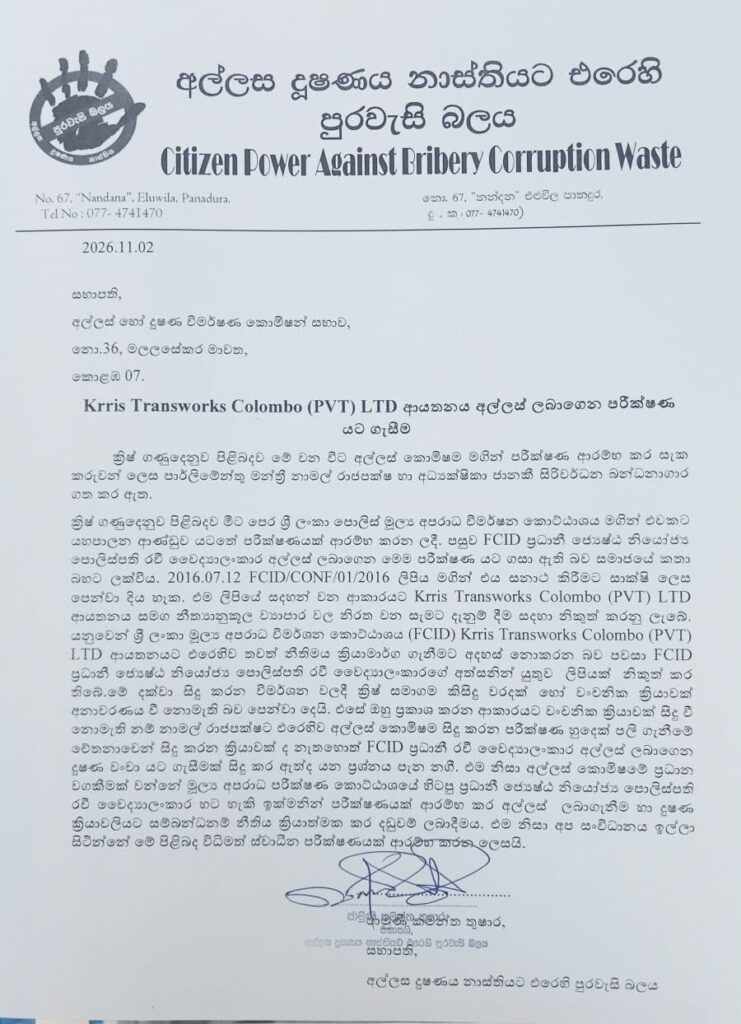
The complaint, attributed to the organisation Citizens’ Power Against Bribery, Corruption and Waste, calls for scrutiny of a communication in which the FCID reportedly informed Krrish Transworks that investigations conducted up to that point had not disclosed wrongdoing by the company.
The document has attracted renewed attention as the Commission to Investigate Allegations of Bribery or Corruption (CIABOC) pursues allegations concerning financial transactions linked to the Krrish project.
Its emergence raises an important question: What was the legal and evidentiary basis of the FCID’s earlier assurance, and how does that conclusion relate to the subsequent investigations?
The answer requires a distinction between an investigative assessment concerning a company, allegations against particular individuals and evidence that may have emerged after the original letter was issued.

What Did the 2016 FCID Letter Say?
According to the complaint, the relevant letter was issued on 12 July 2016 under the authority of then Senior Deputy Inspector General of Police Ravi Waidyalankara, who headed the FCID.
The correspondence concerned investigations into sponsorship provided by the Krrish group for a rugby tournament.
It reportedly stated that inquiries conducted until that date had not established wrongdoing or fraudulent conduct by the company and indicated that the FCID did not intend to pursue further legal action against it.
The letter was also reportedly intended to reassure parties maintaining legitimate commercial relationships with Krrish.
The correspondence has become significant because the financial transactions associated with the project have subsequently featured in criminal proceedings.
However, the wording and legal effect of the document are central to any proper assessment.
An investigative agency’s statement that no offence had been identified by a company at a particular stage does not necessarily amount to a judicial finding, nor does it automatically prevent investigators from pursuing separate allegations against individuals.
Determining whether the letter was justified therefore requires examination of the evidence available in July 2016, the scope of the investigation to which it referred and the authority under which it was issued.

Krrish Case: Court Rejects Namal Rajapaksa’s Bail Request
Colombo Chief Magistrate Asanga S. Bodaragama rejected Namal Rajapaksa’s bail application in the investigation into an alleged Rs. 70 million bribery transaction involving the Krrish development project in Colombo Fort.
READ FULL STORY ↗Earlier Allegations Against Waidyalankara
Questions about the FCID correspondence are not entirely new.
In 2023, a complaint reported by The Sunday Morning alleged irregularities in Waidyalankara’s handling of the Krrish investigation.
That complaint was submitted by Voice Against Corruption convener Wasantha Samarasinghe.
It referred to correspondence between Krrish representatives and the former FCID chief, including a request for reassurance that the investigation would not adversely affect the company’s relationships with banks, contractors and other commercial parties.
According to the complaint, Waidyalankara subsequently issued a letter indicating that the investigation had not disclosed wrongdoing by the company and that further legal action against it was not contemplated.
Samarasinghe questioned whether such an assurance was appropriate while related matters were before the courts and called for an investigation into the circumstances in which it had been issued.
The complaint also raised allegations of possible improper influence.
Those allegations do not, by themselves, establish that Waidyalankara accepted a bribe, suppressed evidence or committed misconduct.
Such conclusions would require evidence examined through an independent investigative process.
Why the Namal Rajapaksa Investigation Matters
The renewed controversy comes against the background of CIABOC proceedings concerning an alleged Rs. 70 million payment connected to the Krrish development project at Transworks Square in Colombo Fort.
According to submissions reported from court, investigators allege that payments were made through businessman Nimal Perera to Namal Rajapaksa in connection with facilitating the allocation of land and obtaining approvals for the project.
The allegations concern transactions said to have taken place in 2012.
CIABOC has maintained that its investigation into alleged bribery is separate from the High Court proceedings involving the alleged misuse of money provided for rugby promotion.
That distinction is particularly important when considering the 2016 FCID letter.
A document addressing whether Krrish Transworks itself had committed wrongdoing in relation to rugby sponsorship may not necessarily resolve allegations concerning whether money was improperly received by a public figure or used for another purpose.
The underlying transactions may overlap, but the alleged offences and the legal questions arising from them are not necessarily identical.
Rajapaksa remains entitled to the presumption of innocence, and allegations advanced during an investigation should not be treated as findings of guilt.
Does the FCID Letter Undermine the Current Case?
The complaint raises a question that deserves a clear, evidence-based response.
If investigators previously concluded that no wrongdoing had been established, what evidence supports the decision to pursue subsequent proceedings?
There may be several legally significant explanations.
Investigators could have obtained additional documents, witness statements or financial records after the earlier assessment.
They may have been examining different alleged offences or the conduct of different individuals.
Alternatively, the original decision to issue the letter may warrant scrutiny if it was made without sufficient evidentiary grounds or while relevant investigative steps remained incomplete.
None of these possibilities should be presumed without examining the relevant records.
CIABOC should therefore be able to explain the scope of the earlier investigation and the basis upon which the present proceedings differ.
At the same time, the existence of the FCID letter does not, on its own, demonstrate that the current investigation is politically motivated.
Nor does the continuation of proceedings establish that the former FCID chief acted improperly.
Both propositions require proof.
Should Ravi Waidyalankara Be Questioned?
Citizens’ Power Against Bribery, Corruption and Waste has reportedly requested an independent investigation into the circumstances surrounding Waidyalankara’s letter.
Such scrutiny would be appropriate if the complaint identifies grounds for suspecting that the correspondence was improperly issued or that relevant evidence was disregarded.
Investigators could examine:
1. The original FCID case file, including the evidence available when the letter was issued on 12 July 2016.
2. The authority for issuing the correspondence, including whether the decision complied with applicable investigative procedures.
3. The scope of the assurance provided to Krrish, particularly whether it concerned only the company’s activities or was intended to address a wider set of transactions.
4. Any outstanding investigative steps, including financial records or requests for examination of company documents that had not been completed.
5. Any evidence of improper influence, should the complaint contain verifiable information supporting that allegation.
6. The relationship between the earlier and current investigations, including whether subsequent evidence materially changed the position.
These questions could be examined without assuming wrongdoing by either Waidyalankara or Rajapaksa.
The Bribery Commission Must Be Seen to Act Impartially
The controversy also presents a broader challenge for Sri Lanka’s anti-corruption framework.
Public confidence depends not only on whether investigations are conducted, but also on whether similar standards are applied consistently to public officials, politicians, commercial entities and investigators themselves.
Where an earlier investigative decision appears inconsistent with subsequent proceedings, the discrepancy should be explained.
If credible evidence suggests that an official improperly interfered with an investigation, that allegation should be examined independently.
Equally, an earlier decision not to proceed against a company must not be treated as an automatic bar to investigating new allegations supported by evidence.
A credible anti-corruption system must be capable of correcting past investigative failures without allowing political considerations to determine who is investigated.
The central issue is therefore wider than the interests of any one politician or former police officer.
It concerns the integrity of investigative decisions and the public’s ability to understand why those decisions were made.
CIABOC’s response to the complaint, including any examination of the 2016 FCID letter, could help clarify whether the earlier correspondence was properly issued and how it relates to the evidence now before investigators.
Until that examination is completed, accusations of political persecution and deliberate concealment remain allegations rather than established conclusions.
The public interest lies in an independent inquiry, an accurate account of the evidence and the equal application of the law.