By Dwayne Ferreira
Scientists identify all five DNA and RNA nucleobases in asteroid Ryugu samples, offering new evidence about the chemical origins of life.
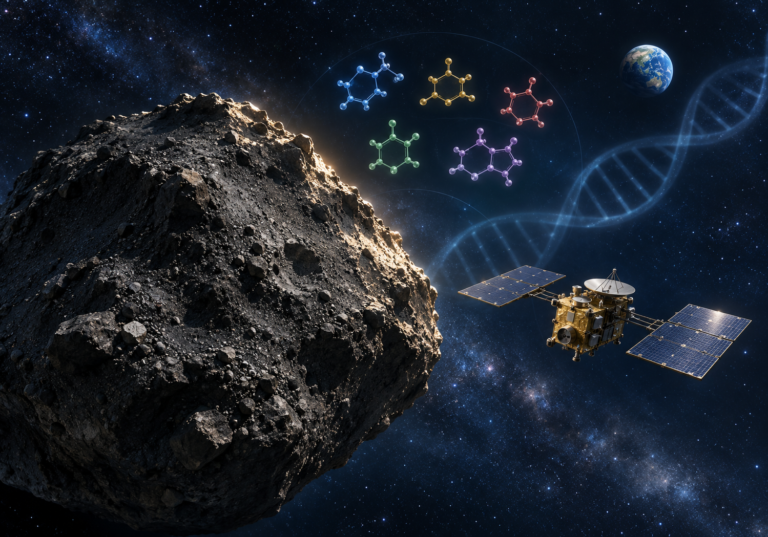
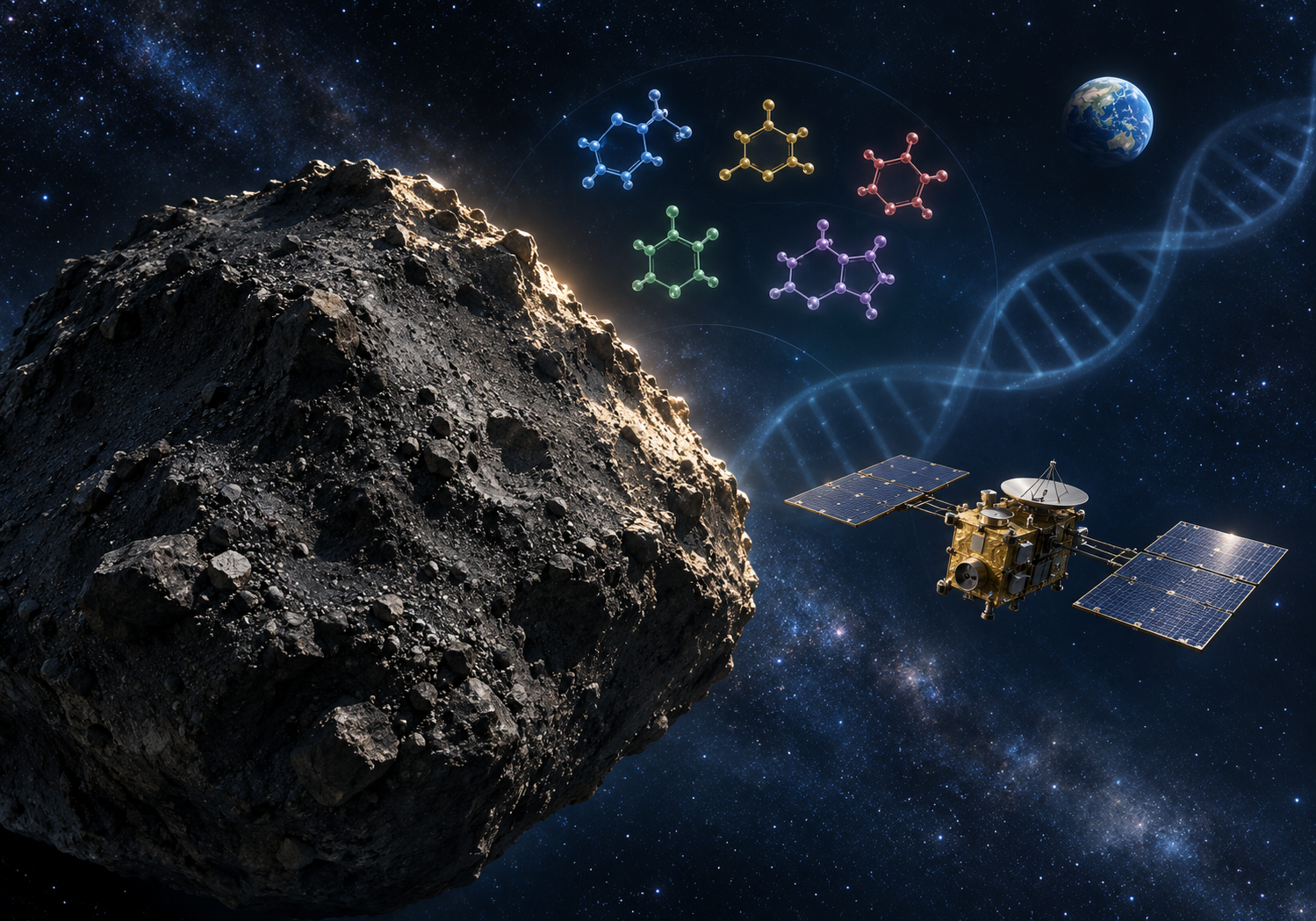
Scientists examining material collected from a 4.5-billion-year-old asteroid have identified all five nucleobases used by living organisms to construct DNA and RNA, adding to evidence that some of life’s essential chemical ingredients existed in space long before Earth became habitable.
The findings concern samples retrieved from asteroid Ryugu by Japan’s Hayabusa2 space mission.
Researchers detected adenine, guanine, cytosine, thymine and uracil, the five principal nucleobases associated with DNA and RNA.
The research was published in Nature Astronomy earlier in 2026 and has resurfaced in science coverage during November. It is therefore a scientific feature rather than a new discovery made on 4 November.

Chemical Ingredients of Life
DNA and RNA carry genetic information and perform essential functions in living organisms.
Their nucleobases are fundamental chemical components of these molecules.
Finding the complete set in extraterrestrial material provides further evidence that important organic compounds can form or survive beyond Earth.
The discovery does not mean that scientists have found life on Ryugu.
Nor does it establish that organisms originated in space.
Instead, it strengthens the possibility that asteroids contributed some of the chemical ingredients involved in the development of life on early Earth.
Samples Returned From Space
Japan’s Hayabusa2 mission collected material directly from Ryugu and returned it to Earth for scientific examination.
Because the samples were obtained and transported under controlled conditions, researchers were able to study extraterrestrial material with reduced exposure to terrestrial contamination.
Earlier investigations had identified the nucleobase uracil in Ryugu samples.
The subsequent identification of the remaining four canonical nucleobases provided a more complete understanding of the asteroid’s organic composition.
Comparable research involving samples collected from asteroid Bennu has also revealed important organic compounds.
What the Findings Mean
Scientists investigating the origins of life are attempting to understand how increasingly complex molecules developed from simpler chemical substances.
Asteroids and meteorites offer valuable evidence because they preserve material associated with the early Solar System.
Organic compounds delivered to the young Earth through impacts may have contributed to the chemical environment from which biological processes eventually emerged.
The Ryugu findings support that possibility, although the precise sequence of events leading to the emergence of life remains unresolved.
Future research will examine how these compounds formed, how they survived in space and whether similar chemical processes occurred elsewhere in the Solar System.