By Dwayne Ferreira
CERN rare particle decay research reveals evidence of a one-in-10-billion process after a 42-year search using Large Hadron Collider data.
GENEVA – Scientists working at CERN’s Large Hadron Collider have announced evidence of an extraordinarily rare particle decay, marking an important milestone in a scientific search that began more than four decades ago.
The finding was announced on 3 November by the LHCb collaboration, whose researchers study the behaviour of subatomic particles to test fundamental theories of physics.

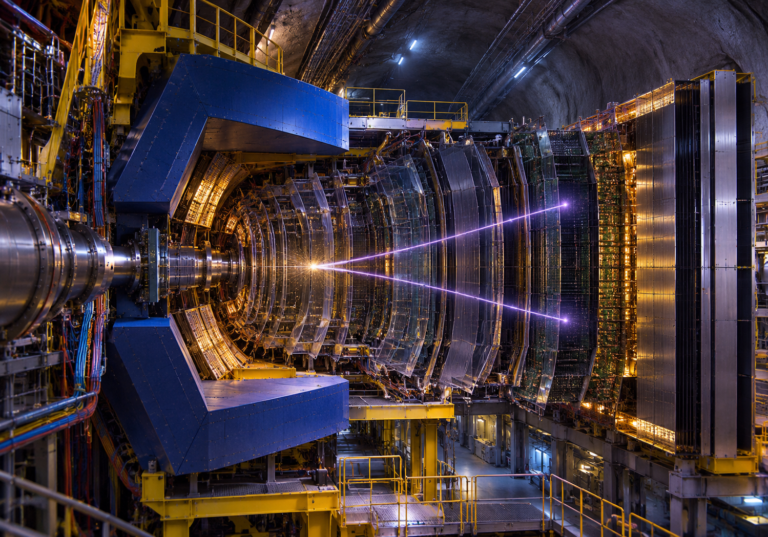
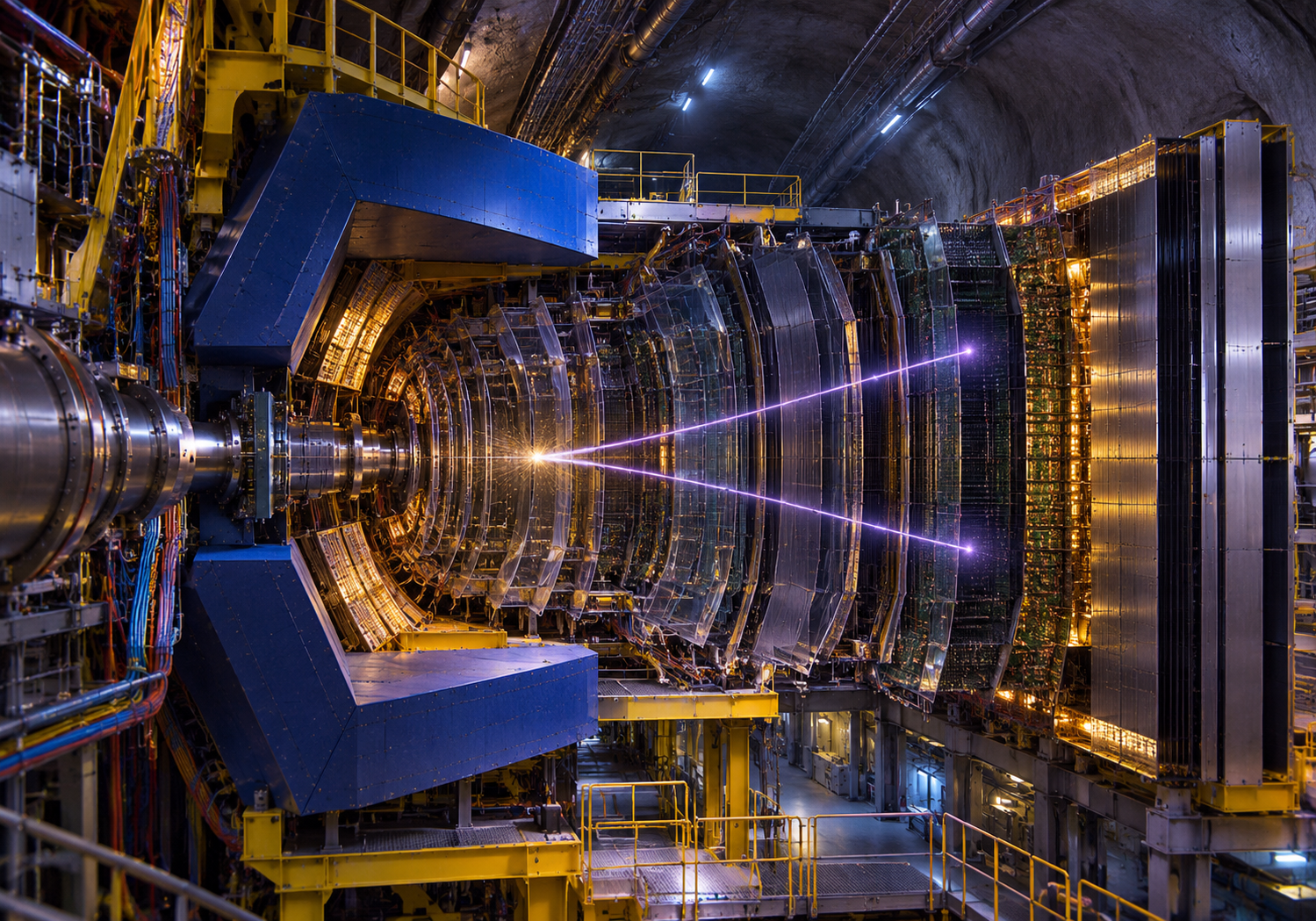
The experiment identified evidence of a process in which a neutral beauty particle, known as a B-zero meson, decays into a muon and an antimuon.
According to CERN, the event occurs at a rate of approximately once in every 10 billion relevant particle decays.
Searching for an Exceptionally Rare Event
Scientists have pursued evidence of this process since 1984.
Its rarity makes it exceptionally difficult to distinguish from the enormous number of other particle interactions produced during high-energy experiments.
The LHCb collaboration used data collected in 2024 and 2025 to identify evidence of the decay.
Improvements to the detector, together with advanced analytical techniques and machine learning, enabled researchers to isolate potential signals from overwhelming experimental background activity.
CERN reported a statistical significance of three standard deviations for the result.
Although scientifically important, this does not meet the higher threshold normally required to declare a definitive discovery in particle physics.
Testing the Standard Model
The Standard Model describes the fundamental particles of matter and the forces governing many of their interactions.
Extremely rare particle decays provide scientists with valuable opportunities to test its predictions.
Unexpected differences between observed and predicted behaviour could potentially indicate previously unknown physical processes.
The newly reported result is consistent with the Standard Model’s predictions.
Researchers therefore regard it as an important confirmation of the experiment’s increasing precision, rather than proof of new physics.
A New Stage of Particle Research
The upgraded LHCb detector has been collecting data at substantially higher rates since 2024, allowing scientists to investigate processes that previously remained beyond the reach of individual experiments.
The latest finding demonstrates how improvements in detector technology and data analysis can reveal exceptionally uncommon events.
Further measurements will be needed to strengthen the evidence and improve estimates of the decay’s frequency.
For physicists, the significance lies not merely in detecting a rare event, but in using that event to test whether the established understanding of matter remains accurate at increasingly precise levels.