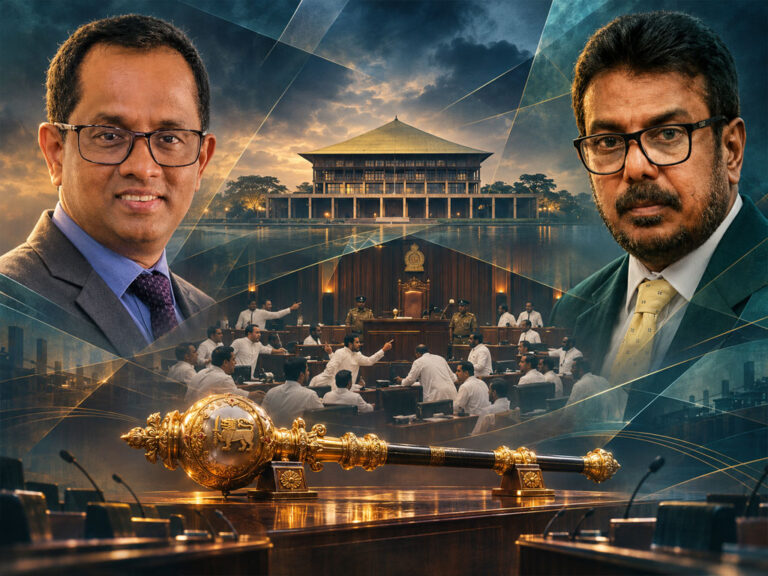
COLOMBO, 4 November 2026: Former Chief Justice and former Foreign Minister accuse the Government of proposing excessive detention powers and warn of consequences for civil liberties and international trade relations.
Former Chief Justice Sarath N. Silva and former Foreign Minister Professor G. L. Peiris have warned that two security bills introduced by the National People’s Power Government could undermine fundamental rights, expand the powers of law enforcement agencies and expose political opponents to arbitrary action.
Addressing a media briefing on Tuesday (3) at the Colombo office of former President and United National Party leader Ranil Wickremesinghe, the two former senior officeholders criticised the Protection of the State from Terrorism Bill and the Prevention of Organised Crimes Bill.
They argued that the legislation, if enacted without adequate safeguards, could weaken judicial oversight and permit the misuse of state powers against political dissent.
Their warnings come amid growing scrutiny of the Government’s proposed replacement for the Prevention of Terrorism Act, which successive administrations have faced pressure to repeal because of its history of abuse.

Two Bills Under Scrutiny
Peiris urged the public to consider the proposed anti-terrorism and organised crime laws together, arguing that their combined effect could significantly alter the balance between state security powers and individual freedoms.
The Protection of the State from Terrorism Bill was presented to Parliament on 6 October 2026, while the Prevention of Organised Crimes Bill was presented on 20 October.
Both were introduced by Minister of Justice and National Integration Harshana Nanayakkara.
The Government’s stated objectives include protecting national security, preventing terrorism, combating organised criminal activity and strengthening the investigation and prosecution of serious offences.
Peiris, however, argued that the proposed legislation contains powers that could be exercised beyond those legitimate objectives.
He warned that the combined effect could place democratic rights and the independence of law enforcement at risk.
Concerns Over Arrest and Detention Powers
Silva focused particularly on provisions allowing members of the armed forces to arrest suspects in specified circumstances.
Under the proposed anti-terrorism legislation, a member of the armed forces or coast guard who makes an arrest must transfer the suspect to the appropriate police authority without unnecessary delay and, subject to specified exceptions, within 24 hours.
Separate provisions govern the period within which an arrested person must be produced before a magistrate.
Silva argued that the detention framework creates opportunities for suspects to remain in custody without sufficiently prompt judicial scrutiny.
He questioned the psychological consequences of detention during which suspects may be unable to obtain immediate judicial protection.
The former Chief Justice maintained that broad arrest powers, particularly when exercised by personnel outside the ordinary civilian policing structure, require strong safeguards against arbitrary detention and mistreatment.
His concerns reflect wider criticism of the proposed legislation’s treatment of suspects and the powers assigned to security agencies.
Risk of Political Dissent Being Treated as Terrorism
Silva also warned that broadly worded terrorism offences could expose Government critics to investigation or prosecution.
He argued that conduct associated with political opposition might be interpreted as a security threat if the law is enforced without adequate limitations.
The proposed legislation contains language addressing protests, advocacy, dissent and industrial action. Nevertheless, human rights organisations have questioned whether those provisions sufficiently protect peaceful political activity from being drawn into terrorism investigations.
Silva accused the Government of seeking additional powers to protect itself from political challenges.
“The government has realised that it is in danger. These new security laws are being brought in to protect the government,” he said.
That assertion reflects Silva’s political and legal criticism. It is not evidence, by itself, that the Government intends to prosecute peaceful opponents.
Evidence and Police Powers Questioned
Peiris separately criticised provisions in the proposed Prevention of Organised Crimes Bill.
He expressed concern that the legislation could weaken safeguards against the use of improperly obtained evidence and confer excessive investigative powers on police and other security personnel.
According to Peiris, existing protections against coerced confessions could be undermined if the proposed rules are enacted.
He warned that statements obtained through intimidation or physical abuse must never be admissible as evidence against suspects.
These concerns require close examination of the precise wording of the Bill and its interaction with existing criminal procedure and evidence laws.
The allegation that the legislation would permit coerced confessions must be distinguished from an established legal interpretation. Any definitive conclusion would depend on the enacted text and, where relevant, judicial determination.
International Human Rights Organisations Raise Concerns
The former Foreign Minister pointed to criticism from international human rights organisations and warned that the proposals could damage Sri Lanka’s standing abroad.
Amnesty International has raised concerns about broad terrorism definitions, lengthy detention provisions and the risk that peaceful dissent could be criminalised.
Human Rights Watch has also criticised the proposed anti-terrorism legislation, particularly its provisions concerning arrest powers, judicial supervision and restrictions on fundamental freedoms.
Both organisations have urged changes to ensure that replacement legislation does not perpetuate abuses associated with the existing Prevention of Terrorism Act.
The World Organisation Against Torture has similarly expressed concern about arrest and detention safeguards, including the possibility of armed forces personnel holding suspects before transferring them to the police.
These assessments provide independent support for concerns about parts of the proposed anti-terrorism law, although they do not establish every allegation made by the Opposition figures about both bills.
Could Sri Lanka’s GSP+ Benefits Be Affected?
Peiris warned that the legislation could also have consequences for Sri Lanka’s trading relationship with the European Union.
He specifically referred to the Generalised Scheme of Preferences Plus, commonly known as GSP+, which provides preferential access to the European market for eligible exports.
Continued access to the scheme is linked to compliance with international conventions concerning human rights, labour protections and other governance standards.
Peiris argued that legislation perceived as inconsistent with international human rights obligations could place those trade benefits under greater scrutiny.
Such an outcome is a potential risk rather than an automatic consequence of introducing the bills.
Any decision affecting Sri Lanka’s GSP+ eligibility would depend on the European Union’s assessment under the applicable framework.
Government’s Responsibility to Address the Criticism
The Government has presented the proposed legislation as part of its effort to modernise the legal framework for combating terrorism and organised crime.
Repealing and replacing the existing Prevention of Terrorism Act has also been a longstanding demand of local and international rights advocates.
However, replacing a controversial law will not necessarily constitute meaningful reform if the new legislation retains powers capable of facilitating arbitrary detention or restrictions on lawful dissent.
The central challenge is to ensure that national security legislation is sufficiently precise, proportionate and subject to effective judicial oversight.
Silva and Peiris have called for coordinated opposition to provisions they regard as dangerous.
Their intervention adds to a broader debate over whether the Government’s proposals adequately reconcile public security with constitutional protections and Sri Lanka’s international obligations.
Parliament’s consideration of the bills will now provide an opportunity to examine those competing concerns, assess proposed safeguards and determine whether further amendments are necessary before the legislation becomes law.