COLOMBO, November 8, 2026 — With men accounting for more than 80% of recorded suicide deaths in 2024, Sri Lanka faces urgent questions about mental health support, economic pressures and the social expectations placed on men.
Behind Sri Lanka’s economic statistics lies a troubling public-health reality: men accounted for more than four out of every five suicide deaths recorded by police in 2024, underscoring the need for greater attention to men’s mental health and the barriers that may prevent them from seeking support.
According to figures compiled from Sri Lanka Police records, 3,285 suicide deaths were reported during 2024.
Of these, 2,664 were men and 621 were women.
Men therefore accounted for approximately 81.1% of recorded deaths.
The disparity is substantial, although suicide is a complex public-health issue that cannot be attributed to any single economic, psychological or social factor.
The figures nevertheless warrant closer examination of the pressures experienced by men, including expectations surrounding employment, financial responsibility, emotional restraint and attitudes towards psychological treatment.
They also point to a broader policy question: Is Sri Lanka paying sufficient attention to the mental health needs of men while pursuing wider economic and social reforms?

Men Represent a Minority of the Population
Sri Lanka’s 2024 Census of Population and Housing recorded a total population of 21,781,800.
According to the Department of Census and Statistics (DCS), women accounted for 51.7% of the population, while men represented 48.3%.
The national sex ratio stood at 93.3 males for every 100 females.
The distribution is relatively balanced, with women forming a modest majority.
However, the representation of men and women in the labour force differs considerably.
Labour Force Survey figures show a substantially higher participation rate among men.
The figures cited in the source material place male labour force participation at 67.6%, compared with 30.3% among women.
This means that a considerably greater proportion of working-age men were either employed or actively seeking employment during the relevant survey period.
The difference reflects several influences, including social expectations, access to employment, education, household responsibilities and the unequal distribution of unpaid care work.
It does not establish that men perform a greater total amount of work than women.
Women undertake substantial unpaid domestic and caregiving responsibilities that are not adequately captured by conventional labour force participation figures.
Nevertheless, the disparity helps illustrate the different economic and social roles that continue to shape the experiences of men and women in Sri Lanka.
The Pressure to Become the Family Breadwinner
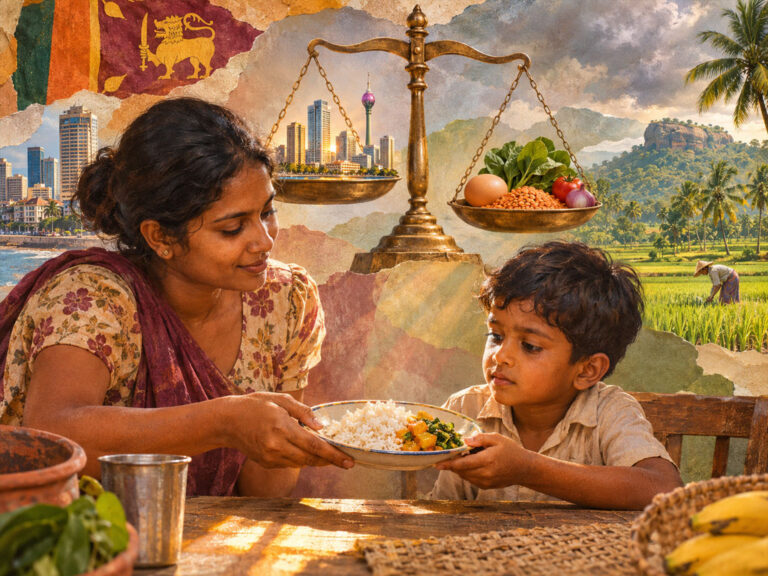
For generations, traditional social expectations have frequently placed men in the position of primary household income earners.
This expectation can create a powerful sense of responsibility.
Employment becomes more than a means of earning a living. For some men, it becomes closely connected to their identity, social standing and perceived value within the family.
When financial difficulties arise, the consequences may therefore extend beyond household budgets.
Unemployment, debt, insecure employment or an inability to meet family expenses can be experienced as personal failure.
These pressures may be especially pronounced in households where income depends heavily on a single earner.
Sri Lanka’s recent economic difficulties have created additional challenges through inflation, changes in employment conditions and the increased cost of essential goods and services.
Men employed in low-paid, insecure or physically demanding occupations may face particular pressures when attempting to maintain family incomes.
However, it would be inaccurate to assume that all men experience these circumstances similarly or that economic pressures affect only men.
Women also experience severe employment insecurity, economic disadvantage and unequal access to paid work.
The policy challenge is therefore to recognise gender-specific vulnerabilities without overlooking the difficulties experienced by either group.
Male Unemployment Figures Do Not Tell the Whole Story
The supplied labour-market figures place male unemployment at 2.8%, compared with 6.9% among women.
At first glance, the lower male unemployment rate appears encouraging.
However, unemployment statistics alone cannot establish whether available jobs offer adequate wages, security or acceptable working conditions.
A person may be classified as employed while earning insufficient income to meet household needs.
Employment can also involve unstable working hours, informal arrangements or limited access to social protection.
For men who experience intense pressure to earn an income, accepting undesirable employment may appear preferable to remaining unemployed.
This possibility deserves investigation.
Yet it should not be presented as a demonstrated explanation for the lower male unemployment rate without supporting research.
Female unemployment also requires attention, particularly because women face distinct barriers to entering and remaining in paid employment.
An effective labour-market policy must address both problems: ensuring that men have access to secure, adequately paid employment while removing obstacles that limit women’s economic participation.
Greater economic participation by women could help diversify household income sources and reduce dependence on a single earner, provided that unpaid domestic and caregiving responsibilities are also shared more fairly.
More Than 80% of Recorded Suicide Deaths Were Men
The most concerning figures relate to suicide.
Sri Lanka Police records indicate that 3,285 suicide deaths were reported in 2024.
The distribution was:
| Category | Recorded deaths | Percentage |
|---|---|---|
| Men | 2,664 | 81.1% |
| Women | 621 | 18.9% |
| Total | 3,285 | 100% |
The figures reveal a substantial difference between male and female suicide mortality.
This pattern is not unique to Sri Lanka.
United Nations data indicate that, in 2021, the global suicide mortality rate was approximately 12.4 deaths per 100,000 men, compared with 5.9 per 100,000 women.
Globally, the male suicide rate was therefore more than twice the female rate.
Sri Lanka’s recorded deaths demonstrate the importance of examining the country’s specific circumstances.
However, the proportion of male suicide deaths should not be confused with the suicide rate for men.
The former measures the share of recorded deaths, while the latter measures deaths relative to the size of the male population.
Both are useful indicators, but they answer different statistical questions.
Equally important is the recognition that suicide rarely has one identifiable cause.
Mental illness, substance use, relationship difficulties, social isolation, financial stress, exposure to violence and other individual circumstances can interact in complex ways.
It would therefore be inappropriate to conclude from the police statistics alone that economic hardship or traditional gender expectations caused these deaths.
The figures establish the scale of the problem. Understanding its causes requires further clinical, social and public-health research.
The Culture of Emotional Silence
One area deserving particular attention is the social expectation that men should remain emotionally strong regardless of their circumstances.
Boys may grow up hearing familiar messages:
- Men should not cry.
- Men must endure hardship without complaint.
- Asking for help demonstrates weakness.
- A man’s value depends upon his ability to provide financially.
Such attitudes can discourage healthy emotional expression.
They may also contribute to the belief that psychological difficulties should be managed privately.
This becomes dangerous when a person experiencing depression, anxiety or overwhelming distress avoids seeking professional assistance.
The consequences may be compounded by the stigma associated with mental-health treatment.
For some men, acknowledging emotional vulnerability can feel inconsistent with expectations surrounding masculinity.
Mental-health support must therefore be presented as a normal component of healthcare rather than a response reserved for people experiencing severe crises.
Seeking counselling, discussing distress with a trusted individual or consulting a medical professional should be regarded as responsible behaviour.
Emotional openness is not a failure of strength.
It is an important part of maintaining psychological well-being.
Debt, Financial Stress and Mental Health
Economic pressure is another area requiring policy attention.
Sri Lankan households have experienced considerable changes in living costs following the country’s economic crisis.
For families dependent upon limited or irregular income, the combination of debt obligations and essential household expenses can create sustained stress.
Men who consider themselves primarily responsible for household finances may experience additional feelings of guilt or inadequacy when they cannot meet those obligations.
Debt-related distress can also affect family relationships and contribute to feelings of isolation.
However, the relationship between financial hardship and suicide is neither automatic nor uniform.
Most people experiencing financial difficulties do not die by suicide.
Mental-health outcomes depend on numerous interacting factors, including individual circumstances, available support, existing health conditions and access to appropriate treatment.
The appropriate response is therefore not to portray financially struggling men as inevitably vulnerable to suicide.
Instead, policymakers should recognise that financial insecurity can contribute to psychological distress and ensure that practical assistance is available before problems escalate.
Financial counselling, debt-management support, employment assistance and accessible mental-health services can form part of a coordinated response.
Why Men’s Mental Health Requires Specific Attention
Mental-health policy should address the needs of the entire population.
Women, children, older people and other vulnerable groups experience serious psychological challenges that also require appropriate services.
The high proportion of male suicide deaths does not diminish those needs.
Instead, it demonstrates why men’s experiences should receive specific attention within a comprehensive national mental-health strategy.
Services need to be accessible to men who may be reluctant to approach traditional counselling facilities.
Workplaces, community organisations, healthcare institutions and educational establishments can all help identify distress and encourage early intervention.
Public awareness campaigns should challenge the belief that emotional suffering must be endured silently.
Healthcare workers should also be equipped to recognise psychological difficulties in patients who initially seek assistance for physical symptoms or other concerns.
Interventions must be informed by research rather than assumptions about masculine behaviour.
Men are not a uniform group.
Their experiences differ according to age, income, education, employment, disability, geographic location and family circumstances.
An effective response must account for these differences.
Sharing Economic and Domestic Responsibilities
Reducing the pressures associated with traditional gender roles requires broader social change.
Sri Lanka’s relatively low female labour force participation rate points to the importance of improving women’s access to paid employment.
However, increasing female employment alone will not automatically resolve the economic or psychological pressures experienced by men.
For meaningful change, unpaid domestic responsibilities must also be distributed more fairly.
Women should not be expected to enter paid employment while continuing to carry an unequal share of household and caregiving responsibilities.
Similarly, men should not be expected to shoulder the entire burden of providing financially for their families.
A healthier balance would allow both partners greater flexibility to contribute economically, participate in family care and seek support when needed.
Such changes can strengthen household resilience while challenging restrictive expectations placed upon both sexes.
The Need for a National Policy Response
Sri Lanka’s suicide statistics provide sufficient grounds for a sustained national response.
Several measures deserve particular consideration:
1. Expand accessible mental-health services
Strengthen counselling and psychological support within public healthcare, workplaces and community institutions.
2. Develop targeted programmes for men
Design evidence-based outreach initiatives addressing barriers that may discourage men from seeking professional assistance.
3. Challenge harmful gender stereotypes
Promote social attitudes that recognise emotional expression, shared financial responsibility and help-seeking as normal and healthy behaviour.
4. Strengthen household economic security
Improve access to employment support, debt counselling and appropriate social protection for financially vulnerable households.
5. Improve research and data collection
Examine suicide trends by age, occupation, location and relevant social circumstances while protecting individual privacy.
6. Encourage shared family responsibilities
Support policies that improve women’s employment opportunities and promote a fairer distribution of unpaid household work.
These measures should operate within a broader mental-health strategy that supports everyone experiencing psychological distress.
Beyond the Statistics
The figures discussed in this report describe different aspects of Sri Lankan society.
Population statistics establish the demographic balance between men and women.
Labour force surveys reveal differences in paid employment participation.
Police records demonstrate a substantial disparity in recorded suicide deaths.
However, these datasets cannot independently explain why individual people experience emotional distress or why particular deaths occur.
That distinction is essential.
The evidence supports greater attention to men’s mental health, but it does not justify reducing a complex public-health problem to a single explanation involving economic pressure or masculinity.
Sri Lanka needs research that can identify the circumstances associated with psychological distress and determine which interventions are most effective.
The country also needs a social environment in which men can acknowledge difficulties without fearing ridicule, rejection or diminished respect.
Economic development, employment security and stronger public services remain important.
So does the recognition that emotional well-being cannot be measured through income or employment statistics alone.
A society that expects men to remain strong must also make it possible for them to seek help when they are struggling.
That principle should form part of Sri Lanka’s approach to public health, family welfare and social development.